
Why Expert Mortgage Advice Matters: A mortgage is not just a rate on a screen.
It is a long-term financial commitment shaped by income, deposit, credit history, property type, lender rules, fees, future plans and risk. In 2024, that made expert mortgage advice more important for many borrowers.
Rates had changed sharply in the period leading up to this article. Lender criteria were also being reviewed more closely. Some borrowers could still access suitable options, but the right route was not always obvious. A cheaper headline rate could carry higher fees. A longer term could lower monthly payments but increase total interest. A quick online search could miss the details that determine whether a case fits.
That is where expert mortgage advice can add value.
At a Glance
Expert mortgage advice helps borrowers understand what they may be able to borrow, which lenders may consider them, what evidence they need, and how different mortgage options affect the wider financial picture.
A mortgage adviser can assess affordability, income, credit profile, deposit, property type, fees, term and future plans before recommending a suitable route.
This matters because the best mortgage is not always the one with the lowest headline rate. It is the mortgage that fits the borrower’s circumstances, budget and long-term plans.
What Does a Mortgage Adviser Actually Check?
Good mortgage advice starts with facts. Before making a recommendation, an adviser will usually review several areas.
These may include:
- Your income and how it is evidenced
- Your regular spending and financial commitments
- Your deposit or available equity
- Your credit history
- The property value and property type
- The mortgage purpose
- The preferred term
- Fixed, tracker or variable-rate options
- Product fees, valuation fees and legal costs
- Early repayment charges
- Future plans, such as moving, overpaying or refinancing
This process matters because lenders do not all assess cases in the same way. One lender may treat overtime, bonus income, self-employed earnings or retained profits differently from another. A borrower may look strong on paper, yet still fail a lender’s criteria if the case is placed incorrectly.
Expert mortgage advice helps reduce that risk.
Why Advice Is Not Just About Finding a Rate
It is natural to look for the lowest mortgage rate. However, a mortgage decision should not stop there.
A low rate may come with a high product fee. A lower monthly payment may depend on extending the mortgage term. A product may look competitive but include early repayment charges that do not suit your future plans.
An adviser should help compare the full cost and structure of the mortgage, not just the first number shown. This includes monthly payments, upfront costs, long-term interest, and the product’s flexibility.
This is especially important for borrowers who may need residential mortgage advice, are moving home, are buying for the first time, or are reviewing options after a fixed rate ends.
Expert Mortgage Advice and Affordability
Affordability is one of the most important parts of a mortgage application.
Lenders assess whether the mortgage appears affordable based on income, commitments, household costs and their own internal rules. The outcome can vary between lenders, even when the borrower’s circumstances are the same.
Expert advice can help you understand:
- How much you may be able to borrow
- Which income sources may be accepted
- Whether debts or commitments may reduce borrowing
- How your term affects monthly payments
- What documents may be needed before applying
This can save time. It can also reduce the chance of applying to a lender that is unlikely to accept the case.
When Mortgage Advice Becomes More Important
Some mortgage cases are more straightforward than others. Expert advice can be especially useful when the case includes more moving parts.
This may include:
- Self-employed income
- Recent job changes
- Variable income
- Adverse credit
- Buy-to-let property
- Limited company borrowing
- Large loans
- Complex deposit sources
- Remortgaging with extra borrowing
- Interest-only borrowing
- Property issues raised by a valuation
For landlords, buy-to-let mortgage advice may be important because rental calculations, portfolio rules and property type can affect lender choice. For homeowners reviewing their current deal, remortgage advice can help compare product transfers, new lender options, fees and timing.
The Practical Value of Advice During the Application
A mortgage application is not only about choosing a product. It is also about presenting the case clearly.
A mortgage adviser can help gather the right documents, explain lender requirements and manage communication during the process. This may include payslips, bank statements, account statements, tax documents, proof of deposit, identification, and property details.
This support can be valuable when a lender asks questions. It can also help avoid delays caused by missing or unclear information.
The right advice does not remove every problem, but it can make the process more structured.
Mortgage Advice, Protection and Wider Risk
A mortgage is often the largest financial commitment a household takes on. That means the advice conversation should not only focus on borrowing.
Borrowers may also need to consider what could happen if income stops, illness affects work, or a household loses financial support. This is where mortgage protection and life insurance may form part of a wider discussion.
Not every client will need every type of cover. Some may already have suitable protection in place. The important point is that the risk is considered properly, not ignored.
How to Choose a Mortgage Adviser
The right adviser should explain the process clearly, understand your circumstances and be upfront about fees.
You may want to ask:
- Are you authorised to provide mortgage advice?
- What types of mortgages do you advise on?
- Do you charge a fee?
- When is the fee payable?
- Which lenders do you work with?
- What documents will you need from me?
- How will you explain the recommendation?
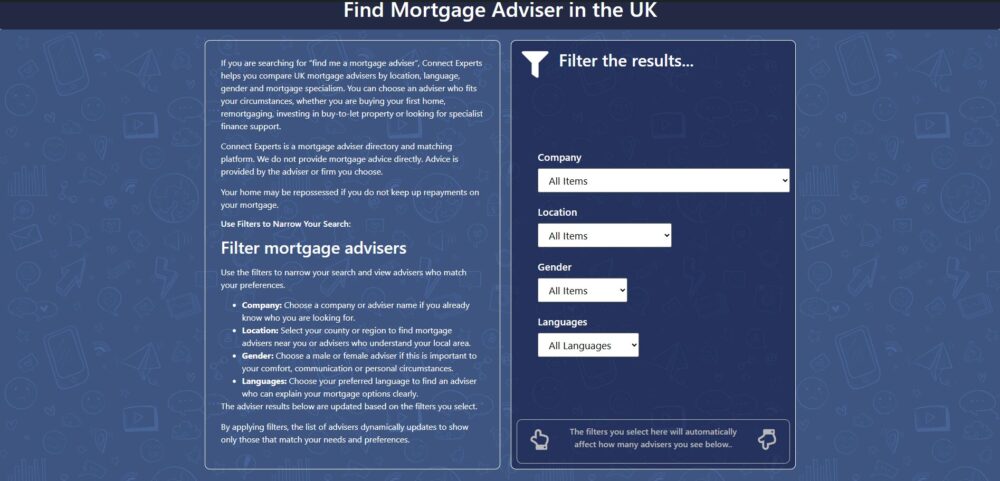
If you want to compare advisers by location, language, gender or mortgage type, you can find a mortgage adviser through Connect Experts. If local knowledge is important, you can also search for a local mortgage adviser.
Connect Experts is a directory and matching platform. Advice is provided by the adviser or firm you choose.
Why Expert Mortgage Advice Matters
A mortgage decision carries both numbers and consequences.
The number is the rate, payment, fee and term. The consequence is how that decision fits your life, your property plans and your financial resilience.
Expert mortgage advice helps connect those two points. It can help you understand what is possible, what is suitable and what evidence is needed before a lender makes a decision.
In 2024, that clarity mattered. Borrowers were not only comparing rates. They were trying to make careful decisions in a market where affordability, criteria and timing could all affect the result.
How do I speak to Connect Mortgages?
You can speak to Connect Mortgages if you want to discuss your mortgage options, understand the next steps, or ask what information may be needed before advice is given.
Important: Your home may be repossessed if you do not keep up repayments on your mortgage or any loan secured on it. Some forms of buy-to-let, commercial mortgage and business finance may not be regulated by the Financial Conduct Authority.
FAQs: Expert Mortgage Advice
Is it worth getting expert mortgage advice?
Yes, it can be worth getting expert mortgage advice if you want help understanding lender criteria, affordability, fees, product options and the application process. It can be especially useful if your income, credit history, property type or borrowing needs are not straightforward.
Can a mortgage adviser get better rates?
A mortgage adviser may have access to a range of lenders and products. Some products may not be available directly to the public. However, the lowest rate is not always the most suitable option. Fees, criteria, term and flexibility also matter.
What should I prepare before speaking to a mortgage adviser?
You should prepare details of your income, deposits, debts, monthly commitments, credit history, property plans and preferred budget. You may also need payslips, bank statements, accounts, tax documents and proof of deposit.
Is mortgage advice regulated?
Many residential mortgage advice activities are regulated by the Financial Conduct Authority. Some forms of buy-to-let, commercial mortgage and business finance may not be regulated. Your adviser should explain this clearly before you proceed.