
Development Finance
Development finance can help fund a property project from site purchase through to completion. It is often used for new builds, conversions, heavy refurbishments, mixed-use schemes and larger property projects where a standard mortgage is not suitable. At Connect Mortgages, we help UK borrowers understand how development finance works, what lenders may need, and how funding can be structured around the build.

Development Finance at a Glance
Development finance is short-term funding for property development projects. It can help with land purchase, build costs, professional fees and staged works.
Funds are usually released in stages as the project progresses.
Lenders normally assess the site, planning position, build costs, Gross Development Value, borrower experience and exit strategy. A clear plan matters. The stronger the project evidence, the easier it can be to approach suitable lenders.
What is Development Finance
Development finance is a type of short-term property loan used to fund construction, conversion or major refurbishment work.
Unlike a standard mortgage, the lender looks closely at the project itself. They may review the land, planning status, build schedule, expected costs, professional team and final value.
Development finance is often repaid when the completed property is sold or refinanced.
This type of finance may be suitable for:
- New build residential developments
- Commercial to residential conversions
- Heavy refurbishment projects
- Mixed-use property developments
- Semi-commercial schemes
- Multi-unit apartment projects
- Land with planning permission
- Property projects held in a limited company
If your project involves buying or refinancing an existing commercial property, you may also want to read our commercial mortgage guide
Who Uses Development Finance?
Development finance is often used by developers, landlords, investors, and businesses planning property projects.
You may be looking to buy land, convert an existing building, build several homes or refurbish a property before selling or refinancing.
It may also suit limited companies that need structured funding for a property development plan.
You may need development finance if:
- You are building from the ground up
- The property is not currently mortgageable
- The work includes structural changes
- Funds are needed in stages
- The project depends on planning consent
- You need finance based on the future value
- You plan to sell or refinance after completion
Development finance is not always the right route. For lighter works or faster property purchases, bridging finance may be more suitable.
Development Finance vs Bridging Finance
Development finance and bridging finance are both short-term funding options. However, they are used for different needs.
| Feature | Development Finance | Bridging Finance |
|---|---|---|
| Main purpose | Building, conversion or major refurbishment | Short-term property funding |
| Funding release | Usually staged | Usually upfront |
| Lender focus | Build costs, GDV, planning and exit | Current value, security and exit |
| Typical use | New builds, conversions, heavy works | Auction purchase, chain break, light works |
| Repayment | Sale or refinance after completion | Sale, refinance or another exit route |
Development finance is usually better suited to larger projects with a build programme. Bridging finance may be better suited to faster property purchases or short-term funding gaps.
You can read more about short-term property funding in our bridging loan guide.
How Development Finance Works
Development finance is usually arranged around the cost, timeline and future value of the project.
The lender may provide an initial amount at the start. Further funds can then be released in stages as the build progresses.
These stages are often checked by a monitoring surveyor or quantity surveyor before each release.
A typical journey may include:
- Initial project review
- Site, planning and cost assessment
- Development appraisal
- Lender agreement in principle
- Valuation and monitoring surveyor review
- Legal work and facility agreement
- Initial drawdown
- Staged funding releases
- Project completion
- Sale or refinance to repay the loan
The exact process depends on the lender, project type, borrower profile and exit route.
What Lenders Look At
Development finance lenders usually want a clear and realistic picture of the project.
They may assess the borrower, the site, the proposed works and the repayment plan.
Important areas include:
- Purchase price or current land value
- Planning permission position
- Build costs and professional fees
- Contingency allowance
- Gross Development Value
- Loan to cost
- Loan to Gross Development Value
- Borrower experience
- Contractor and professional team
- Timescale and build programme
- Exit strategy
- Demand for the completed property
Gross Development Value, often called GDV, is the estimated value of the completed project. This matters because many lenders use GDV when assessing risk, loan size, and repayment terms.
Mortgage Advice..
Thinking of getting a mortgage? Our experienced team of skilled mortgage advisers are here to offer the essential guidance you require. Relying on our comprehensive understanding of the mortgage market, we’ll ensure you secure the perfect mortgage to suit your specific situation.
Mortgage Advice..
Thinking of getting a mortgage? Our experienced team of skilled mortgage advisers are here to offer the essential guidance you require. Relying on our comprehensive understanding of the mortgage market, we’ll ensure you secure the perfect mortgage to suit your specific situation.
What Can Development Finance Cover?
Development finance can be used for several parts of a property project.
This may include:
- Buying land
- Funding construction costs
- Funding conversion works
- Paying professional fees
- Supporting heavy refurbishment
- Funding mixed-use development
- Creating residential units
- Improving a site before sale
- Completing works before refinance
Some lenders may also consider projects for which planning permission has already been granted. Others may consider more complex cases, depending on the borrower and site.
Development Finance for New Builds
New build projects often need staged funding.
This is because the value of the site can change as work progresses. A lender will usually want to understand the full build route before agreeing terms.
For a new build project, lenders may review:
- Planning consent
- Site ownership
- Construction method
- Build cost schedule
- Contractor experience
- Expected sales values
- Local demand
- Exit strategy
A clear development appraisal can help lenders understand the project before work begins.
Development Finance for Conversions and Refurbishments
Development finance may also support conversions and major refurbishments.
This can include converting a commercial building into residential units, changing a house into flats or improving a property before sale.
The level of work matters.
Light refurbishment may require a different financing route than structural refurbishment. If the works are smaller or short-term, bridging finance may be considered instead.
For larger conversions, development finance may offer a better fit because funds can be released in stages.
Exit Routes for Development Finance
Lenders need to understand how the loan will be repaid.
This is known as the exit strategy.
Common exit routes include:
- Selling the completed property
- Refinancing onto a buy-to-let mortgage
- Refinancing onto a commercial mortgage
- Moving onto development exit finance
- Retaining the completed units for rental income
If the completed property will be rented, you may need to consider buy-to-let mortgage options.
If the property will be owned through a company, our limited company buy-to-let mortgage guide may also be useful.
Is Development Finance Right for Your Project?
Development finance may be suitable if your project needs staged funding and a clear build plan.
It may not be the right choice for every borrower.
Before applying, it helps to ask:
- Is planning permission in place?
- Are build costs realistic?
- Is there enough contingency?
- Is the contractor experienced?
- Is the GDV supported by evidence?
- Is the exit route clear?
- Is the project held personally or through a company?
- Could bridging finance be more suitable?
- Could a commercial mortgage be needed after completion?
If you are unsure, speaking to an adviser early can help you avoid the wrong finance route.
Why Speak to Connect Mortgages?
Development finance can be complex because every site is different.
One lender may focus on borrower experience. Another may focus more on GDV, location, planning or exit route.
Connect Mortgages can help you understand the funding route before you apply.
We can help with:
- Reviewing your project at an early stage
- Explaining lender expectations
- Discussing staged funding
- Reviewing possible exit options
- Considering bridging or commercial alternatives
- Helping you prepare a stronger application
- Connecting your project with suitable finance routes
Connect Mortgages is a credit broker, not a lender. Your adviser will explain your options based on your circumstances and the project details.
Find a Development Finance Broker
Some borrowers want to compare advisers before making contact.
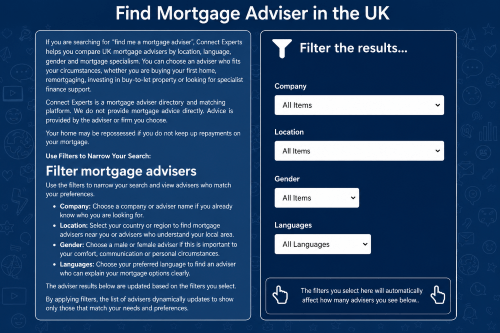
Connect Mortgages works alongside Connect Experts, a UK mortgage adviser directory.
You can use Connect Experts to find development finance mortgage brokers by location, language and area of expertise.
Connect Experts does not provide mortgage advice directly. Advice is provided by the adviser or firm you choose.
FAQs: Development Finance
Most frequent questions and answers about development finance
You usually need a clear project plan, cost schedule, planning position, GDV estimate and exit strategy.
A development finance adviser can help review the project before approaching lenders.
Not always.
Some lenders prefer experienced developers. Others may consider first-time developers if the project is strong and the professional team is experienced.
The lender will usually assess the full risk of the case.
Yes, development finance can be used for major refurbishment or structural work.
For lighter works, bridging finance may be more suitable.
Yes, many development finance cases are arranged through limited companies.
The lender will still assess the directors, project, costs, site and exit route.
Gross Development Value is the estimated market value of the completed project.
Lenders often use GDV when assessing the loan size and risk.
Development finance is usually repaid by selling the completed property or refinancing it.
The exit route must be clear before the lender agrees the loan
Terms vary by lender and project.
Many development finance facilities are short term and structured around the expected build period.
Development exit finance can help repay the original development loan once the project is complete or near completion.
It may give the borrower more time to sell units or arrange longer-term finance.
What next?
We will come back to you quickly to let you know how we can help. If you would like to speak to us immediately, call us on 01708 676 111.
Looking for our intermediaries site?

Liz Syms is the CEO and Founder of Connect Mortgages and Connect for Intermediaries, a leading firm specialising in property investment finance. With more than 25 years of experience in the mortgage and financial services industry, Liz has helped thousands of clients secure both residential homes and investment properties.
Renowned for her expertise and commitment to excellence, Liz is passionate about delivering tailored, high-quality advice on mortgages and protection. Her leadership has positioned her as a trusted figure in the sector, and under her guidance, Connect Mortgages has expanded to a national team of over 300 advisers.
Driven by a vision to make Connect Mortgages one of the UK’s most successful mortgage networks, Liz continues to champion professional standards and client-focused solutions across the industry.
About the Author
Liz Syms is the CEO and Founder of Connect Mortgages, a specialist in finance for property investment. With over 25 years of experience in mortgages and financial services, Liz has helped countless people get their dream homes and investment properties. She is passionate about giving her clients the best advice possible when it comes to financial decisions relating to mortgages and protection and is dedicated to providing the highest quality of service. With her wealth of knowledge in the industry, Liz is a respected leader in mortgages and financial services and has grown her team to over 300 advisers nationally. She strives to make Connect Mortgages one of the most successful companies in its field.