

Subprime mortgages are often misunderstood. For many borrowers, the word feels like a judgement. In reality, it usually describes a mortgage application that does not fit standard lending criteria.
A missed payment, default, CCJ, IVA, bankruptcy, debt management plan or low credit score can affect lender choice. However, it does not always close every mortgage route.
Today, UK lenders usually focus on the full picture. They may look at your credit history, income, deposit, current commitments, recent conduct and the property itself.
That is why this guide does not treat subprime mortgages as a label. It treats them as a lending question.
Can the mortgage be affordable, suitable and sustainable?
Subprime Mortgages at a Glance
A subprime mortgage is not usually a separate mortgage product in the UK.
It is a term often used for mortgage applications involving credit problems, higher risk or non-standard circumstances.
You may hear the term if you have:
- Missed payments
- Defaults
- County Court Judgments, also called CCJs
- An IVA
- Bankruptcy
- A Debt Management Plan
- High credit use
- A low credit score
- Limited credit history
- Previous mortgage declines
Specialist lenders may still consider your application. However, they will usually look closely at affordability, deposit size, credit history and recent payment conduct.
Rates may be higher. Fees may be higher. Deposit requirements may also be stricter.
The practical question is not simply whether you have bad credit. It is whether your current position supports responsible borrowing.
What Is a Subprime Mortgage?
A subprime mortgage is a term used to describe lending to borrowers who may not meet standard mortgage criteria.
In the UK, the term is less commonly used by lenders today. You are more likely to hear phrases such as adverse credit mortgage, bad credit mortgage, impaired credit mortgage or specialist mortgage.
The word “subprime” does not mean the mortgage is poor quality.
It usually means the borrower may be seen as higher risk because of their credit history, income profile or wider financial position.
That risk can affect:
- Lender choice
- Interest rate
- Product fees
- Deposit size
- Affordability assessment
- Underwriting checks
- Documentation needed
- Speed of application
A subprime mortgage application needs careful preparation. A rushed application can lead to avoidable declines.
Why the Term Subprime Can Be Misleading
The word subprime became widely known after the 2008 financial crisis.
That history can make the term sound unsafe or outdated. However, modern UK mortgage lending is different from the lending environment that existed before the financial crisis.
Today, regulated mortgage lenders must assess affordability and suitability. They will usually consider whether the mortgage can be maintained now and in the future.
So, the better question is not:
“Can I get a subprime mortgage?”
The better question is:
“Which lenders may consider my current credit profile, and is borrowing sensible right now?”
That shift matters.
A mortgage should not be used to hide a financial problem. It should be considered only when the numbers, evidence and long-term plan make sense.
Who Might Need a Subprime or Bad Credit Mortgage?
You may need a specialist mortgage route if your credit file includes recent or historic issues.
This can include:
- Missed mortgage payments
- Missed loan or credit card payments
- Defaults
- CCJs
- Debt Management Plans
- IVAs
- Bankruptcy
- Repossession
- Payday loan use
- High credit card balances
- Overdraft misuse
- Multiple recent credit applications
- Thin or limited credit history
Some issues carry more weight than others.
A missed mobile phone payment from several years ago may be treated differently from a recent mortgage arrear. A small satisfied CCJ may be viewed differently from a recent unpaid CCJ.
Lenders usually care about pattern, timing, severity and recovery.
How Lenders Assess Subprime Mortgage Applications
Lenders do not all use the same rules.
One lender may decline a case quickly. Another may consider it if the wider position is strong.
A lender may review:
- The type of credit issue
- The date it happened
- Whether it has been settled
- The amount involved
- The reason it happened
- Your income stability
- Your monthly commitments
- Your deposit or equity
- Your bank statements
- Your employment status
- Your property type
- Your recent payment behaviour
Recent conduct is important.
A borrower with historic issues and clean recent payments may be viewed more positively than someone with continuing arrears.
Time also matters.
Older credit problems may become less significant if your current finances show stability.
Technical Factors That Can Affect the Mortgage
Subprime mortgage applications are often assessed through several technical layers.
These layers can decide whether the case is possible, expensive or better delayed.
| Factor | Why it matters |
|---|---|
| Credit event type | Defaults, CCJs, IVAs and bankruptcy are not treated equally |
| Date of issue | Recent problems usually carry more risk |
| Settlement status | Settled issues may be viewed more positively |
| Deposit size | A larger deposit can reduce lender risk |
| Loan-to-value | Lower borrowing against the property may increase options |
| Income evidence | Stable and provable income supports affordability |
| Debt-to-income position | High existing debts can restrict borrowing |
| Bank statements | They can show conduct, spending and affordability |
| Property type | Some properties reduce lender choice |
| Application route | A broker can help avoid unsuitable lenders |
This is why subprime mortgage advice is not only about credit score.
It is about matching the borrower, property and lender criteria.
Why Rates and Deposits Can Be Higher
A lender prices a mortgage according to perceived risk.
If the lender believes there is a higher chance of missed payments, it may charge a higher interest rate. It may also ask for a larger deposit.
This does not mean the borrower is being punished.
It means the lender is pricing uncertainty.
The main cost areas to review are:
- Interest rate
- Arrangement fee
- Valuation fee
- Broker fee
- Legal costs
- Early repayment charges
- Higher monthly payment
- Future remortgage options
The cheapest rate is not always the right answer.
A product may look attractive but have fees, restrictions or criteria that do not fit the case.
Subprime, Adverse Credit and Near-Prime: What Is the Difference?
These terms are often used together, but they do not always mean the same thing.
| Term | What it usually means |
|---|---|
| Subprime mortgage | A broad term for higher-risk mortgage lending |
| Adverse credit mortgage | A mortgage application involving past credit problems |
| Bad credit mortgage | A consumer-friendly term for adverse credit borrowing |
| Near-prime mortgage | A case that sits between standard and adverse credit lending |
| Specialist mortgage | A mortgage for non-standard income, credit, property or borrowing needs |
A borrower may not know which category they fall into.
That is normal.
A specialist adviser can review the case before approaching lenders. You can read more about adverse credit mortgages if your main concern is missed payments, defaults or CCJs.
Practical Steps Before Applying
Preparation can make a major difference.
Before applying, consider these steps:
- Check your credit reports
- Review all addresses and linked accounts
- Correct any errors
- Avoid unnecessary new credit applications
- Keep all payments up to date
- Reduce unsecured debt where possible
- Save evidence for your deposit
- Prepare income documents
- Keep bank statements clean and clear
- Explain historic credit issues honestly
Do not hide credit problems.
Lenders will usually see them during the assessment. A clear explanation can be more helpful than silence.
Documents You May Need
A subprime or adverse credit mortgage application may need more evidence than a standard case.
You may need:
- Proof of identity
- Proof of address
- Payslips
- Bank statements
- Tax calculations
- Tax Year Overviews
- Accounts
- Credit reports
- Deposit evidence
- Details of defaults or CCJs
- Proof that debts have been settled
- Explanation of historic credit issues
- Current mortgage statement, if remortgaging
Self-employed applicants may need extra care.
A lender may look closely at income trends, retained profit, dividends, salary, net profit or business bank statements.
When Waiting May Be Better Than Applying
Sometimes the right advice is not to apply immediately.
Waiting may help if:
- A default is very recent
- A CCJ is unpaid
- Bank statements show gambling or returned payments
- Income has recently changed
- Deposit funds are unclear
- Credit use is very high
- You have made several recent applications
- A better rate may become available after more clean conduct
This is not a delay for the sake of delay.
It is a way to protect the application.
A mortgage decline can affect confidence and may limit the next route. It is usually better to apply when the case is ready.
Can You Remortgage With Subprime Credit?
You may be able to remortgage with adverse or subprime credit, but the route depends on your equity, income and recent conduct.
A remortgage may be considered for:
- Moving to a new rate
- Raising money
- Debt consolidation
- Removing or adding someone to the mortgage
- Changing the mortgage term
- Moving from interest-only to repayment
Debt consolidation needs extra care.
Securing unsecured debts against your home can reduce monthly payments, but it may increase the total cost over time. Your home may also be at risk if payments are not maintained.
If your current mortgage deal is ending, our remortgage advisers can review your options.
Can First-Time Buyers Get a Subprime Mortgage?
Some first-time buyers may still be able to get a mortgage with credit problems.
Lenders may look at:
- Deposit size
- Income stability
- Credit issue type
- Date of the issue
- Whether debts are settled
- Current account conduct
- Overall affordability
- Property value and type
First-time buyers should avoid guessing.
A high-street decline does not always mean the whole market is closed. However, applying to the wrong lender can make the journey harder.
If affordability is unclear, use our mortgage calculator before speaking to an adviser.
Can Specialist Lenders Help?
Specialist lenders may consider borrowers who fall outside standard criteria.
They may help where the case involves:
- Credit issues
- Complex income
- Self-employment
- Contract work
- Multiple income sources
- Non-standard property
- Buy-to-let finance
- Larger borrowing
- Recent life changes
Specialist does not mean automatic approval.
It means the lender may be willing to assess more detail. You can learn more about wider specialist mortgage options if your case includes more than credit history.
The Role of a Mortgage Adviser
A mortgage adviser can help you understand the application before it reaches a lender.
This can include:
- Reviewing your credit position
- Checking likely lender appetite
- Explaining deposit requirements
- Assessing affordability
- Preparing documents
- Avoiding unsuitable applications
- Explaining costs and risks
- Supporting the application journey
This matters because subprime mortgage cases often fail due to poor placement.
The issue is not always the borrower. Sometimes the issue is the wrong lender, wrong timing or weak preparation.
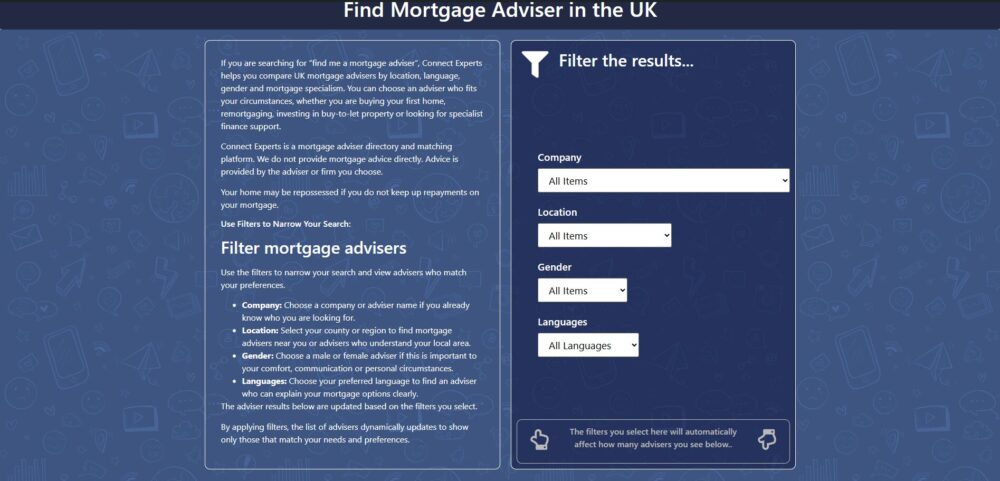
If you want to compare adviser profiles, you can use Connect Experts to find an adverse credit mortgage broker.
You can also use the Connect Experts mortgage broker directory to search by location, language, or adviser profile.
Connect Experts is part of Connect Group. It is a mortgage adviser directory and matching platform. Mortgage advice is provided by the adviser or firm you choose.
Subprime Mortgages and Credit Repair
A mortgage should not be seen as a shortcut around credit repair.
Better credit conduct can improve future options.
Helpful habits include:
- Paying commitments on time
- Reducing high balances
- Keeping credit use controlled
- Avoiding repeated applications
- Checking reports for errors
- Registering on the electoral roll where possible
- Keeping bank conduct stable
- Building savings where possible
The aim is not only to get accepted.
The aim is to move towards stronger borrowing options over time.
A specialist mortgage may be a stepping stone. It should not be treated as the final destination.
Ask Connect Mortgages about your options
FAQs: Subprime Mortgages
What is a subprime mortgage?
A subprime mortgage is a term used for mortgage lending where the borrower may not meet standard lender criteria. This may be due to bad credit, missed payments, defaults, CCJs, bankruptcy, an IVA or other financial issues.
Are subprime mortgages still available in the UK?
The term subprime is not commonly used by UK lenders today. Borrowers are more likely to hear terms such as adverse credit mortgage, bad credit mortgage or specialist mortgage.
Can I get a mortgage with bad credit?
It may be possible to get a mortgage with bad credit. Lenders may review the type of credit issue, when it happened, whether it has been settled, your income, deposit and affordability.
Will I need a bigger deposit?
You may need a bigger deposit if you have credit issues. This depends on the lender, the credit problem, how recent it was and your wider financial position.
Do subprime mortgages have higher rates?
They can have higher rates than standard mortgages. This is because lenders may view the application as higher risk.
Is a CCJ an automatic mortgage decline?
No. A CCJ does not always mean an automatic decline. Lenders may look at the date, amount, reason, settlement status and your current affordability.
Should I apply directly to a lender?
You can apply directly, but it may not be the best route if your credit history is complex. A mortgage adviser can help identify lenders that may consider your position before you apply.
Can I remortgage with adverse credit?
It may be possible to remortgage with adverse credit. Your options may depend on your equity, income, credit history, current mortgage and reason for remortgaging.
Is subprime the same as adverse credit?
Not exactly. Subprime is a broad term linked to higher-risk lending. Adverse credit is more specific and usually refers to credit problems such as missed payments, defaults, CCJs, IVAs or bankruptcy.
Can I improve my options before applying?
Yes. You may improve your options by checking your credit reports, correcting errors, reducing debts, keeping payments up to date and preparing clear documents before applying.
Important Information
Your home may be repossessed if you do not keep up repayments on your mortgage.
Connect Mortgages is a trading style of Connect IFA Ltd, which is authorised and regulated by the Financial Conduct Authority.
The FCA does not regulate some forms of buy-to-let, commercial mortgage and bridging finance.
A fee may be payable for arranging your mortgage. Your adviser will confirm the amount before you choose to proceed.