
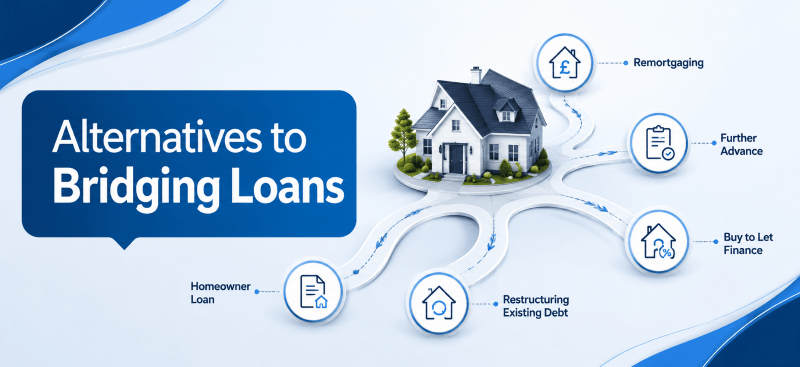
Alternatives to Bridging Loans – A bridging loan can solve a timing problem.
However, not every timing problem needs bridging finance.
That is the important point.
A bridging loan is designed for short-term use. It may help when money is needed quickly, often before a sale, refinance, or longer-term mortgage completes. Yet speed is only one part of the decision. Cost, repayment route, affordability, property condition, lender criteria and risk all matter.
The right question is not always “Can I get a bridge?”
Sometimes, the better question is:
Is there a safer, cheaper, or more suitable alternative to a bridging loan?
This guide explains the main alternatives to bridging loans, how they work, and when each option may fit.
Alternatives to Bridging Loans at a Glance
If you have more time, a remortgage or further advance may be cheaper than bridging finance.
If you want to keep your current mortgage, a second charge mortgage may help you raise money without replacing your first mortgage.
If you are funding a build or major works, development finance may be more suitable than a bridge.
If the property is commercial or semi-commercial, a commercial mortgage may offer a longer-term route.
If the property is being bought for rental, a buy-to-let mortgage may be the better exit or long-term solution.
If the property cannot yet qualify for a standard mortgage, bridging finance may still be needed.
Your home or property may be repossessed if you do not keep up repayments on your mortgage or any loan secured on it.
When a Bridging Loan May Not Be the Right Fit
Bridging finance has a clear purpose.
It can help when a borrower needs short-term funding and has a realistic exit plan. That exit may be a property sale, refinance, or another confirmed source of repayment.
However, a bridging loan may not be suitable when the need is not genuinely short-term. It may also be unsuitable where the exit strategy is uncertain, the costs are too high, or the borrower needs stable monthly repayments over a longer period.
A bridge can look simple because it solves today’s problem.
Yet property finance should also answer tomorrow’s question:
How will this borrowing end?
If the answer is unclear, another product may be better.
For a broader explanation of how bridging finance works, read our guide to bridging loans.
Main Alternatives to Bridging Loans
The most suitable alternative depends on what the money is for.
A homeowner, landlord, developer and business owner may all need short-term funding. However, they may not need the same product.
| Alternative | When It May Help | Key Point |
|---|---|---|
| Remortgage | You have time and want to raise money against your property | May offer longer-term borrowing |
| Further advance | Your current lender may lend more | Keeps borrowing with the same lender |
| Second charge mortgage | You want to keep your current mortgage | Adds a separate secured loan |
| Development finance | You are funding a build or major works | Funds may be released in stages |
| Commercial mortgage | You need long-term business property finance | May suit commercial premises |
| Buy-to-let mortgage | You are refinancing a rental property | Often used as a bridge exit |
| Personal savings | You want to avoid borrowing | Reduces finance cost but uses your capital |
| Family or private funding | You have private support available | Needs clear written terms |
Remortgage as an Alternative to a Bridging Loan
A remortgage means moving your mortgage to a new deal, often with a new lender. It may allow you to raise extra funds if there is enough equity in the property.
This can be useful when speed is not the main issue.
For example, a homeowner may want funds for home improvements, debt consolidation, business investment, or another property-related purpose. If the case allows time for valuation, underwriting and legal work, a remortgage may be more suitable than a bridge.
A remortgage may work well when:
- Your current mortgage deal is ending.
- You have enough equity.
- Your income supports the new borrowing.
- The lender accepts the reason for raising funds.
- You do not need completion within days.
However, it may not suit every borrower.
There may be early repayment charges on your current mortgage. You may also lose an existing rate that is cheaper than current market options. In some cases, a remortgage may take too long for the transaction.
The practical test is simple.
If time allows, compare the full cost of remortgaging against the full cost of bridging finance.
Further Advance from Your Existing Lender
A further advance means borrowing more from your current mortgage lender.
This can be useful when you do not want to move your whole mortgage. It may also reduce legal work compared with a full remortgage.
A further advance may suit borrowers who:
- Have a good payment record.
- Have enough property equity.
- Need extra funds for an accepted purpose.
- Want to keep their main mortgage in place.
- Prefer to deal with their current lender.
However, your lender does not have to agree.
They will still assess affordability, credit profile, property value and the loan purpose. The new borrowing may also be offered at a different rate from your current mortgage.
This option is often overlooked because it sounds ordinary.
Yet ordinary can be powerful when it avoids unnecessary cost.
Second Charge Mortgage as an Alternative to a Bridging Loan
A second charge mortgage is a separate loan secured against a property that already has a mortgage.
It does not replace your current mortgage. Instead, it sits behind the first mortgage.
This can be useful when remortgaging would mean losing a favourable rate. It may also help where a remortgage would trigger early repayment charges.
A second charge mortgage may be considered for:
- Home improvements.
- Business funding.
- Tax bills.
- Debt consolidation.
- Property investment.
- Large one-off costs.
However, it adds another secured loan to your property.
That means affordability matters. Lenders will review income, outgoings, credit profile, property value, mortgage balance and the reason for borrowing.
A second charge mortgage may be slower than bridging finance. Yet it may offer a longer repayment term and a more structured route.
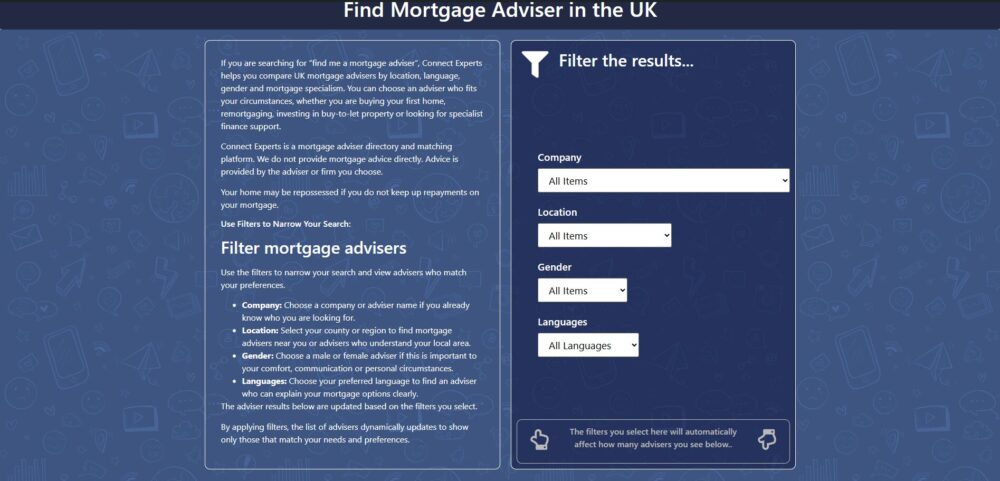
If you want to compare advisers with this specialism, Connect Experts has a useful page for finding second charge brokers.
Development Finance for Building or Major Works
Development finance is often used for larger property projects.
It may suit ground-up builds, conversions, heavy refurbishments or projects where funds are needed in stages.
Unlike a simple bridging loan, development finance is usually linked to the build programme. The lender may release funds as work progresses. This can help match borrowing to the project rather than drawing all funds at once.
Development finance may be more suitable when:
- The project involves structural work.
- The property is being built or converted.
- The borrower needs staged funding.
- The end value matters to the lending decision.
- Professional costings and planning documents are available.
This type of finance is technical.
Lenders may review planning permission, build costs, gross development value, experience, contractor details and exit strategy. The exit could be a sale, refinance, or long-term investment mortgage.
A bridging loan may still help with light refurbishment or short-term purchase funding. However, larger works may need development finance from the outset.
Commercial Mortgage as a Longer-Term Alternative
A commercial mortgage may be suitable when the borrowing relates to business premises, commercial property, or certain investment properties.
It is usually designed for longer-term borrowing.
This matters because a bridging loan is temporary. A commercial mortgage can support a property that the borrower plans to hold.
A commercial mortgage may fit when:
- The borrower wants to buy business premises.
- A company wants to refinance commercial property.
- A landlord owns commercial or semi-commercial premises.
- The property has a stable rental or trading position.
- The funding need is not short-term.
Commercial mortgage lenders will usually assess the property, income, business performance, lease terms, deposit, credit profile and repayment strategy.
For business funding needs that do not fit a mortgage route, you can also review our guide to business loans.
Buy-to-Let Mortgage as a Bridge Exit or Alternative
Some property investors use bridging finance because the property is not yet ready for a buy-to-let mortgage.
That may happen when a property needs refurbishment, has no working kitchen or bathroom, or does not meet standard lender criteria.
However, if the property is already lettable and meets lender requirements, a buy-to-let mortgage may be more suitable.
A buy-to-let mortgage may help when:
- The property will be rented out.
- Rental income supports the application.
- The property meets lender condition rules.
- The borrower wants a longer-term product.
- The purchase does not require urgent short-term finance.
This option is especially relevant for landlords who are buying or refinancing rental property.
If the property needs work first, bridging finance may still be used as a short-term route. The buy-to-let mortgage may then become the exit.
Using Savings Instead of Bridging Finance
Using savings can reduce borrowing costs.
There may be no lender arrangement fee, valuation fee, legal charge, interest roll-up, or exit fee. It can also make the transaction cleaner.
However, using savings is not risk-free.
It may reduce your emergency fund. It may also leave less capital available for tax, repairs, delays, legal costs or unexpected property issues.
Savings may work best when:
- The amount needed is modest.
- The transaction is low risk.
- You will still keep enough emergency funds.
- The money will be replaced within a clear timeframe.
The question is not only whether you have the money.
It is whether using it leaves you financially resilient.
Family Loans and Private Funding
Family support or private funding can sometimes replace bridging finance.
This may be helpful where timing matters, but the borrower wants to avoid lender fees or complex underwriting.
However, private borrowing needs care.
A family loan can affect relationships if repayment is delayed. Private investor funding may also have strict terms. In some cases, there may be legal, tax or security implications.
Before using private funding, consider:
- Is the agreement written down?
- Is interest being charged?
- What happens if repayment is delayed?
- Is security being taken over the property?
- Has each party taken legal advice?
- Are tax issues involved?
A handshake may feel simple at the start.
It can become complicated when money, property and timing meet.
Personal Loans and Unsecured Borrowing
A personal loan may be considered for smaller borrowing needs.
Unlike bridging finance, it is usually unsecured. This means the loan is not directly secured against property.
However, unsecured borrowing may have lower borrowing limits. It may also carry higher rates than some mortgage-based options, depending on the borrower’s profile.
A personal loan may suit:
- Smaller funding needs.
- Shorter repayment plans.
- Borrowers who do not want secured borrowing.
- Situations where property security is unnecessary.
It may not suit large property purchases, auction deadlines, major refurbishments, or cases where funds are needed quickly at scale.
When Bridging Finance May Still Be the Right Option
Alternatives matter.
However, they do not remove the need for bridging finance in every case.
A bridging loan may still be considered when:
- Completion is needed quickly.
- A property chain has broken.
- An auction deadline must be met.
- The property is not mortgageable yet.
- A refurbishment must happen before refinance.
- A sale is expected but has not completed.
- A clear exit strategy is available.
This is why advice matters.
The right product should match the problem, not just the borrower’s urgency.
If you want to compare short-term finance advisers by expertise, Connect Experts also provides a page for finding bridging loan mortgage brokers.
How to Compare Alternatives to Bridging Loans
Before choosing any product, compare the full picture.
Do not only compare the monthly payment.
A lower monthly payment may still cost more over time if the term is longer. A fast product may also cost more if fees, interest and exit charges are high.
Review:
- Total cost over the expected term.
- Interest rate and how interest is charged.
- Arrangement fees.
- Valuation fees.
- Legal fees.
- Broker fees.
- Exit fees.
- Early repayment charges.
- Monthly affordability.
- Impact on future borrowing.
- Speed of completion.
- Property condition.
- Exit strategy.
The best option is not always the cheapest today.
It is the option that fits the purpose, timescale and repayment route.
Practical Examples
Buying before selling
A homeowner wants to buy a new property before their current home sells.
A bridging loan may help if the purchase cannot wait. However, if there is enough time, a remortgage, a further advance, or a second-charge mortgage may be compared first.
Funding home improvements
A homeowner wants to fund an extension.
If the work is modest, a further advance, a remortgage, or a second-charge mortgage may be suitable. If the work is structural or part of a larger project, development finance may be more appropriate.
Buying an unmortgageable property
An investor wants to buy a property that needs major repairs.
A standard mortgage may not be available until the property meets lender requirements. Bridging finance may be used first, with a buy-to-let mortgage as the planned exit.
Buying business premises
A business owner wants to buy the building they trade from.
A commercial mortgage may be more suitable than a bridge if the business can support long-term repayments and completion is not urgent.
External Guidance Worth Reading
MoneySavingExpert explains that bridging loans are short-term secured loans often used to bridge timing gaps in property purchases, but they can be expensive and high-risk if plans fail. You can read the overview of bridging loans for a wider context.
MoneyHelper also explains how second mortgages work, including the risks of secured borrowing and the importance of affordability.
Speak to Connect Mortgages
Alternatives to bridging loans should be compared before you commit to short-term finance.
Connect Mortgages can help you review your position, the property, the timescale, the amount needed and the repayment route.
That may include:
- Remortgage options.
- Further advance options.
- Second charge mortgage options.
- Development finance.
- Commercial mortgage routes.
- Buy-to-let refinance options.
- Bridging finance where appropriate.
The aim is not simply to borrow.
The aim is to borrow in a way that makes sense when the pressure has passed.
Speak to Connect Mortgages before choosing a route.
Your home or property may be repossessed if you do not keep up repayments on your mortgage or any loan secured on it.
FAQs: Alternatives to Bridging Loans
What is the best alternative to a bridging loan?
The best alternative depends on the reason for borrowing. A remortgage, further advance, second charge mortgage, development finance or commercial mortgage may be considered.
Is a remortgage cheaper than a bridging loan?
A remortgage may be cheaper over a longer term. However, fees, early repayment charges, rates and timing must be compared before deciding.
Is a second charge mortgage an alternative to bridging finance?
Yes, it can be. A second charge mortgage may help you raise funds without replacing your current mortgage.
When might development finance be better than bridging finance?
Development finance may be better for major works, conversions or ground-up builds. It can release funds in stages as the project progresses.
Can I use a personal loan instead of a bridging loan?
A personal loan may suit smaller borrowing needs. It is unlikely to suit large property purchases, auction deadlines or major refurbishment projects.
Is bridging finance always expensive?
Bridging finance is usually more expensive than many longer-term mortgage products. The total cost depends on rate, term, fees, security and exit route.
Do I need an exit strategy if I choose an alternative?
Yes. Every borrowing route needs a repayment plan. This is especially important where the debt is secured against property.
Can Connect Mortgages compare bridging loan alternatives?
Yes. Connect Mortgages can help compare suitable options based on your property, income, timescale, purpose and repayment strategy.