

Buy-to-Let Mortgage Brokers for UK Landlords – A rental property is not judged by bricks alone.
A lender sees rent, risk, deposit, ownership, tax position, experience and exit strategy. A landlord may see a flat, a house, or an HMO. A buy-to-let mortgage broker sits between those two views.
The broker’s role is to turn a property plan into a lending case that can be assessed clearly.
At Connect Mortgages, our buy-to-let mortgage brokers help UK landlords review mortgage options for first rental properties, remortgages, limited company purchases, portfolio lending, HMOs and more complex landlord cases.
Buy-to-Let Mortgage Brokers at a Glance
A buy-to-let mortgage broker helps landlords understand how lenders assess rental property finance.
They can compare lender criteria, rental stress tests, deposit requirements, fees, ownership structures and product options.
This may help if you are buying your first rental property, remortgaging, expanding a portfolio or applying through a limited company.
Buy-to-let mortgages are usually assessed on rental income, property type, loan-to-value, landlord experience and wider financial position.
Not every buy-to-let mortgage is regulated in the same way. You should also seek tax and legal advice where needed.
What Does a Buy-to-Let Mortgage Broker Do?
A buy-to-let mortgage broker helps landlords find mortgage options for properties they plan to rent to tenants.
This is different from a standard residential mortgage. A residential mortgage is for a home you live in. A buy-to-let mortgage is usually for an investment property.
A broker may help with:
- Comparing lender criteria
- Checking rental income requirements
- Reviewing deposit and loan-to-value options
- Explaining interest-only and repayment routes
- Assessing personal or limited company borrowing
- Reviewing portfolio landlord requirements
- Preparing documents before application
- Explaining fees, product terms and early repayment charges
- Supporting communication with lenders
The right broker does not only look for a rate. They assess whether the mortgage structure fits the property, rent, borrower and long-term plan.
You can also read our wider buy-to-let mortgage guide for a broader view of how these mortgages work.
Why Buy-to-Let Advice Matters
Buy-to-let can look simple from the outside.
A landlord buys a property. A tenant pays rent. The rent helps support the mortgage.
However, the mortgage market sees more detail.
Lenders may ask whether the property is standard construction. They may assess the expected rent against the mortgage payment. They may look at the borrower’s income, tax position, credit profile and landlord experience.
Some lenders may be comfortable with first-time landlords. Others may prefer experienced borrowers. Some accept HMOs, limited companies or larger portfolios. Others do not.
This is why advice matters.
A good buy-to-let mortgage broker helps turn uncertainty into structure. The aim is not to remove risk. The aim is to understand it before making a decision.
How Lenders Assess Buy-to-Let Mortgages
Most buy-to-let lenders assess the property and the rent first.
They will usually consider:
- Expected or current monthly rent
- Property value
- Deposit or equity
- Loan-to-value ratio
- Interest coverage ratio
- Mortgage product rate
- Fixed or variable product type
- Property type and condition
- Borrower income and commitments
- Credit history
- Landlord experience
- Ownership structure
- Existing buy-to-let portfolio
Many lenders use rental stress testing. This checks whether the rent is high enough to support the mortgage payment under the lender’s rules.
The calculation may change depending on the product, tax position, ownership structure and borrower type.
This is one reason two landlords can buy similar properties and receive different outcomes.
Buy-to-Let Deposits and Loan-to-Value
Buy-to-let mortgages usually need larger deposits than residential mortgages.
Many lenders may require at least 20% to 25% deposit. Some cases may need more.
Higher deposits may be needed where the case involves:
- A first-time landlord
- A first-time buyer
- An HMO
- A holiday let
- A limited company
- A non-UK resident borrower
- A new-build flat
- A property needing work
- Complex credit history
The deposit is only part of the lender’s decision. Rental income, product fees, property type and lender policy can also shape the result.
Before you apply, you can use the buy-to-let affordability calculator to estimate how rental income may affect borrowing.
Interest-Only or Repayment Buy-to-Let
Many buy-to-let mortgages are arranged on an interest-only basis.
This means the monthly payment covers interest, but the loan balance does not reduce. The landlord needs a repayment plan for the end of the term.
Some landlords choose repayment mortgages instead. This means each monthly payment reduces the loan balance.
Both routes have trade-offs.
Interest-only may support monthly cash flow. However, the debt remains in place.
Repayment may reduce the mortgage balance. However, monthly payments are usually higher.
A broker can explain both options and compare the full cost, not just the headline payment.
Personal Name or Limited Company Buy-to-Let
Some landlords buy property in their own name. Others use a limited company.
A limited company buy-to-let mortgage may suit some landlords who want to build a portfolio or retain profit within a company. However, it will not suit everyone.
Lenders may assess:
- The company structure
- SIC codes
- Directors and shareholders
- Personal guarantees
- Company documents
- Deposit source
- Rental income
- Existing portfolio exposure
- Director income and credit history
A mortgage broker can explain how lenders view the company structure. However, they cannot replace tax advice.
Before choosing how to own the property, speak to a qualified tax adviser or accountant.
You can read more in our guide to limited company buy-to-let mortgages.
Portfolio Landlords
A portfolio landlord usually owns four or more mortgaged buy-to-let properties.
These cases can involve more detailed underwriting. A lender may review the whole portfolio, not just the property being purchased or refinanced.
They may ask for:
- A full property schedule
- Current mortgage balances
- Rental income for each property
- Property values
- Loan-to-value levels
- Business plan
- Cash flow details
- Tax position
- Ownership structure
- Landlord experience
This matters because one weak property can affect the strength of the whole case.
A broker can help prepare the details before the application reaches the lender. Our buy-to-let portfolio mortgage page explains this in more detail.
HMO Buy-to-Let Mortgages
HMO mortgages can be more complex than standard buy-to-let mortgages.
An HMO is usually a property rented to three or more people who are not from one household and who share facilities.
Lenders may assess:
- HMO licence position
- Room sizes
- Property layout
- Fire safety requirements
- Local authority rules
- Landlord experience
- Valuation method
- Rental demand
- Management plan
Some lenders accept smaller HMOs. Others prefer experienced landlords or larger deposits.
The mortgage must fit the property’s use. It must also reflect the legal and practical responsibilities of letting shared accommodation.
You can read our dedicated guide to HMO property finance.
When Bridging Finance May Fit a Buy-to-Let Strategy
Some landlords use short-term finance before moving onto a longer-term buy-to-let mortgage.
This may happen when:
- A property is bought at auction
- Completion is needed quickly
- The property needs light refurbishment
- The property is not yet mortgageable
- A tenant is not in place
- A landlord needs time before refinance
Bridging finance can be useful but also expensive. It needs a clear exit route.
The exit may be sale, refinance or another agreed repayment source.
Our bridging loans page explains how short-term property finance works.
Buy-to-Let Tax and Regulation
A mortgage broker can advise on mortgage options. They cannot provide tax advice unless authorised to do so.
Tax can change the outcome of a buy-to-let plan.
Individual landlords should understand how mortgage interest relief works. GOV.UK explains the rules for residential landlord finance cost relief.
You can read the official guidance on tax relief for residential landlords.
Regulation also matters.
Some buy-to-let lending sits outside standard residential mortgage regulation. Consumer buy-to-let has its own regulatory framework. The FCA explains this in its buy-to-let lending guidance.
Your adviser should explain which rules apply to your case.
Landlord Insurance and Risk Planning
A buy-to-let mortgage is only one part of the landlord’s position.
The property also needs practical protection.
Landlords may need to consider buildings cover, contents cover, rent protection, legal expenses and liability risks. The right cover will depend on the property, tenancy type and lender requirements.
You can review related cover on our landlord insurance page.
Insurance does not make a property risk-free. It helps protect against some events that can affect rent, repairs and financial stability.
Documents You May Need
Preparing documents early can help reduce delays.
A buy-to-let mortgage broker may ask for:
- Proof of identity
- Proof of address
- Bank statements
- Income documents
- Deposit evidence
- Credit details
- Property details
- Expected rental income
- Tenancy details
- Current mortgage statement
- Portfolio schedule
- Limited company documents
- Accountant details where relevant
Complex cases may need more evidence.
This can include leases, planning documents, HMO licences, company accounts, rental valuations or refurbishment plans.
Common Buy-to-Let Mortgage Mistakes
Many landlord mortgage issues start before the application.
Common mistakes include:
- Choosing a property before checking lender criteria
- Assuming rent will meet stress tests
- Ignoring product fees
- Forgetting early repayment charges
- Using the wrong ownership structure
- Underestimating deposit requirements
- Applying to lenders that do not accept the property type
- Not planning for void periods
- Treating tax as an afterthought
- Using short-term finance without a clear exit
A broker can help identify these points early.
That does not guarantee approval. It gives the case a clearer route.
Why Use Connect Mortgages for Buy-to-Let Broker Support?
Connect Mortgages helps landlords review buy-to-let mortgage options across a wide range of property and borrower types.
This may include first-time landlords, portfolio landlords, limited company investors, HMO landlords, remortgage clients and borrowers with more complex needs.
Our role is to help you understand the mortgage route before you apply.
That includes lender criteria, affordability, rental calculations, documentation, risk points and product options.
We are a credit broker, not a lender. Any mortgage will be subject to status, lender criteria and affordability checks.
Find a Buy-to-Let Mortgage Adviser
Some landlords want direct support from an adviser with buy-to-let experience.
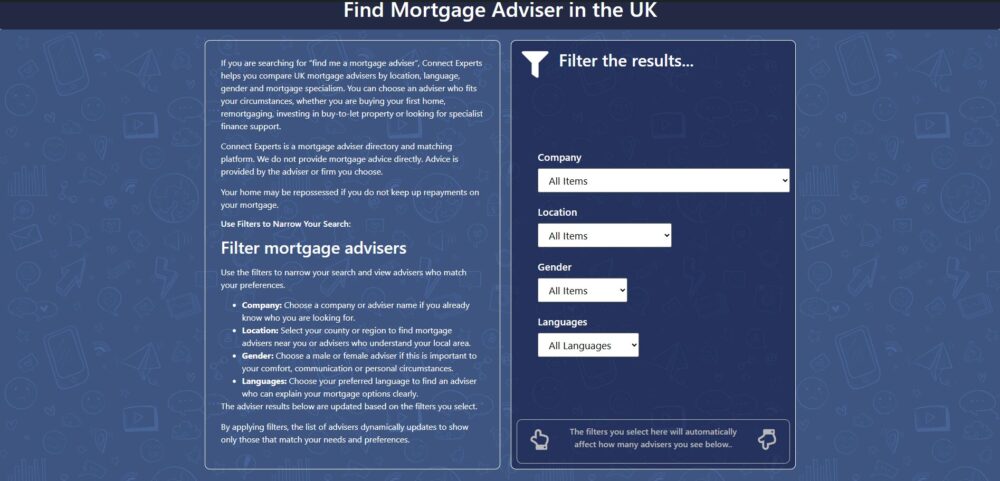
Through Connect Experts, you can find a buy-to-let mortgage adviser by location, language and specialist area.
This can help if you want to compare adviser profiles before making contact.
Connect Experts is part of the wider Connect Group. Advice is provided by the adviser or firm you choose.
Speak to a Buy-to-Let Mortgage Broker
A rental property is a financial decision, but it is also a responsibility.
The right mortgage should support the rent, the borrower, the property and the long-term plan.
If you are buying, refinancing or reviewing a landlord mortgage, Connect Mortgages can help you understand your options before you apply.
Contact Connect Mortgages to speak with a buy-to-let mortgage broker.
FAQs: Buy-to-Let Mortgage Brokers
What is a buy-to-let mortgage broker?
A buy-to-let mortgage broker helps landlords compare mortgage options for rental properties. They review lender criteria, rental income, deposit, property type and borrower circumstances.
Why should I use a buy-to-let mortgage broker?
A broker can help explain lender rules, rental stress tests, product fees and ownership options. This can reduce confusion before you apply.
Are buy-to-let mortgages based on rental income?
Rental income is a key part of most buy-to-let assessments. Lenders may also review deposit, credit history, income, property type and landlord experience.
How much deposit do I need for a buy-to-let mortgage?
Many lenders ask for at least 20% to 25% deposit. Some cases need more, depending on the lender and property.
Can a first-time landlord get a buy-to-let mortgage?
Yes, some lenders accept first-time landlords. Criteria differ, so advice can help identify suitable lender routes.
Can I get a buy-to-let mortgage through a limited company?
Yes, some landlords buy or refinance through a limited company. You should seek tax advice before choosing this structure.
What is a portfolio landlord?
A portfolio landlord usually owns four or more mortgaged buy-to-let properties. Lenders may assess the full portfolio.
Can I get a buy-to-let mortgage for an HMO?
Yes, but HMO mortgages can be more complex. Lenders may check licence rules, layout, room sizes and landlord experience.
Are all buy-to-let mortgages regulated?
No. Some buy-to-let mortgages are not regulated in the same way as residential mortgages. Consumer buy-to-let has specific rules.
Can I remortgage a buy-to-let property?
Yes, many landlords remortgage when a rate ends, when they want to release equity, or when they need to review costs.