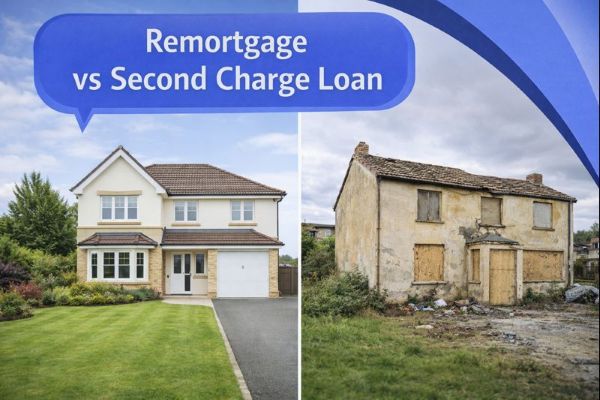
Remortgage vs Second Charge Loan: Which Option Suits You Best? Homeowners looking to unlock equity often face a pivotal decision: whether to remortgage their property or take out a second-charge mortgage. Both are effective ways to raise capital from your home. Still, the best option depends on your individual circumstances, including your current mortgage terms, the equity you’ve built, your credit profile, and your future financial goals.
A remortgage replaces your current mortgage with a new one, typically to secure a better interest rate or borrow additional funds. This can be a great option if your fixed-rate term is ending soon or if you’re aiming to consolidate debt into a single payment. However, it may come with early-repayment charges or move you to a less favourable rate.
In contrast, a second-charge mortgage is an additional secured loan on your property that doesn’t affect your existing mortgage. It’s handy if you’re on a low-rate deal, locked into a long-term mortgage, or facing steep exit fees. It allows you to tap into your home’s equity for things like home improvements, large purchases, or business funding without refinancing your primary loan.
Understanding the difference between these two financing options is essential for making a smart, future-proof decision. In this guide, we’ll break down the pros and cons of each, explore when one may be more beneficial than the other, and help you determine which path is right for your financial well-being.
What Is a Second Charge Mortgage?
A second charge mortgage, also known as a secured loan, allows you to borrow against the equity in your home without changing your existing mortgage. This can be ideal if:
- You’re locked into a low fixed-rate mortgage.
- You are incurring early-repayment charges on your current deal.
- You need additional funds for home improvements, debt consolidation, or investment purposes.
Visit our second charge mortgage advice page for a full guide.
When Should You Consider Remortgaging?
Remortgaging involves switching your current mortgage to a new deal, often with a different lender. It may be the better option if:
- Your fixed rate is ending soon.
- You want to consolidate all debts into one lower monthly payment.
- Your home’s value has increased, and you qualify for better rates.
Explore your options with our mortgage calculators to estimate your potential savings.
Key Differences at a Glance
| Feature | Remortgage | Second Charge Loan |
|---|---|---|
| Affects current mortgage | Yes | No |
| New lender involved | Usually | No |
| Ideal for debt consolidation | Yes | Yes |
| Preserves existing rate | No | Yes |
| Additional affordability checks | Yes | Yes |
Pros and Cons
Remortgage Pros:
- Potential to lower interest rate
- Simplifies payments into one mortgage
Remortgage Cons:
- May incur early repayment charges
- Could lose a favourable deal
Second Charge Pros:
- Keeps current mortgage untouched
- Fast access to funds
Second Charge Cons:
- Higher rates than primary mortgages
- Adds a second monthly payment
Real-World Example
A homeowner with a £200,000 mortgage fixed at 2% and £100,000 in equity wants to borrow £30,000. If they remortgage, they risk losing the low rate. A second-charge mortgage lets them keep the existing deal while accessing additional funds.
Is a Second Charge Loan Regulated?
Yes. Like first-charge mortgages, second-charge loans are regulated by the Financial Conduct Authority (FCA). Our advisors at Connect Mortgages are fully FCA-authorised and will ensure your loan recommendation meets your affordability and suitability criteria.
For more details on the FCA’s rules, visit our mortgage compliance page.
Choosing the Right Option
Use this quick checklist:
- Want to keep your current deal? Second charge loan
- Looking to lower your rate? Remortgage
- Consolidating multiple debts? Either could work
Still unsure? Contact our expert mortgage advisers for personalised guidance.
Thank you for reading our “Remortgage vs Second Charge Loan | Which Option Suits You Best?” publication. Stay “Connect“-ed for more updates soon!
FAQ | Remortgage vs Second Charge Loan
| Question | Answer |
|---|---|
| Is a second charge loan cheaper than a remortgage? | Not always. A second-charge loan may be more cost-effective if you’re tied into a low fixed rate and would incur early-repayment charges by remortgaging. However, second charge loans often have higher interest rates than primary mortgages. It’s important to weigh the total cost over time with the help of a qualified mortgage adviser. |
| Can I get a second charge with bad credit? | Yes, it’s possible. Many specialist lenders offer second-charge loans to applicants with adverse credit histories. While rates may be higher and affordability checks more rigorous, these options can still be viable if you have sufficient equity. Learn more in our guide to adverse credit mortgages. |
| Are second charge loans only for homeowners? | Yes. Second charge loans are secured against your existing property, so you must be a homeowner with available equity. These loans are not available to renters or first-time buyers. |
| Do I need my existing lender’s permission to take out a second charge? | Yes. Your main mortgage lender must consent before a second charge can be registered. This is because the second lender will be taking a lower-priority claim on your property. Our team will handle this process for you as part of the application. |
| Can I repay a second-charge loan early? | Most second-charge loans can be repaid early, but you may incur early-repayment charges or exit fees. It’s crucial to check the terms of your agreement before committing. We ensure all costs and flexibility options are clear before you proceed. |