
10 First-Time Buyer Mortgage Tips From Mortgage Brokers: Buying your first home is not only a financial decision.
It is also a test of preparation.
A mortgage can feel simple from a distance. You save a deposit, find a property, apply, and wait for an offer. Yet in practice, lenders consider many moving parts before they decide.
They look at your income, deposit, credit record, spending, documents, property type and future affordability. A good mortgage broker can help you understand how those parts fit together.
This guide explains 10 practical tips for first-time buyers from a broker’s perspective. It focuses on what to check before you apply, what lenders may ask for, and how to avoid avoidable delays.
At a Glance
First-time buyers should prepare before viewing homes or applying for a mortgage. Start by checking your deposit, income, spending, credit file and documents. Then compare mortgage types, understand extra buying costs, and check whether Stamp Duty may apply.
A broker can help you understand lender criteria, compare suitable options and prepare your application properly. However, your mortgage should still fit your budget, not just the maximum amount a lender may offer.
1. Understand What a Broker Does Before You Apply
A mortgage broker does more than search for a rate.
They assess your circumstances before matching you with lenders. This matters because one lender may treat your income, deposits, or credit history differently from another lender.
For a first-time buyer, this can make the process clearer. You may not know which lenders accept your income type, a gifted deposit, overtime, a new job, bonus income, or your credit profile.
A broker may help with:
- Checking your mortgage affordability
- Explaining loan-to-value
- Comparing fixed, tracker and variable rates
- Preparing documents
- Reviewing lender criteria
- Explaining fees and application steps
- Supporting the mortgage application process
Before choosing a broker, ask how they are paid, what fees may apply, and whether they can explain your options clearly.
If you want to understand the wider mortgage process first, read our First-Time Buyer Mortgage guide.
2. Know How Much Deposit You Have
Your deposit is the money you put towards the property purchase.
Many first-time buyers start with a 5% deposit. For example, a £250,000 property with a 5% deposit would need £12,500 before other costs.
A larger deposit can sometimes help. It may reduce the loan-to-value, improve lender choice, and lower monthly repayments. However, the right deposit size depends on your savings, income, property price and overall budget.
Lenders also care about where the deposit comes from.
Common deposit sources include:
- Personal savings
- A gifted deposit from family
- Inheritance
- Sale proceeds from another asset
- Lifetime ISA savings, where eligible
If your deposit is a gift, the lender may ask for a gift deposit letter. They may also ask for evidence of the donor’s funds.
This is why deposit planning should start early. A deposit is not only a number. It is also part of the lender’s checks.
3. Check Your Affordability Before Choosing a Property
The property you want and the mortgage you can afford are not always the same.
A lender will usually assess your income against your committed spending. They may also look at future interest rate risk, household costs and dependants.
They may review:
- Basic salary
- Overtime, bonus or commission
- Self-employed income
- Credit cards
- Loans
- Car finance
- Student loans
- Childcare costs
- Dependants
- Regular spending
- Bank statements
This means two buyers with the same salary may receive different borrowing outcomes.
For example, one buyer may have low commitments and a strong credit record. Another may have car finance, credit card balances and recent missed payments. Their borrowing options may differ.
Use the Residential Affordability Calculator to get an initial estimate before you commit to viewings.
4. Do Not Focus Only on the Lowest Rate
The lowest rate may look attractive, but it is not always the right deal.
A mortgage product should be reviewed with its full cost. This includes the rate, product fee, valuation fee, incentives, term, early repayment charges and monthly payment.
A lower rate with a high product fee may not always work well for a smaller mortgage. A slightly higher rate with lower upfront costs may sometimes be more suitable.
The main mortgage types first-time buyers often compare include:
- Fixed-rate mortgages
- Tracker mortgages
- Standard variable rate mortgages
- Discounted variable rate mortgages
- Repayment mortgages
- Interest-only mortgages, where suitable
Many first-time buyers prefer fixed rates because payments stay the same during the fixed period. That can make budgeting easier when owning a home for the first time.
However, fixed rates can also include early repayment charges. This matters if you may move, repay early or need flexibility.
A mortgage is not only about the first monthly payment. It is about how the product behaves over time.
5. Prepare Your Credit File Before the Lender Sees it
Your credit file can affect your mortgage options.
A poor credit history does not always stop a first-time buyer from getting a mortgage. However, it can affect the lenders available, the deposit required and the rate offered.
Before applying, check your credit file with the main credit reference agencies. Look for errors, old addresses, missed payments or linked financial accounts that no longer apply.
Useful steps include:
- Registering on the electoral roll
- Paying bills on time
- Reducing credit card balances where possible
- Avoiding new borrowing before applying
- Checking old addresses are correct
- Reviewing financial links to other people
- Correcting errors early
Do not wait until the application stage to find a problem.
If you have had defaults, County Court Judgments, missed payments or debt arrangements, speak to a broker before applying. The age, size and reason for the issue may matter.
6. Understand Extra Costs Before Making an Offer
Your deposit is not the only cost.
First-time buyers should also budget for the full purchase journey. A property may feel affordable at the deposit stage, but the wider costs can change the picture.
You may need to budget for:
- Solicitor or conveyancing fees
- Property searches
- Mortgage arrangement fees
- Valuation fees
- Survey costs
- Buildings insurance
- Contents insurance
- Moving costs
- Basic repairs
- Furniture
- Service charges, if buying leasehold
- Stamp Duty, where payable
In England and Northern Ireland, first-time buyers may qualify for Stamp Duty relief if they meet the rules.
For purchases during the temporary relief period from 23 September 2022 to 31 March 2025, first-time buyers paid no Stamp Duty on the first £425,000. They paid 5% on the part from £425,001 to £625,000. The relief did not apply above £625,000.
You can check the official GOV.UK position on First-Time Buyers’ Relief. You can also estimate possible tax costs with our Stamp Duty Calculator.
7. Get Your Documents Ready Early
Mortgage delays often happen because documents are missing, unclear or inconsistent.
Before a lender reviews your application, prepare your paperwork. This helps your broker check the case and reduce avoidable back-and-forth.
Common documents include:
- Passport or driving licence
- Proof of address
- Payslips
- Bank statements
- Proof of deposit
- Gifted deposit letter, where relevant
- Credit commitment details
- Employment contract, where needed
- Tax calculations, if self-employed
- Tax year overviews, if self-employed
- Company accounts, where needed
- Details of the property being bought
Your documents should tell the same story as your application.
For example, your income, bank statements and deposit evidence should be clear. If the lender needs to ask too many questions, the application may slow down.
Good preparation does not guarantee approval. However, it can help the process move more smoothly.
8. Think carefully about the mortgage term
The mortgage term affects the monthly payment and the total interest paid.
A longer term may reduce monthly payments. That can help affordability, especially for first-time buyers managing new household costs.
However, a longer term may mean paying more interest over the life of the mortgage. A shorter term may cost more each month but may reduce the total interest paid.
This is a practical balance.
A first-time buyer should ask:
- Can I afford the payment now?
- Would the payment still work if costs rise?
- Do I expect my income to change?
- How long do I plan to stay in the property?
- Would I like the option to overpay?
- Are there early repayment charges?
You can estimate possible monthly repayments with the Quick Mortgage Calculator.
Use calculators as a guide only. A lender’s final decision will depend on its own criteria.
9. Understand loan-to-value before comparing deals
Loan-to-value, often called LTV, compares the mortgage amount with the property value.
If you buy a £250,000 property with a £25,000 deposit, you need a £225,000 mortgage. That means the mortgage is 90% of the property value, so the LTV is 90%.
LTV matters because lenders price risk differently.
A lower LTV may give access to more products. A higher LTV can still be possible, but it may come with tighter checks or higher rates.
In 2023, the UK Mortgage Guarantee Scheme supported access to 95% mortgages through participating lenders. This was aimed at helping buyers with smaller deposits, including first-time buyers. You can read the GOV.UK background on the Mortgage Guarantee Scheme.
A 5% deposit can help some buyers enter the market sooner. However, it may also mean higher monthly payments and less protection against house price changes.
The question is not only “Can I buy now?”
It is also, “Can I own this home comfortably after completion?”
10. Choose advice that fits your circumstances
No two first-time buyers are exactly the same.
One buyer may have a large deposit but variable income. Another may have a smaller deposit and strong employment. Someone else may be self-employed, buying with family support or dealing with past credit issues.
This is why advice should be based on your full situation.
A first-time buyer broker may help you understand:
- How much you may be able to borrow
- Which lenders may fit your circumstances
- Whether your deposit source is acceptable
- What documents are needed
- What the monthly payments may look like
- What risks should be considered
- When to apply for a mortgage in principle
- What happens after an offer is accepted
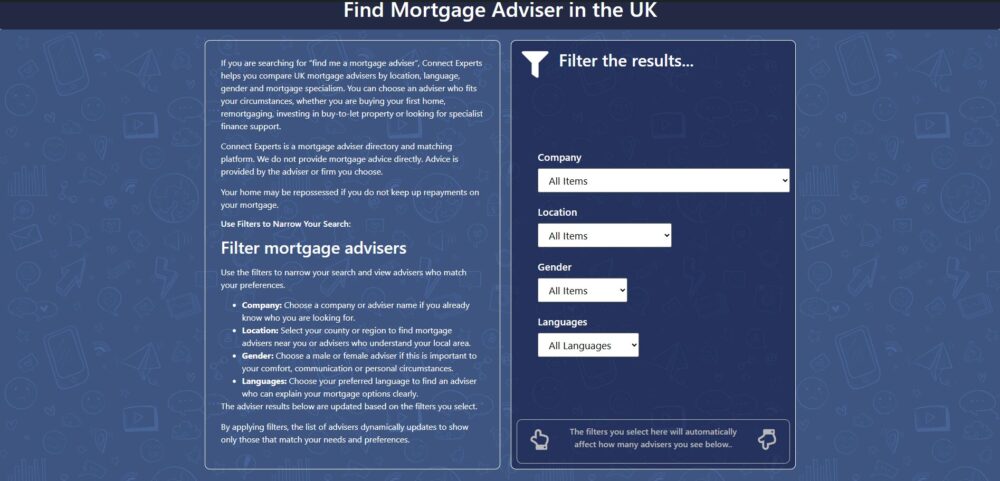
If you want to compare advisers by location, language or preference, you can use Find First-Time Buyer Mortgage Advisers on Connect Experts.
Connect Experts is part of the Connect Group. It is a mortgage adviser directory and matching platform. Advice is provided by the adviser or firm you choose.
You can also search the wider UK mortgage adviser directory if your needs go beyond a first-time buyer mortgage.
First-time buyer mortgage checklist
Before applying, check the following:
- Do you know your deposit amount?
- Can you evidence the deposit source?
- Have you checked your credit file?
- Have you reviewed your monthly spending?
- Do you know your likely buying costs?
- Have you prepared your documents?
- Have you compared product fees as well as rates?
- Do you understand the mortgage term?
- Have you checked Stamp Duty, where relevant?
- Have you spoken to a broker before applying?
This checklist is simple, but it can prevent costly delays.
What next?
A first home should not start with guesswork.
It should start with clear numbers, realistic costs and the right questions.
If you are preparing to buy your first home, speak to Connect Mortgages before you apply. We can help you understand your options, check what lenders may look for and explain the next steps.
Contact Connect Mortgages to discuss your first-time buyer mortgage options.
FAQs: First-time buyer mortgage tips
What is the first step for a first-time buyer?
The first step is to check your deposit, income, spending and credit file. This helps you understand whether you may be ready to apply for a mortgage.
How much deposit does a first-time buyer need?
Many first-time buyers start with a 5% deposit. However, a larger deposit may improve lender choice and reduce monthly payments.
Can a first-time buyer get a mortgage with bad credit?
Yes, it may be possible. However, bad credit can affect lender choice, deposit requirements and the rate offered. Speak to a broker before applying.
Should first-time buyers use a mortgage broker?
A broker can help first-time buyers understand lender criteria, compare suitable products and prepare the application. This can be useful if you are unsure where to start.
What documents do first-time buyers need?
You may need ID, proof of address, bank statements, payslips, proof of deposit and details of any credit commitments. Self-employed buyers may need tax documents or accounts.
Is the lowest mortgage rate always best?
Not always. Product fees, incentives, early repayment charges, term length and monthly affordability also matter.
What extra costs should first-time buyers budget for?
Budget for legal fees, searches, valuation fees, survey costs, insurance, moving costs, furniture and Stamp Duty where payable.
Can first-time buyers get 95% mortgages?
Some lenders may offer 95% loan-to-value mortgages, subject to criteria. This can help buyers with smaller deposits, but monthly payments may be higher.