

Adverse Credit Mortgages: How Specialist Lending Works – Past credit problems can change how a mortgage application is assessed. They do not always close the door.
An adverse credit mortgage is not a fixed product. It is a mortgage option for borrowers whose credit history requires closer review by lenders.
That history may include missed payments, defaults, County Court Judgments, IVAs, bankruptcy, debt management plans or previous mortgage arrears.
The practical question is rarely “Is the credit file perfect?”
It is usually “What happened, when did it happen, has it been resolved, and can the mortgage remain affordable now?”
That is where specialist mortgage advice can matter.
Adverse Credit Mortgages at a Glance
An adverse credit mortgage may be possible if you have had credit problems in the past.
Lenders usually assess:
- The type of credit issue
- The date it was registered
- Whether the debt has been settled
- The amount involved
- Your deposit or equity
- Your income and affordability
- Your recent payment conduct
- The property type
- The reason for the mortgage
A recent missed mortgage payment may be viewed differently from an older mobile phone default. A satisfied CCJ may be viewed differently from an unpaid one. A strong deposit, stable income and clean recent conduct may improve the case. However, approval is never guaranteed. Each lender has its own criteria.
For a service-led route, read our adverse credit mortgage advice page.
What Is an Adverse Credit Mortgage?
An adverse credit mortgage is a mortgage application in which the borrower has credit issues that may not meet standard high-street criteria.
It may also be called a bad-credit mortgage, poor-credit mortgage, or impaired-credit mortgage.
The mortgage itself is still secured against the property. The difference is how the lender assesses risk.
Some lenders focus heavily on credit score. Other lenders look more closely at the story behind the credit file.
They may ask:
- Was the issue a one-off event?
- Was it linked to illness, divorce, redundancy or business difficulty?
- Has the debt been paid?
- Has payment conduct improved?
- Is the borrower now financially stable?
- Does the deposit reduce the lender’s risk?
This is why two borrowers with similar credit scores may receive different outcomes.
What Counts as Adverse Credit?
Adverse credit can include several types of credit history.
Common examples include:
- Missed payments
- Late payments
- Defaults
- County Court Judgments, also called CCJs
- Debt Management Plans
- Individual Voluntary Arrangements, also called IVAs
- Bankruptcy
- Repossession
- Mortgage arrears
- Payday loan use
- High credit card balances
- Repeated overdraft use
- Previous mortgage declines
Not all issues carry the same weight.
Mortgage arrears are usually more serious than a missed utility payment. A recent default may be more difficult than one registered several years ago. An unpaid CCJ may restrict options more than a satisfied CCJ.
A lender will normally want to understand the full picture before making a decision.
How Lenders Assess Adverse Credit Mortgages
Adverse credit mortgage applications are usually assessed through layers.
The credit file is one layer. Affordability is another. Deposit, property type and current conduct also matter.
A lender may review:
- Credit report data
- Bank statements
- Payslips or accounts
- Existing debts
- Monthly commitments
- Deposit source
- Property value
- Loan-to-value
- Current mortgage conduct
- Explanation of past credit issues
The lender is not only asking whether something went wrong. It is asking whether the risk is now understood, controlled and affordable. That distinction matters. A historic credit problem may be manageable if the current position is stable.
A smaller recent problem may still cause difficulty if spending is stretched.
Why Timing Matters
Timing is one of the most important parts of adverse credit lending.
A credit issue from last month will usually be assessed more strictly than one from four years ago.
Lenders may also treat satisfied and unsatisfied debts differently.
For example, a CCJ that has been paid may give a lender more comfort than one still outstanding.
However, the exact outcome depends on the lender, the amount, the date, and the wider case.
This is why checking your credit file before applying can help.
It gives you time to see what lenders may see.
It also gives you time to correct errors or prepare explanations where needed.
Deposit and Loan-to-Value
Deposit size can affect adverse credit mortgage options.
A larger deposit may reduce the lender’s risk because the loan-to-value is lower.
Loan-to-value means the mortgage amount compared with the property value.
For example, a £180,000 mortgage on a £240,000 property is 75% loan-to-value.
With adverse credit, some lenders may ask for a larger deposit than they would for a clean credit case.
This is more likely where the credit issue is recent, serious or unpaid.
However, deposit is not the only factor.
A large deposit does not automatically solve weak affordability.
Likewise, a smaller deposit does not always mean the case is impossible.
The full application still needs to make sense.
Affordability Still Comes First
Adverse credit does not remove the need for affordability checks.
Lenders must consider whether the mortgage is affordable now and in the future.
They may review income, debts, household spending and existing commitments.
They may also stress-test payments against higher rates.
This can be especially important if you already have loans, credit cards or other secured borrowing.
Before applying, it may help to estimate borrowing using the residential affordability calculator.
The result is only a guide. It is not a mortgage offer.
However, it can help you understand whether your plans are realistic before a lender checks the case.
Documents You May Need
Preparation is important with adverse credit mortgages.
A clear file can help the adviser and lender understand the case faster.
You may need:
- Proof of identity
- Proof of address
- Payslips or accounts
- Bank statements
- Credit report details
- Evidence of deposit
- Details of outstanding debts
- Proof that debts were settled
- Explanation of missed payments or defaults
- Existing mortgage statement, if remortgaging
The explanation should be factual.
It should not try to hide the issue.
A lender may already see the marker on the credit file.
A clear explanation can help show what changed and why the position is now stronger.
Can You Remortgage With Adverse Credit?
You may be able to remortgage with adverse credit, but the options depend on the case.
A lender may assess:
- Your current mortgage balance
- Property value
- Available equity
- Payment history
- Current interest rate
- Early repayment charges
- Reason for remortgaging
- New monthly payment
Some homeowners remortgage after credit issues because their current deal is ending.
Others want to raise funds or consolidate debts.
Debt consolidation needs careful advice.
It may reduce monthly payments in some cases. However, it can increase the total amount repaid if borrowing is spread over a longer term.
It can also turn unsecured debts into borrowing secured against your home.
You can read more about the wider remortgage process on our remortgage advice page.
Second Charge Mortgages and Adverse Credit
A second charge mortgage may be considered where a homeowner wants to raise money without replacing the main mortgage.
This can be relevant if the current mortgage has a strong rate or high early repayment charges.
A second charge mortgage sits behind the first mortgage.
This means you would have two secured loans on the property.
It may be used for home improvements, debt consolidation or other large costs.
However, it must be affordable alongside the existing mortgage.
It also increases the risk to your home if repayments are not maintained.
You can compare this route by reading our guide to second charge mortgages.
Buy-to-Let and Adverse Credit
Adverse credit can also affect buy-to-let mortgage options.
Landlords may be assessed on credit history, rental income, deposit, property type and portfolio position.
Limited company applications may involve checks on directors and shareholders.
A lender may also review the reason for the credit issue and whether it has been resolved.
Buy-to-let lending is assessed differently from standard residential lending.
Rental cover, tax position and property use may all matter.
If the property will be rented out, read our buy-to-let mortgage page before applying.
Practical Steps Before You Apply
A mortgage application with adverse credit should not begin with hope alone.
It should begin with evidence.
Before you apply:
- Check your credit file with more than one credit reference agency
- Make sure your address history is correct
- Register to vote where appropriate
- Avoid unnecessary credit applications
- Keep bank conduct stable
- Reduce unsecured debt where possible
- Settle outstanding issues where suitable
- Keep proof of settled debts
- Prepare a short explanation of what happened
- Speak with an adviser before choosing a lender
The aim is not to pretend the credit issue is not there.
The aim is to present the case clearly.
A good application tells the lender what happened, what changed and why the mortgage is now sustainable.
What Can We Learn From Credit History?
Credit history is not only a record of mistakes.
It is also a record of recovery.
That matters because financial life is rarely perfect.
People face redundancy, illness, divorce, failed businesses, rising costs and family pressure.
A lender still has to assess risk responsibly.
However, a past issue should be viewed with context.
The real question is whether the borrower is now in a stronger position.
That is why adverse credit mortgage advice needs both technical knowledge and practical judgement.
The numbers matter.
The story behind the numbers also matters.
When an Adverse Credit Mortgage May Not Be Right
An adverse credit mortgage may not be suitable in every case.
It may be better to wait if:
- The credit issue is very recent
- Affordability is too tight
- Debts are still increasing
- Bank statements show ongoing pressure
- The deposit is not yet strong enough
- The planned mortgage would create further risk
- A better outcome may be possible after more preparation
Waiting can feel frustrating.
However, a declined application can create more pressure.
A short delay may sometimes lead to a stronger case and better lender choice.
Finding the Right Adviser
Adverse credit cases often need careful lender selection.
Applying to the wrong lender can waste time and weaken confidence.
A specialist adviser can help review the credit file, assess affordability and identify lenders that may consider the case.
They can also explain product costs, risks and alternatives.
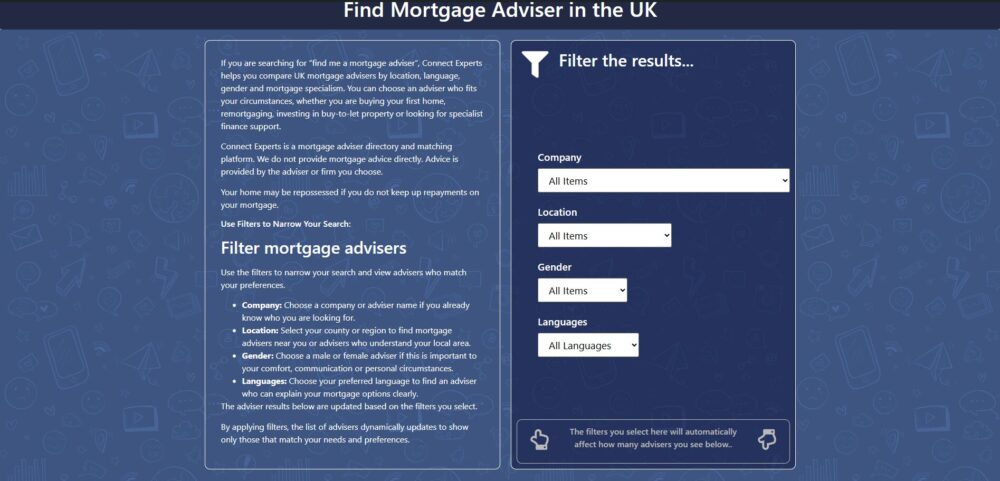
If you want to compare adviser profiles, you can use Connect Experts to find an adverse credit mortgage broker.
Connect Experts is part of the Connect Group. It is a mortgage adviser directory and matching platform.
Mortgage advice is provided by the adviser or firm selected by the customer.
You can also read the Connect Experts adverse credit mortgage guide for wider education before choosing an adviser.
Useful Independent References
For general information about bad credit and mortgages, MoneyHelper provides guidance on how poor credit can affect borrowing.
You can read MoneyHelper’s guide to getting a mortgage with bad credit.
For CCJs, GOV.UK explains how County Court Judgments can affect credit records.
You can read GOV.UK’s guide to CCJs and your credit rating.
Speak With Connect Mortgages
Adverse credit mortgage advice should be clear, practical and honest.
The right route depends on your credit file, income, deposit, property plans and current financial position.
Connect Mortgages can help you determine whether now is the right time to apply.
We can also explain what lenders may look for before you make a full application.
To start the conversation, contact our team through Connect Mortgages contact us.
FAQs: Adverse Credit Mortgages
Can I get a mortgage with adverse credit?
You may be able to get a mortgage with adverse credit. It depends on the type of issue, when it happened, whether it has been settled, your deposit, affordability and recent conduct.
Is adverse credit the same as bad credit?
Adverse credit is often used to describe bad credit, poor credit, impaired credit or credit history that does not fit standard lending criteria.
Do I need a larger deposit?
You may need a larger deposit if the credit issue is recent, serious or unpaid. However, deposit size is only one part of the assessment.
Can I get a mortgage with a CCJ?
Some lenders may consider applicants with a CCJ. They may look at the date, amount, settlement status and reason for the judgment.
Can I remortgage with adverse credit?
You may be able to remortgage with adverse credit. Your options may depend on equity, affordability, current mortgage conduct and the reason for remortgaging.
Will a settled default still matter?
A settled default may still matter, but it may be viewed more positively than an unsettled one. The date, amount and wider case will also matter.
Should I apply directly to a lender?
You can apply directly, but adverse credit cases often need careful lender selection. A broker may help avoid unsuitable applications.
Can I get a buy-to-let mortgage with adverse credit?
It may be possible. Lenders may assess rental income, deposit, credit history, property type and landlord experience.
What should I do before applying?
Check your credit file, reduce unnecessary borrowing, prepare documents and speak with an adviser before choosing a lender.
Does advice guarantee approval?
No. Mortgage approval is never guaranteed. Advice can help you understand your options, prepare your case and avoid unsuitable lender approaches.