
Buying your first home is not only about finding a property.
It is about turning hope into evidence.
A lender does not lend because a buyer feels ready. A lender lends when the deposit, income, credit file, property and documents make sense together. That is why the first mortgage journey should start before the first viewing.
This guide explains the practical mortgage steps first-time buyers should understand before buying their first home.
At a Glance
Buying your first home usually involves checking affordability, saving a deposit, getting a mortgage agreement in principle, finding a property, applying for the mortgage, passing underwriting, receiving a mortgage offer and completing the purchase.
A first-time buyer may be able to buy with a 5% deposit, subject to lender criteria, affordability and credit checks. A larger deposit may improve the number of mortgage options available.
Before you apply, prepare your payslips, bank statements, proof of deposit, ID, address history and credit commitments. If you are self-employed, lenders may also ask for tax calculations, tax year overviews and accounts.
You can read more about a First-Time Buyer Mortgage for a deeper guide before speaking with an adviser.
What Does Buying Your First Home Really Involve?
Buying a first home can feel emotional, but the mortgage process is technical.
A lender will assess whether the mortgage is affordable now and whether it still looks sensible under their checks. They will review income, deposits, outgoings, credit history and the property itself.
The property also matters. Some lenders may be more cautious with flats above commercial premises, unusual construction, short leases, ex-local-authority properties, or new-build homes. This does not always mean a mortgage is impossible. However, it can affect which lenders may consider the case.
The right first step is not always viewing homes. It is understanding your buying power.
Step 1: Check How Much You May Be Able to Borrow
Affordability is not one fixed number.
Different lenders use different affordability models. One lender may treat overtime, bonuses, commissions, childcare, student loans, or credit commitments differently from another lender.
A buyer with the same income and deposit could receive different borrowing figures from different lenders. This is why affordability should be checked before making an offer.
You can use the Residential Affordability Calculator to get an initial idea of borrowing potential.
A proper affordability review may look at:
- Basic salary
- Overtime, bonus or commission
- Self-employed income
- Credit cards and personal loans
- Car finance
- Student loans
- Childcare costs
- Dependants
- Bank statements
- Credit file conduct
- Deposit source
- Mortgage term
The question is not only “How much can I borrow?”
The better question is “How much can I borrow and still live well?”
Step 2: Understand Your Deposit and LTV
LTV means loan-to-value.
It compares the mortgage amount with the property value. For example, if you buy a £250,000 property with a £12,500 deposit, the mortgage would be £237,500. That would be a 95% LTV mortgage.
A 5% deposit may be possible for some first-time buyers. However, it is subject to lender criteria, affordability, credit checks and property type.
A larger deposit may help because it can reduce the lender’s risk. It may also give access to more products, lower rates or lower monthly payments.
Deposit evidence is important. Lenders usually need to see where the deposit came from. This may include savings, a gifted deposit, sale of assets or other acceptable sources.
If the deposit is gifted, the lender may ask for a signed gifted deposit letter. They may also ask for proof of funds from the person giving the gift.
Step 3: Get a Decision in Principle
A decision in principle is often called a DIP or agreement in principle.
It gives an early indication of whether a lender may consider your application. It is not a mortgage offer. It does not guarantee approval.
However, it can help you understand your price range before viewing homes. Estate agents may also ask whether you have one before accepting an offer.
A DIP usually depends on the information provided at that stage. A full application can still be declined if the documents, valuation, credit search or property details create issues later.
That is why accuracy matters from the start.
Step 4: Choose a Property with the Mortgage in Mind
A home is personal. A mortgage is conditional.
Before making an offer, think about how a lender may view the property. A lender may consider the property’s condition, location, construction type, lease length, value and resale potential.
This matters because a buyer can love a property that a lender does not like.
Common property points to check include:
- Lease length, if buying a flat
- Service charges and ground rent
- Property condition
- Construction type
- New-build status
- Nearby commercial use
- Any structural concerns
- Whether the property is habitable
- Whether the valuation may support the agreed price
The right home should work emotionally and financially.
Step 5: Submit the Mortgage Application
Once your offer is accepted, the full mortgage application can be submitted.
This is where the detail becomes important. The lender will review the application, income evidence, bank statements, credit file, deposit evidence and property details.
A well-packaged application can reduce delays. Missing documents can slow the process.
First-time buyers should usually prepare:
- Passport or driving licence
- Proof of address
- Latest payslips
- Latest bank statements
- Proof of deposit
- Credit commitment details
- Gifted deposit letter, if needed
- P60, where useful
- Tax documents, if self-employed
- Solicitor details
- Estate agent details
- Property information
The lender may ask further questions. This is normal. Underwriting is not only a box-ticking exercise. It is the stage where the lender checks whether the case holds together.
Step 6: Understand Underwriting and Valuation
Underwriting is the lender’s review of the mortgage application.
The underwriter checks whether the case meets the lender’s rules. They may ask questions about income, spending, credit conduct, deposit source or property details.
The lender will also arrange a valuation. This is for the lender’s benefit, not a full survey for the buyer.
A valuation helps the lender decide whether the property is suitable security for the mortgage. It may confirm the agreed price, down-value the property or raise concerns.
A buyer may also choose to arrange a more detailed survey. This can help identify issues before exchange of contracts.
Step 7: Receive the Mortgage Offer
A mortgage offer confirms that the lender is willing to lend, subject to the conditions in the offer.
You should read the offer carefully. It will show the loan amount, mortgage term, rate, monthly payment, product period, fees and conditions.
A mortgage offer is a major step, but the purchase is not complete yet.
Your solicitor still needs to complete legal checks. These may include searches, title checks, enquiries, contract review and completion arrangements.
Step 8: Budget for Costs Beyond the Deposit
The deposit is only one cost.
First-time buyers should also consider legal fees, valuation costs, survey costs, moving costs, mortgage fees, and insurance.
Stamp Duty may also need checking. For the September 2022 period, first-time buyer Stamp Duty Land Tax relief in England and Northern Ireland applied differently depending on the purchase price. You can review the Stamp Duty Land Tax rules for first-time buyers or use the Stamp Duty Calculator for an estimate.
Insurance should also be considered before completion. Buildings insurance is often required by the lender from exchange of contracts for freehold purchases. Life cover, critical illness cover and income protection may also be discussed, depending on your needs.
A mortgage protects the lender’s interest in the property. Protection can help protect the household behind the mortgage.
Should First-Time Buyers Use a Mortgage Broker?
A mortgage broker can help first-time buyers understand lender criteria, compare suitable products and prepare the application.
This can be useful where the case is not simple. For example, the buyer may be self-employed, using a gifted deposit, buying a new-build home, earning variable income, or dealing with credit issues.
A broker can also explain the differences among rate, fees, term, LTV, monthly payment, and lender criteria.
The lowest rate is not always the best route if the lender is unlikely to accept the case.
Good mortgage advice should help the buyer make a clear decision, not just a quick one.
When Should You Speak to an Adviser?
It is sensible to speak with an adviser before you start viewing properties.
This can help you understand:
- Your likely borrowing range
- Your deposit position
- Whether your credit file needs work
- Which documents you may need
- Whether your income is likely to fit lender rules
- Whether your property plans may limit lender choice
- What monthly payments may look like
- What costs to prepare for
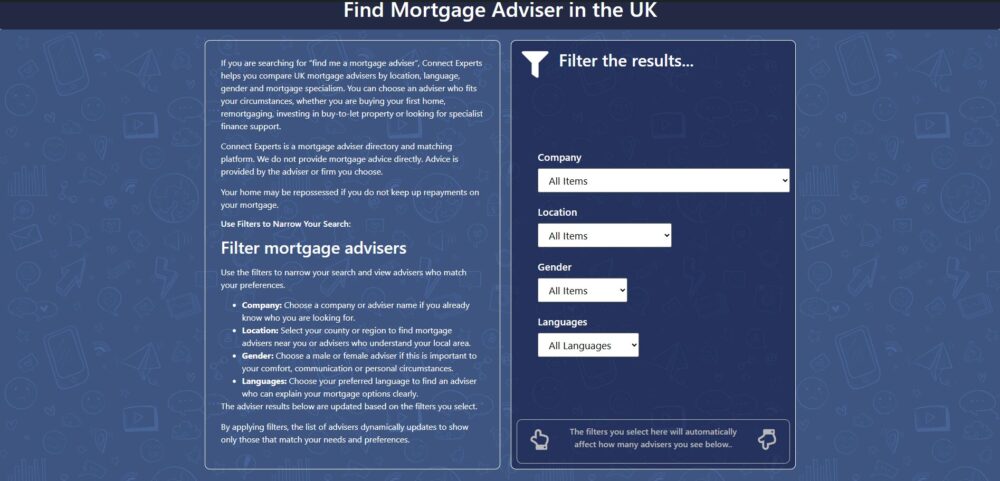
If you would prefer to search by location, language or adviser preference, you can find a first-time buyer mortgage adviser through Connect Experts.
First-Time Buyer Mortgage FAQs
Can I buy my first home with a 5% deposit?
Some first-time buyers may be able to buy with a 5% deposit. This usually means a 95% LTV mortgage. Approval depends on lender criteria, affordability, credit history and the property being purchased.
What is the first step when buying your first home?
The first step is to check affordability and deposit position. This helps you understand your budget before you start viewing properties or making offers.
Is a decision in principle the same as a mortgage offer?
No. A decision in principle is an early indication. A mortgage offer is issued after a full application, underwriting and valuation.
What documents do first-time buyers need?
Most lenders ask for ID, proof of address, payslips, bank statements and proof of deposit. Self-employed buyers may need tax calculations, tax year overviews and accounts.
Can a mortgage be declined after a decision in principle?
Yes. A lender can still decline the full application if the documents, credit search, valuation or property details do not meet its criteria.
Do first-time buyers need protection?
Protection is not the same as a mortgage. However, buyers should consider how the mortgage would be paid if illness, injury, death or loss of income affected the household.