

Finding Self-Employed Mortgage Lenders in 2023: A self-employed mortgage is not a separate product. It is a mortgage application where the borrower’s income is assessed differently.
That distinction matters.
In 2023, borrowers were facing higher interest rates, tighter affordability checks and more careful lender reviews. For self-employed applicants, the question was not simply “which lender is best?” It was “which lender understands the way my income is earned, recorded and evidenced?”
That is where the search begins.
At a Glance
Self-employed borrowers can apply for the same broad types of mortgages as employed borrowers. The difference is how lenders assess income.
A lender may review SA302 tax calculations, Tax Year Overviews, business accounts, bank statements, retained profits, dividends, contracts or accountant information. The right route depends on how you trade.
If you are a sole trader, lender assessment may focus on net profit. If you are a limited company director, some lenders may look at salary and dividends, while others may consider company profit. If you are a contractor, lenders may assess contract value, track record and future income stability.
The right lender is not always the lender with the lowest headline rate. It is the lender whose criteria match your income, deposit, credit profile, property type and future plans.
Why the 2023 Market Made Lender Choice More Important
The 2023 mortgage market was shaped by higher borrowing costs. In August 2023, the Bank of England increased Bank Rate to 5.25%, which affected the wider mortgage environment and affordability calculations.
For self-employed borrowers, this made preparation more important. A lender may accept the business model, but the application still has to pass affordability, credit and evidence checks.
A good mortgage application is built before it is submitted. It is not only about finding a willing lender. It is about presenting income in a way that fits the lender’s rules.
That is why self-employed borrowers should avoid treating every lender as the same. Lenders may take different views on:
- How long you have been trading
- How stable your income appears
- Whether your latest year is higher or lower than previous years
- How much income has been retained in the business
- How much debt or regular commitment you hold
- Whether your accounts are up to date
- Whether your deposit source is clear
This is where technical mortgage advice can help.
What Lenders May Check for Self-Employed Borrowers
Lenders need to understand whether the mortgage is affordable now and likely to remain affordable.
For a self-employed applicant, this may include a review of personal income, business income and spending patterns. The evidence may differ depending on the borrower’s structure.
A sole trader may be assessed on declared net profit. A partner may be assessed on their share of partnership profit. A limited company director may be assessed on salary, dividends or, with some lenders, company profit. A contractor may be assessed on day rate, contract history or annualised earnings.
No single method applies across the whole market.
This is why a borrower with strong income can still receive different outcomes from different lenders. The issue may not be affordability in principle. It may be the lender’s method of reading the income.
For more details on this route, see our guide to Self-Employed Mortgage.
Documents Self-Employed Mortgage Lenders May Request
The documents are not just admin. They tell the story of the income.
A lender may request:
- SA302 tax calculations
- Tax Year Overviews
- Full business accounts
- Business bank statements
- Personal bank statements
- Proof of deposit
- ID and address evidence
- Accountant details or accountant certificate
- Current and previous contracts
- Evidence of ongoing work or retained clients
HMRC allows applicants to print an SA302 tax calculation and Tax Year Overview when they need proof of earnings for a mortgage. These documents help lenders compare declared income with the borrower’s tax position.
The key point is consistency. Figures should be clear, current and explainable. If the latest income has fallen, the lender may ask why. If income has increased sharply, the lender may check whether that level is sustainable.
Why the Lowest Rate is Not Always The Right Starting Point
It is natural to look at the interest rate first. Yet for self-employed borrowers, the cheapest headline rate may not be the most useful route.
A lender with a low rate may have strict income rules. Another lender may price slightly higher but take a more practical view of company directors, contractors, retained profits or one year’s accounts.
A mortgage is not only a price. It is a set of rules.
Borrowers should compare:
- The interest rate
- The product fee
- Valuation and legal costs
- Early repayment charges
- Overpayment rules
- Income assessment method
- Maximum loan-to-value
- Credit scoring approach
- Property type restrictions
- Processing times
For wider context on standard residential mortgage routes, see Residential Mortgages.
How Affordability Affects Self-Employed Mortgage Applications
Affordability is central to mortgage lending. Lenders assess income against regular commitments, household costs, credit agreements, dependants and future mortgage payments.
For self-employed borrowers, this can feel more complex because income may not arrive in equal monthly amounts. A business may have a strong annual profit but uneven cash flow. A director may retain profit for tax planning or business resilience. A contractor may earn more in active months and less between contracts.
That does not mean the case is weak. It means the application needs to be matched to a lender that understands the income pattern.
Before applying, borrowers should review their likely borrowing range. A useful starting point is the Residential Affordability Calculator.
Deposit, LTV and Lender Confidence
Deposit size still matters.
A larger deposit reduces the loan-to-value ratio. This can improve lender confidence and may widen the number of available products. In a higher-rate market, a lower LTV may also help affordability because the borrower needs a smaller loan.
For example, a borrower buying a £300,000 home with a £30,000 deposit is applying at 90% LTV. With a £60,000 deposit, the application moves to 80% LTV. The income still matters, but the risk profile may look different.
For self-employed borrowers, deposit strength can be useful when income is complex. It does not replace affordability, but it can support the overall case.
When Remortgaging as a Self-Employed Borrower
Self-employed borrowers may also need to choose a lender when remortgaging.
A borrower may have become self-employed after taking out their current mortgage. Another may have changed from a sole trader to a limited company. Others may have a stronger business than before, but a lower declared personal income due to retained profits.
These changes can affect lender choice.
If your current deal is ending, it is sensible to review documents early. Waiting until the final month can reduce choice, especially if accounts or tax records need updating.
For more information, visit our Remortgage page.
Why Can Advice Improve the Search
The best self-employed mortgage lender is not a universal answer. It depends on the borrower.
This is where a mortgage adviser can add value. An adviser can review how income is earned, how it is recorded and which lenders may be more suitable before an application is submitted.
This matters because failed applications can waste time and may affect confidence. A careful route helps reduce guesswork.
Connect Mortgages is a credit broker, not a lender. We assess your circumstances and search for lenders and products that may fit your needs. A fee may be payable for arranging your mortgage, and your adviser will confirm this before you proceed.
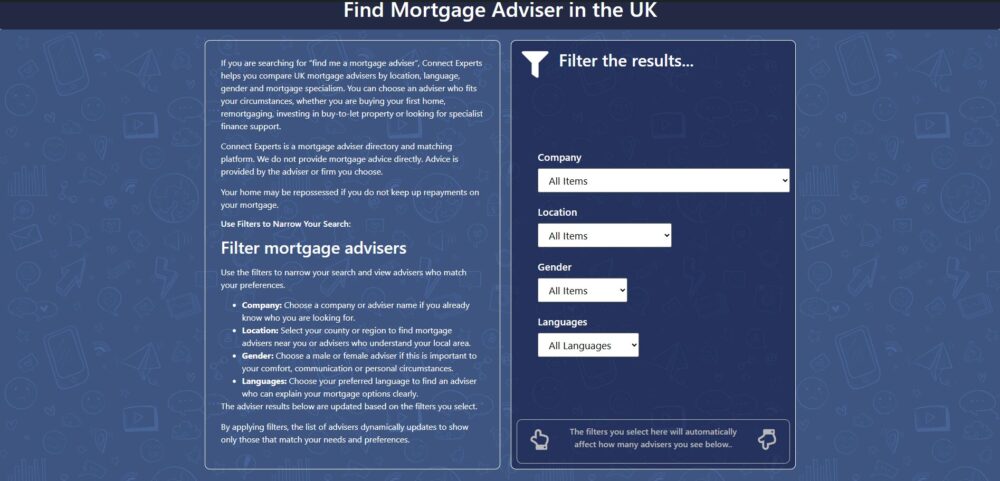
You can also use Find a Mortgage Adviser to search for advisers by location, mortgage type, language, gender or adviser name.
Practical Checklist Before Applying
Before approaching self-employed mortgage lenders, prepare the case properly.
- Check your latest accounts are complete
- Download your SA302 tax calculations
- Download your Tax Year Overviews
- Review your personal and business bank statements
- Reduce avoidable credit commitments where possible
- Check your credit file for errors
- Keep deposit evidence clear
- Prepare explanations for income changes
- Speak to an adviser before submitting an application
A lender wants clarity. The clearer the application, the easier it is to assess.
FAQs: Self-employed mortgage lenders
Are there specific self-employed mortgage lenders?
There is no separate category called a self-employed mortgage lender. Many lenders consider self-employed applicants, but their criteria differ.
Can I get a mortgage with one year’s accounts?
Some lenders may consider one year’s accounts, but choice may be more limited. The strength of the overall case matters.
Do lenders use gross income or net profit?
It depends on your trading structure. Sole traders are often assessed on net profit. Company directors may be assessed using salary and dividends, or in some cases company profit.
Will lenders accept retained profits?
Some lenders may consider retained profits for limited company directors. Others may not. This is one reason lender selection is important.
Do self-employed borrowers pay higher mortgage rates?
Not automatically. The rate depends on the product, deposit, credit profile, affordability, property type and lender criteria.
Should I use a mortgage adviser?
Self-employed income can be assessed in different ways. An adviser can help match the case to lenders that may understand the income structure.