
First-Time Buyer Buy-to-Let Mortgages: Buying your first property as a rental investment is possible, but it is not assessed like a standard home purchase.
A first-time buyer buy-to-let mortgage is for someone who does not currently own a property and wants to buy a property to rent out. This can be more complex than a normal buy-to-let case because some lenders prefer applicants who already own their own home or have landlord experience.
The question is not only whether you can get a mortgage.
The better question is whether the rent, deposit, property, credit profile and long-term plan make the mortgage sustainable.
At a Glance
A first-time buyer may be able to obtain a buy-to-let mortgage, but lenders are usually more limited.
Lenders may look closely at your deposit, income, credit history, expected rental income, property type and lack of landlord experience. Some lenders will accept first-time buyers. Others will not. The mortgage is usually assessed mainly on rental income, using lender stress tests. Your personal income and financial position may still matter.
You should also consider stamp duty, tax, insurance, letting costs, legal duties and the risk of void periods before applying.
If you are new to property investment, it is sensible to understand how buy-to-let mortgages work before choosing a lender.
What Is a First-Time Buyer Buy-to-Let Mortgage?
A first-time buyer buy-to-let mortgage is a mortgage used to buy a property that you intend to rent to tenants, even though you have not owned a property before.
This is different from a residential mortgage.
With a residential mortgage, the lender assesses whether you can afford to live in the property. With a buy-to-let mortgage, the lender usually assesses whether the property can produce enough rent to support the loan.
That difference matters.
A home is assessed around personal affordability. A rental property is assessed around income, risk and future demand.
Can a First-Time Buyer Get a Buy-to-Let Mortgage?
Yes, some first-time buyers can get buy-to-let mortgages.
However, not every lender accepts this type of application. Some lenders want applicants to already own a residential property. Others may accept first-time buyers if the wider case is strong.
A lender may review:
- Your deposit
- Your personal income
- Your credit history
- The expected monthly rent
- The property value
- The property type
- Your age and mortgage term
- Your employment or self-employment position
- Your landlord experience
- Whether you are buying personally or through a limited company
This is why first-time buyer buy-to-let is a criteria-led product. The cheapest rate is not useful if the lender is unlikely to accept the case.
For a more detailed explanation of the first rental property journey, read our guide to mortgage advice for first-time landlords.
Why Lenders Treat First-Time Buyers Differently
A first-time buyer has not yet proved they can own and manage a mortgaged property.
That does not mean the application cannot work. It means the lender may ask more questions.
Lenders may want to know whether you understand the responsibility of owning a rental property. They may also want the comfort that you can manage costs if the property is empty, repairs are needed, or rent is lower than expected.
A buy-to-let property is not just an asset. It is also a responsibility.
The rent may look strong on paper, but the lender still has to consider what happens if the numbers change.
Deposit Requirements
Buy-to-let mortgages often need a larger deposit than residential mortgages.
The exact deposit depends on the lender, property type, loan-to-value, rental income and your wider profile. A higher deposit may improve lender choice by reducing risk and helping the rent cover the mortgage more comfortably.
First-time buyers should avoid using every available pound for the deposit.
A landlord also needs money for legal fees, valuation fees, stamp duty, insurance, safety checks, maintenance and periods without tenants.
A deposit gets you into the transaction. Reserves help you stay in control after completion.
Rental Income and Stress Testing
Buy-to-let lenders usually assess whether the expected rent can support the mortgage payment.
This is often called rental stress testing.
The lender may test the rent against a notional interest rate, not just the actual rate you apply for. They may also require the rent to exceed the stressed mortgage payment by a set percentage.
The calculation can vary between lenders.
It may depend on:
- The mortgage amount
- The expected rent
- The product rate
- The stressed interest rate
- Whether the mortgage is fixed or variable
- Whether you are a basic-rate or higher-rate taxpayer
- Whether the property is owned personally or through a company
This is one of the main reasons first-time buyers should check affordability before making an offer.
You can use the Buy-to-Let Affordability Calculator as an early guide, but it does not replace mortgage advice.
Personal Income and Credit Profile
Although buy-to-let lending is heavily based on rental income, your personal position still matters.
Some lenders set minimum income requirements. Others may use personal income to support the application or assess whether you can manage rental shortfalls.
Your credit profile is also important.
Missed payments, high unsecured debt, or recent credit issues may reduce lenders’ willingness to lend. This can be more sensitive for first-time buyers because the lender has less property ownership history to review.
Before applying, it helps to check:
- Your credit report
- Your deposit source
- Your monthly commitments
- Your proof of income
- Your bank statements
- Your expected rental figures
- Your available cash after completion
A strong application is not built on optimism. It is built on evidence.
Stamp Duty and First-Time Buyer Relief
First-time buyer relief is usually linked to buying a property that you intend to live in as your only or main residence.
If you are buying a property as a buy-to-let, you should not assume that first-time buyer relief will apply.
Stamp duty rules can be different across England, Northern Ireland, Scotland and Wales. You should check the applicable rules for the property’s location and seek tax advice as needed.
HMRC guidance explains that first-time buyer relief depends on the buyer intending to occupy the dwelling as their only or main residence: HMRC first-time buyer SDLT relief.
Personal Name or Limited Company?
Some first-time buyers consider buying a rental property through a limited company.
This may be suitable for some landlords, but it is not the right route for everyone. A company structure can affect tax, lender choice, legal work, administration, accountancy costs and future borrowing.
A lender may also assess limited company buy-to-let applications differently.
Before choosing a structure, speak to a qualified tax adviser or accountant. A mortgage adviser can then explain how lenders view the chosen route.
The ownership structure should follow the plan, not the other way round.
Property Type and Rental Demand
Not every rental property is treated the same by lenders.
A standard house or flat let to one household may be simpler than a house in multiple occupation, a multi-unit block, a holiday let, an ex-local authority flat, a new-build flat or an unusual property.
Lenders may assess:
- The lease length
- Property condition
- Construction type
- Local rental demand
- Expected rent
- Tenancy type
- Valuation comments
- Whether licences are needed
- Whether the property is suitable security
For first-time buyers, a simpler property may offer a clearer route. More complex properties can still be possible, but lender criteria may be stricter.
Landlord Costs to Plan For
The mortgage payment is only one cost.
A first-time landlord should also plan for:
- Stamp duty
- Legal fees
- Valuation fees
- Product fees
- Broker fees, where applicable
- Letting agent fees
- Buildings insurance
- Landlord insurance
- Safety checks
- Repairs and maintenance
- Service charges, where relevant
- Ground rent, where relevant
- Licensing costs, where relevant
- Void periods
- Tax on rental income
Rental property can create income, but it also creates duties.
You may want to review landlord insurance before tenants move in.
Regulation and Buy-to-Let Mortgages
Most buy-to-let mortgages are treated as business borrowing and may not be regulated in the same way as residential mortgages.
Some buy-to-let cases may be classed differently, such as consumer buy-to-let, depending on the circumstances.
Your adviser should explain whether the mortgage is regulated, how the recommendation works and what protections apply.
The Bank of England’s Prudential Regulation Authority sets expectations for buy-to-let underwriting standards, including affordability assessments and interest coverage testing.
Documents You May Need
A lender may ask for several documents before assessing the case.
These may include:
- Proof of identity
- Proof of address
- Proof of deposit
- Bank statements
- Payslips or accounts
- SA302s or tax calculations, where relevant
- Details of existing credit commitments
- Property details
- Rental valuation
- Tenancy expectations
- Company documents, if buying through a company
Documents matter because buy-to-let applications often fail when the numbers are unclear.
A clean file helps the lender understand the risk.
Common Mistakes First-Time Buyers Make
First-time buyers often focus on the property before the lending criteria.
That can create problems later.
Common mistakes include:
- Assuming all buy-to-let lenders accept first-time buyers
- Using residential mortgage logic for a rental property
- Underestimating deposit and stamp duty costs
- Ignoring rental stress testing
- Forgetting void periods and repair costs
- Choosing a property before checking lender appetite
- Assuming a limited company is always better
- Applying to a lender before the case has been checked
A good buy-to-let decision starts before the offer is made.
When a First-Time Buyer Buy-to-Let May Work
This route may be more realistic when the applicant has a suitable deposit, a clean credit profile, a stable income, a realistic rent, and a property that meets the lender’s criteria.
It may also help if the borrower understands landlord duties and has cash reserves after completion.
A first-time buyer buy-to-let mortgage is not just about access to finance. It is about proving that the investment can withstand lender checks.
When It May Be Difficult
The application may be harder if the deposit is small, the rent is weak, the property is unusual or the applicant has recent credit issues.
It may also be harder if the borrower has no clear reason for buying a rental property before buying their own home.
Some lenders may question the plan if it appears that the borrower intends to live in the property. A buy-to-let mortgage must match the intended use.
If you plan to live in the property, you should discuss residential mortgage options instead.
How a Mortgage Adviser Can Help
A mortgage adviser can help you understand which lenders may consider first-time buyer buy-to-let applications.
They can review:
- Whether your deposit is likely to be enough
- Whether the rent supports the loan
- Which lenders accept first-time buyers
- Whether personal income is needed
- Whether the property type creates issues
- Whether a personal or company route may be considered
- What documents are needed
- What risks should be reviewed before application
This helps reduce the chance of applying to an unsuitable lender.
You can also compare first-time landlord mortgage brokers through Connect Experts if you want to search by adviser specialism, location or preference.
How Connect Mortgages Can Help
Connect Mortgages helps clients understand buy-to-let options before they apply.
Our advisers can review your circumstances, explain lender criteria and help you assess whether a first-time buyer buy-to-let mortgage may be realistic.
The aim is not to rush the application.
The aim is to understand the numbers, the property and the responsibility before you commit.
If you are ready to discuss your plans, you can contact Connect Mortgages and speak with an adviser.
Find a Buy-to-Let Mortgage Adviser
Some clients prefer to search for an adviser directly.
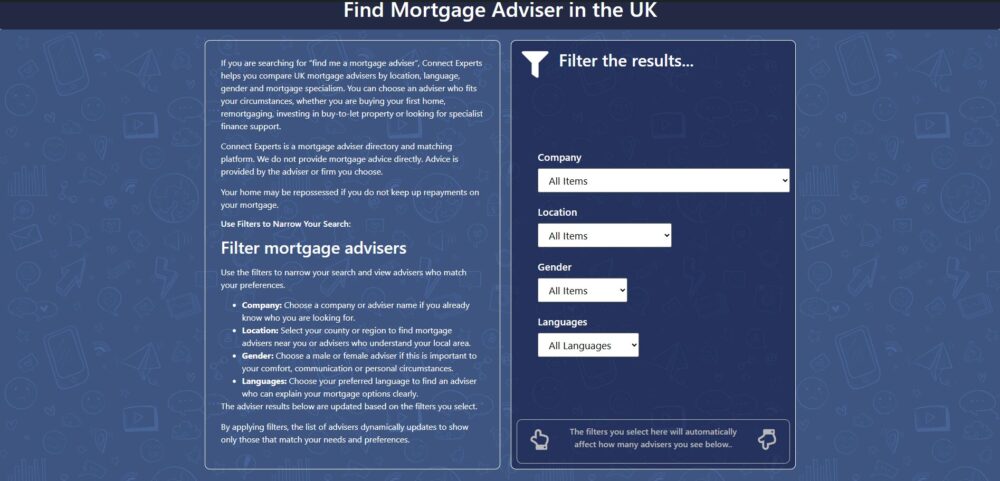
Connect Experts helps users find mortgage advisers by location, language, gender and area of expertise. This may be useful if you want support from someone who regularly works with landlords on finance.
You can start by consulting buy-to-let mortgage advisers and choose one based on your needs.
FAQ: First-Time Buyer Buy-to-Let Mortgages
Can a first-time buyer get a buy-to-let mortgage?
Yes, some lenders consider first-time buyers for buy-to-let mortgages. Your options may depend on deposit, rent, income, credit history, property type and lender criteria.
Is a first-time buyer buy-to-let mortgage the same as a first-time buyer residential mortgage?
No. A residential mortgage is for a property you intend to live in. A buy-to-let mortgage is for a property you intend to rent to tenants.
Do I need landlord experience?
Not always. Some lenders accept applicants with no landlord experience. Others prefer experienced landlords or existing homeowners.
How is affordability assessed?
Buy-to-let affordability is usually assessed using expected rental income. The lender may apply a stress test to check whether rent can support the mortgage.
Will first-time buyer stamp duty relief apply?
Usually not if the property is bought as a rental investment. First-time buyer relief is generally linked to buying a home you intend to occupy as your only or main residence.
Can I live in the property later?
You should not live in a property with a standard buy-to-let mortgage unless the lender has agreed to a suitable change. Speak with an adviser before changing the property use.
Can I buy through a limited company?
Some first-time landlords buy through a limited company, but this is not suitable for everyone. Tax, legal, lender and administration points should be reviewed first.
Is buy-to-let mortgage advice regulated?
Some buy-to-let mortgages are not regulated in the same way as residential mortgages. Your adviser should explain the position before you proceed.
What is the biggest risk for first-time buyer landlords?
The biggest risk is treating the purchase like a normal home loan. Buy-to-let lending is based on rent, criteria, costs and risk, not only personal affordability.
Should I speak to a broker before making an offer?
Yes. Speaking to a broker early can help you understand lender appetite, deposit needs, rental stress testing and whether the property is likely to fit buy-to-let criteria.
Important Information
Your property may be repossessed if you do not keep up repayments on your mortgage.
Not all buy-to-let mortgages are regulated by the Financial Conduct Authority. Your adviser will explain how this applies to your circumstances.
Tax treatment depends on your individual circumstances and may change. You should seek tax advice before choosing how to buy or hold a rental property.
A fee may be payable for arranging your mortgage. Your adviser will explain any fees before you decide whether to proceed.