
First Time Buyer Mortgage
Buying your first home starts with one clear question. Can you get a mortgage that fits your income, deposit, credit history and monthly budget? A first-time buyer mortgage helps you buy your first residential property. However, the right mortgage is not only about the lowest rate. Lenders also look at your income, deposit, debts, credit record, employment type and the property you want to buy. At Connect Mortgages, we help first-time buyers understand their options before they apply. This can make the process clearer, calmer and more practical from the start.

First-Time Buyer Mortgage: Quick Answer
A first-time buyer mortgage is a residential mortgage for someone buying their first home.
You may be able to buy with a deposit from 5%, subject to lender criteria, affordability and credit checks. Some buyers may need a larger deposit, especially if income, credit history or property type makes the case more complex.
Before you apply, it helps to check:
- How much deposit you have
- How much you may be able to borrow
- What your monthly payments could look like
- Which costs you need to budget for
- Whether your credit file is ready
- What documents a lender may ask for
You can start with our Residential Affordability Calculator or speak with a Connect Mortgages adviser.
What is a First-Time Buyer?
A first-time buyer is usually someone who has never owned a residential property before.
This normally includes property owned in the UK or abroad. It can also include property owned jointly with someone else.
Your first-time buyer status matters because it may affect:
- Stamp Duty relief
- Lender criteria
- Government support options
- Deposit planning
- Mortgage product eligibility
If you are buying with another person, both buyers may need to meet the first-time buyer rules for certain reliefs.
You can also estimate possible property tax costs with our Stamp Duty Calculator.
How Does a First-Time Buyer Mortgage Work?
A first-time buyer mortgage works like a standard residential mortgage.
You borrow money from a lender to buy your home. You then repay the mortgage over an agreed term. This is often between 25 and 40 years, depending on your age, income, lender and plans.
Most first-time buyers choose a repayment mortgage. This means each monthly payment covers interest and part of the loan balance.
Your adviser can explain the main mortgage types, including:
- Fixed-rate mortgages
- Tracker mortgages
- Variable-rate mortgages
- Repayment mortgages
- Interest-only options, where suitable
Many first-time buyers prefer fixed rates because the monthly payment stays the same for the fixed period. This can help with budgeting when you are new to homeownership.
You can learn more about residential borrowing on our Residential Mortgage page.
How Much Deposit Does a First-Time Buyer Need?
Many first-time buyers start with a 5% deposit.
For example, a £250,000 property with a 5% deposit would need £12,500 upfront. The mortgage would cover the remaining amount, subject to lender approval.
However, a bigger deposit can sometimes help. It may give you access to more lenders, better rates or lower monthly payments.
A lender may ask for a higher deposit if:
- Your credit history has recent issues
- Your income is complex
- You are buying a non-standard property
- Your affordability is tight
- You need a specialist mortgage product
Deposit rules can vary between lenders. This is why advice can be useful before you start viewing properties.
Can First-Time Buyers Get a Mortgage With a Small Deposit?
Yes, some first-time buyers may be able to get a mortgage with a small deposit.
Some lenders offer 95% loan-to-value mortgages, which means you may only need a 5% deposit. Eligibility will still depend on your income, credit record, debts, property type and lender criteria.
There may also be family-assisted options, such as:
- Gifted deposits
- Family support arrangements
- Guarantor-style options
- Joint Borrower Sole Proprietor mortgages
A gifted deposit must usually be declared to the lender. The person giving the gift may also need to confirm that the money does not need to be repaid.
How Much Can First-Time Buyers Borrow?
The amount you can borrow depends on affordability.
Lenders usually review your income, regular spending, credit commitments and future financial commitments. They may also test whether the mortgage remains affordable if rates change.
They may look at:
- Basic salary
- Overtime, bonuses or commission
- Self-employed income
- Childcare costs
- Credit cards and loans
- Student loans
- Car finance
- Dependants
- Bank statements
- Credit history
Some first-time buyers may be able to borrow more with one lender than another. This is because each lender uses different affordability rules.
Use our Residential Affordability Calculator to get an initial estimate.
First-Time Buyer Mortgage if You Are Self-Employed
Self-employed first-time buyers can get a mortgage.
However, lenders may ask for different evidence compared with employed applicants. This may include accounts, tax calculations, tax year overviews and business bank statements.
Your options may depend on:
- How long you have traded
- Your latest year’s income
- Your average income
- Your business structure
- Whether income is rising or falling
- How your accounts are presented
If you are buying your first home while self-employed, visit our Self-Employed Mortgage page.
Mortgage Advice..
Thinking of getting a mortgage? Our experienced team of skilled mortgage advisers are here to offer the essential guidance you require. Relying on our comprehensive understanding of the mortgage market, we’ll ensure you secure the perfect mortgage to suit your specific situation.
First-Time Buyer Mortgage With Bad Credit
A poor credit history does not always stop you getting a first-time buyer mortgage.
However, it can affect the lenders available, the deposit needed and the rate you may be offered.
Lenders may review:
- Missed payments
- Defaults
- County Court Judgments
- Debt management plans
- Individual voluntary arrangements
- Bankruptcy history
- Payday loan use
- The age and size of the issue
Older issues may have less impact than recent missed payments. However, every lender has different rules.
If your credit history is not perfect, avoid guessing. A declined application can make the next step harder. Speak with an adviser before applying.
You can also read our Adverse Credit Mortgage guide.
What Costs Should First-Time Buyers Budget For?
Your deposit is only one part of buying your first home.
You may also need to budget for:
- Solicitor or conveyancing fees
- Search fees
- Valuation fees
- Mortgage arrangement fees
- Survey costs
- Stamp Duty, where payable
- Buildings insurance
- Contents insurance
- Moving costs
- Furniture and basic repairs
- Service charges, if buying a leasehold property
Some costs are paid before completion. Others may be paid when the mortgage starts. A clear budget can help you avoid using all your savings on the deposit.
Use our Mortgage Calculators to plan your early figures.
Do First-Time Buyers Pay Stamp Duty?
Some first-time buyers may pay no Stamp Duty.
Others may pay Stamp Duty depending on the property price, location and current rules. England, Scotland, Wales and Northern Ireland use different property tax systems.
If you are buying in England or Northern Ireland, first-time buyer relief may apply if you meet the criteria. If you are buying in Scotland or Wales, different rules apply.
Always check the current position before making an offer.
You can estimate your possible cost with our Stamp Duty Calculator.
What Documents Do First-Time Buyers Need?
Before applying, it helps to prepare your documents.
Lenders may ask for:
- Proof of ID
- Proof of address
- Payslips
- Bank statements
- Proof of deposit
- Credit commitment details
- Tax documents, if self-employed
- Gifted deposit letter, where relevant
- Details of the property being purchased
Getting these ready early can reduce delays. Your adviser can tell you what is needed before a full mortgage application is submitted.
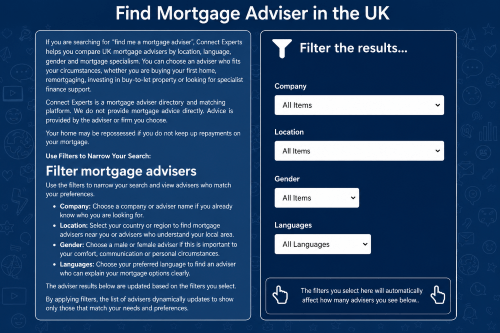
Want to Choose a First-Time Buyer Mortgage Adviser?
Some buyers want to compare advisers before making contact.
If you would prefer to search by location, language or adviser preference, you can use Connect Experts.
Connect Experts is part of the Connect Group. It is a mortgage adviser directory and matching platform. Advice is provided by the adviser or firm you choose.
You can search for first-time buyer mortgage advisers or use the wider mortgage adviser directory.
FAQs: First Time Buyer Mortgage
Most frequent questions and answers about first time buyer mortgage
To be eligible for a first time buyer mortgage, you must generally not have ever owned property before. Some lenders may class you as a first-time buyer if you have not owned a property for many years.
Your mortgage affordability depends on your income, credit score, and other financial factors. A good starting point is to calculate how much you can afford monthly for a mortgage payment by subtracting your expenses from your income. Speak with a mortgage advisor to find out what type of loan you qualify for and get an estimate of how much you can borrow.
To get a mortgage as a first-time buyer, research different mortgage options. Additionally, compare various lenders.Furthermore, get pre-approved to streamline the process. Also, working with a mortgage advisor is essential.They can help you find suitable terms for your needs.
Yes, a first-time buyer can get an interest-only mortgage. However, they will need to meet certain criteria to qualify for one. A longer-term repayment mortgage may be more suitable.
First-time buyers can access a range of mortgage products, such as fixed rate, variable rate, tracker, and offset mortgages. There are also special schemes that can help first-time buyers get on the property ladder. Each option has its advantages and disadvantages, so it is essential to research the different types of mortgages before deciding.
Yes, first-time buyers can obtain a self-build mortgage to finance the construction of their own home. Some lenders have specific products designed for this purpose and may offer incentives such as cashback or discounts on legal fees. There is also a Government scheme called ‘help to build.
What next?
We will come back to you quickly to let you know how we can help. If you would like to speak to us immediately, call us on 01708 676 111.
Looking for our intermediaries site?
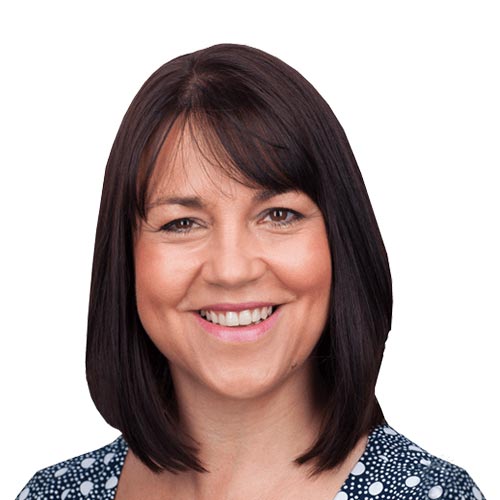
Liz Syms is the CEO and Founder of Connect Mortgages and Connect for Intermediaries, a leading firm specialising in property investment finance. With more than 25 years of experience in the mortgage and financial services industry, Liz has helped thousands of clients secure both residential homes and investment properties.
Renowned for her expertise and commitment to excellence, Liz is passionate about delivering tailored, high-quality advice on mortgages and protection. Her leadership has positioned her as a trusted figure in the sector, and under her guidance, Connect Mortgages has expanded to a national team of over 300 advisers.
Driven by a vision to make Connect Mortgages one of the UK’s most successful mortgage networks, Liz continues to champion professional standards and client-focused solutions across the industry.
About the Author
Liz Syms is the CEO and Founder of Connect Mortgages, a specialist in finance for property investment. With over 25 years of experience in mortgages and financial services, Liz has helped countless people get their dream homes and investment properties. She is passionate about giving her clients the best advice possible when it comes to financial decisions relating to mortgages and protection and is dedicated to providing the highest quality of service. With her wealth of knowledge in the industry, Liz is a respected leader in mortgages and financial services and has grown her team to over 300 advisers nationally. She strives to make Connect Mortgages one of the most successful companies in its field.