
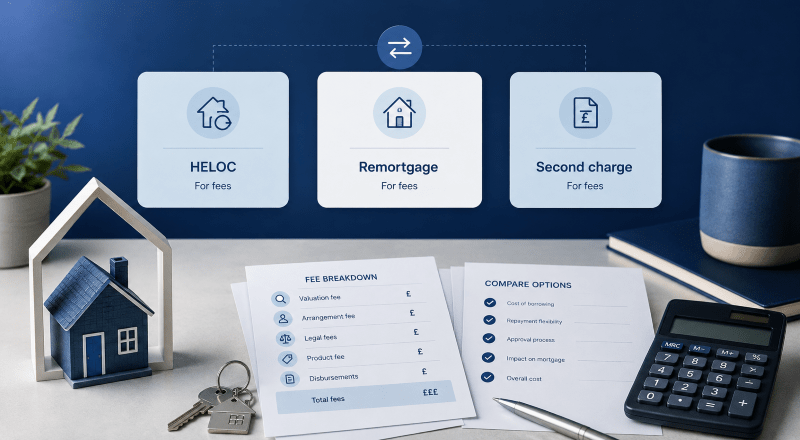
HELOC vs Remortgage vs Second Charge for Fees: There is no single product called a school fees mortgage.
Homeowners may encounter several borrowing options, including a HELOC, a remortgage, or a further advance or second-charge mortgage. Each raises money differently and affects the household’s financial position in different ways.
The correct comparison begins with four practical questions:
- How much money is required?
- When will it be needed?
- What will the borrowing cost?
- How will it be repaid?
The existing mortgage must also be considered. Its interest rate, remaining term and early repayment charge can determine whether replacing it would be sensible.
How Does a HELOC Work?
A Home Equity Line of Credit may provide an agreed limit secured against the property.
Instead of receiving all the money at completion, the borrower may draw funds in stages, subject to the product rules.
This could correspond with termly or annual school invoices.
Potential benefits include:
- Staged access to funds.
- Interest normally charged on the drawn balance.
- The possibility of repaying and redrawing money.
- Avoiding a large release before the funds are needed.
Important considerations include:
- Variable interest rates.
- Arrangement and account fees.
- Drawdown restrictions.
- The length of the availability period.
- Whether repaid funds can be accessed again.
- The risk of allowing the balance to grow.
The defining feature is flexibility. That flexibility is valuable only when supported by disciplined use and a credible repayment plan.
How Does a Remortgage Work?
A remortgage replaces the existing mortgage with a new mortgage.
The new loan may include additional borrowing for eligible purposes, such as education costs, where accepted by the lender.
A remortgage could provide:
- One overall mortgage arrangement.
- A potentially competitive rate on the additional borrowing.
- A longer repayment term.
- Access to a wider lender market.
However, the new rate normally applies to both the existing mortgage balance and the additional borrowing.
This can be expensive if the homeowner already has a competitive fixed rate. An early repayment charge may also apply.
Other costs can include:
- Product fees.
- Adviser fees.
- Valuation charges.
- Legal costs.
- Exit or administration charges.
- Early repayment charges on the current mortgage.
A remortgage may deserve closer consideration when the current mortgage deal is already ending.
Read the remortgage guide for more information about replacing an existing mortgage.
How Does a Further Advance Work?
A further advance is additional borrowing from the existing mortgage lender.
The original mortgage usually remains in place, while the extra borrowing may be established as a separate part of the mortgage account.
Potential advantages include:
- Preserving the existing mortgage product.
- Dealing with a lender that already knows the property.
- Potentially simpler administration.
- Avoiding a complete remortgage.
Potential disadvantages include:
- Access to only one lender’s products.
- Different rates for separate parts of the mortgage.
- Different product end dates.
- Limited flexibility over future drawings.
- The need to meet the existing lender’s current criteria.
A further advance commonly releases a lump sum rather than creating a reusable credit facility.
How Does a Second Charge Mortgage Work?
A second charge mortgage is a separate loan secured against a property that already has a first mortgage.
The first mortgage normally remains in place. The second charge lender takes an additional legal charge behind it.
This structure may be useful when replacing the first mortgage would disturb a competitive rate or create a substantial early repayment charge.
Potential benefits include:
- Retaining the original mortgage.
- Accessing a different lender.
- Raising a defined lump sum.
- Using a separate repayment term.
Important risks and costs include:
- A second monthly payment.
- A potentially higher interest rate.
- Legal and valuation costs.
- Additional secured borrowing.
- A longer overall debt period.
- Possible complications when selling or remortgaging.
The second charge mortgage guide explains how the additional legal charge works.
Comparing the Four Routes
| Question | HELOC | Remortgage | Further advance | Second charge |
|---|---|---|---|---|
| Existing mortgage replaced? | Usually no | Yes | No | No |
| Funds normally available in stages? | Often | Usually no | Usually no | Usually no |
| Separate monthly payment? | Often | Usually no | Often a separate account part | Yes |
| Existing fixed rate preserved? | Usually | No | Yes | Yes |
| Full affordability assessment? | Yes | Yes | Yes | Yes |
| Secured against the property? | Yes | Yes | Yes | Yes |
| Future drawing flexibility? | Potentially | No | Usually limited | Usually no |
The word “usually” is important. The lender’s final product documents determine how the arrangement works.
How Should the Costs be Compared?
Compare every option over the same period and using the same borrowing requirement.
The calculation should include:
- Existing mortgage balance.
- Current mortgage rate.
- Remaining fixed period.
- Early repayment charges.
- Additional amount required.
- Timing of each school invoice.
- Rate on the additional borrowing.
- All product and legal fees.
- Monthly payments.
- Expected repayment date.
- Total interest.
- Total amount repayable.
For a remortgage, include the effect of moving the existing mortgage balance to a different rate.
For a second charge, include payments and interest on both mortgages.
For a HELOC, model when each draw will occur and how the balance may grow.
For a further advance, consider whether its product end date aligns with the main mortgage.
Which Option May Suit a Staged Requirement?
A HELOC may deserve consideration where school fees arise over several years and the family does not want to borrow the full projected amount immediately.
However, suitability depends on:
- Product availability.
- The HELOC rate.
- Drawdown charges.
- Whether future access could be restricted.
- The expected repayment pattern.
- The family’s spending discipline.
A staged facility is not automatically cheaper. A higher rate or longer term could outweigh the benefit of delayed drawings.
Which Option May Preserve an Existing Mortgage?
A further advance, such as a HELOC or a second charge, may leave the first mortgage in place.
This could be valuable where the current mortgage has:
- A low fixed rate.
- Several years remaining.
- A substantial early repayment charge.
- Other favourable terms.
Preserving a mortgage is not automatically the best decision. The combined cost of both arrangements must still be compared with remortgaging.
Which Option Offers One Mortgage Payment?
A remortgage will normally combine the existing mortgage with additional borrowing into a single arrangement.
That may make payments easier to manage.
However, simplicity has a price if the homeowner must give up a valuable rate on the existing balance. The total cost matters more than the number of direct debits.
What Risks Apply to Every Option?
All four routes involve borrowing secured against the property.
Common risks include:
- The home may be repossessed if repayments are not maintained.
- Interest rates could rise.
- A longer term could increase total interest.
- School fees could exceed the original forecast.
- Income could fall.
- Moving home could become more complicated.
- Additional borrowing could reduce future mortgage options.
- The family could reach retirement with debt still outstanding.
A borrowing structure is not simply a price attached to money. It is a commitment attached to time.
The strongest option is not necessarily the one that releases the most money. It is the one whose costs and risks remain manageable when life does not align with the central forecast.
Learn more about education finance for school fees before deciding whether staged borrowing could support your plans.

The treatment of some goods, services and special educational provision can differ. Families should consult the official GOV.UK guidance on private school fees and VAT and obtain specialist tax advice where necessary.
Your home may be repossessed if you do not keep up repayments on your mortgage or other loans secured against it.Your home may be repossessed if you do not keep up repayments on your mortgage or other loans secured against it.