
Mortgage With No Minimum Income: Buy-to-Let Guide – A mortgage is never really granted on hope. It is granted on evidence.
When people search for a mortgage with no minimum income, they are often asking a practical question. Can a lender consider them if their personal earnings are low, irregular, retired, self-employed, or paid in a non-standard way?
For standard residential mortgages, lenders must assess personal affordability. That usually means income, spending, debts and future repayment risk.
However, some buy-to-let lenders take a different view. They may not require a set minimum personal income if the rental property can cover the mortgage. In these cases, the focus moves from salary to rent, interest cover, deposit, property type and overall lending risk.
This guide explains how a mortgage with no minimum income may work for landlords and property investors. It also explains what lenders may still check before they decide.
Mortgage With No Minimum Income
A mortgage with no minimum income usually means a buy-to-let mortgage where the lender may not require a fixed level of personal earnings.
It does not mean there are no checks.
A lender may still assess:
- Expected monthly rent
- Interest cover ratio
- Stress-tested mortgage payments
- Deposit size
- Loan-to-value
- Property type
- Landlord experience
- Credit history
- Existing mortgages
- Overall financial position
- Personal or limited company ownership
This type of lending is most relevant to buy-to-let landlords, portfolio landlords, limited company landlords, retirees with rental property plans, and applicants with non-standard income.
If you want to understand wider landlord finance options, read our Buy-to-Let Mortgage guide.
What Does No Minimum Income Mean?
No minimum income means no affordability assessment.
It usually means the lender does not apply a fixed personal income threshold. For example, some lenders may not require the applicant to earn £20,000, £25,000, or £30,000 a year from employment or self-employment.
Instead, the lender may focus on whether the rental property can support the mortgage.
This is more common in buy-to-let lending than in residential lending. A residential mortgage normally depends on the borrower’s personal ability to repay. A buy-to-let mortgage is usually assessed based on the property’s rental income, although the borrower’s overall profile still matters.
The philosophical point is simple. A lender is not only asking, “How much do you earn?” They are asking, “Can this mortgage remain sustainable when real life changes?”
Is a No-Minimum-Income Mortgage the Same as a No-Income Check?
No.
This is an important distinction.
A no-minimum-income mortgage may still involve checks. The lender may review your credit history, bank statements, property details, rental income, deposit source and existing borrowing.
The lender may not require payslips or a fixed level of personal income. However, they still need enough evidence to decide whether the case fits their criteria.
A mortgage with no minimum income is not a shortcut around responsible lending. It is a different way of assessing risk.
Why Buy-to-Let Lenders May Accept No Minimum Income
Buy-to-let lending is built around rental performance.
A landlord does not normally repay the mortgage from a monthly salary alone. The mortgage is usually covered by tenants’ rent. Because of this, some lenders may accept lower or irregular personal income if the property produces enough rent.
This may help applicants who are:
- Self-employed
- Retired
- Company directors
- Contractors
- Portfolio landlords
- Limited company landlords
- Investors with income from several sources
- Applicants with strong assets but low taxable income
- Landlords whose rental income is stronger than their salary
However, every lender has its own criteria. Some lenders still require a minimum income. Others may accept no minimum income, but only where the rental calculation is strong.
How Lenders Assess Rental Income
The key calculation is usually the interest cover ratio, often called ICR.
ICR compares the expected monthly rent with the mortgage interest payment. The lender wants to see that rent exceeds the mortgage interest by a set margin.
For example, a lender may want rent to cover 125% to 145% of the stressed mortgage payment. The exact figure may depend on the borrower’s tax position, product type, fixed-rate period, ownership structure and property type.
A basic example:
| Item | Example |
|---|---|
| Monthly rent | £1,400 |
| Stressed monthly interest payment | £1,000 |
| Rental cover | 140% |
| Possible outcome | May fit some lender calculations |
This example is only illustrative. Lender stress rates and ICR rules can change. The same rent figure may produce different results with different lenders.
You can estimate rental-based borrowing with our Buy-to-Let Affordability Calculator.
Why the Stress Test Matters
The rent today is only one part of the decision.
Lenders often test the mortgage against a higher interest rate than the pay rate. This helps them judge whether the property could still support the mortgage if rates rise or costs increase.
This can explain why one landlord may be declined even when the monthly rent looks strong.
The lender may ask:
- Is the rent high enough against the stressed payment?
- Does the property type carry extra risk?
- Is the loan-to-value too high?
- Is the applicant an experienced landlord?
- Does the applicant already hold several buy-to-let mortgages?
- Is the property owned personally or through a limited company?
Good buy-to-let lending is not just about the rate. It is about whether the rent, the property, and the borrower fit together.
Personal Name or Limited Company Buy-to-Let
Some landlords buy in their personal name. Others buy through a limited company, often using a Special Purpose Vehicle.
This can affect lender choice and the rental stress test. Some lenders use different ICR rules for limited company applications. Others may apply different criteria depending on the applicant’s tax position.
A limited company buy-to-let mortgage may be suitable for some landlords who plan to build a portfolio. However, it is not right for everyone. Tax, legal and administration issues should be reviewed before choosing this route.
You can read more in our Limited Company Buy-to-Let Mortgages guide.
Who May Need a Mortgage With No Minimum Income?
This type of mortgage may be relevant when personal income does not tell the full story.
| Applicant type | Why no minimum income may matter |
| Retired landlord | Pension income may be modest, but rental cover may be strong |
| Self-employed applicant | Income may vary from year to year |
| Company director | Salary may be low due to dividend planning |
| Portfolio landlord | Rental income may be spread across several properties |
| Limited company landlord | The property may be assessed through company ownership |
| Investor with assets | Taxable income may be lower than overall wealth |
| Contractor | Income may not follow a standard payslip pattern |
If you are self-employed, our Self-Employed Mortgage guide explains how lenders may assess business income for residential borrowing.
What Lenders May Still Check
A no-minimum-income rule does not remove the lender’s need to assess risk.
You may still need to provide:
- Proof of identity
- Proof of address
- Bank statements
- Deposit evidence
- Existing mortgage details
- Expected rent or rental valuation
- Property details
- Credit history
- Tenancy information
- Portfolio schedule, if you own several properties
- Company documents, for limited company cases
The lender may also consider whether the property is standard, leasehold, new-build, HMO, multi-unit, commercial, semi-commercial, or unusual in construction.
The more complex the property, the more careful the underwriting may be.
First-Time Landlords and No Minimum Income
Some first-time landlords may find no-minimum-income options harder to access.
This does not mean they cannot apply. It means lender choice may be narrower. Some lenders prefer applicants who already own property or have landlord experience.
A first-time landlord may need a stronger overall case. This could include a larger deposit, strong rent, good credit, clear property details and a realistic plan for void periods, repairs and insurance.
A lender may also ask whether the applicant owns their own home. Some lenders view existing homeownership as a sign of mortgage experience.
Portfolio Landlords
Portfolio landlords often face more detailed checks.
If you own four or more mortgaged buy-to-let properties, lenders may assess the wider portfolio. They may review rent, mortgage balances, property values, loan-to-value, cash flow and background borrowing.
A portfolio landlord with low personal income may still be considered if the portfolio is strong. However, weak rental cover or high gearing can limit options.
You can learn more in our Buy-to-Let Portfolio Mortgages guide.
HMOs and Specialist Rental Property
HMO lending can be more detailed than standard buy-to-let lending.
The lender may assess the number of rooms, licence position, local authority rules, fire safety, shared facilities, landlord experience and rent per room. Some lenders only accept experienced landlords for HMO finance.
No minimum income may still be possible with some lenders. However, the property and landlord profile must usually be strong enough to support the risk.
For more details, read our HMO Property guide.
Residential Mortgages and No Minimum Income
A residential mortgage is different from a buy-to-let mortgage.
If you are buying or remortgaging a home to live in, lenders normally assess your personal income and expenditure. This includes income, committed spending, household costs, debts and the likely impact of rate changes.
Therefore, a “no minimum income” search result should not be treated as a promise that residential lenders will ignore income. They will not.
If your income is low, irregular, or supported by benefits, a broker can help you understand which lenders may consider your circumstances. However, the lender must still be satisfied that the mortgage is affordable.
Product Features That Can Affect Suitability
The right mortgage is not only about getting accepted.
You should also understand the product terms.
Important features may include:
- Interest rate
- Product fee
- Valuation fee
- Legal costs
- Early repayment charges
- Fixed-rate period
- Stress test rate
- Interest-only or repayment structure
- Maximum loan-to-value
- Minimum property value
- Rental calculation
- Personal guarantee requirements
- Limited company criteria
A low headline rate may not be the best fit if the stress test restricts borrowing. A product with a higher rate may sometimes allow a stronger rental calculation, depending on lender criteria.
This is why product choice and criteria must be reviewed together.
Technical Reference Points
The Prudential Regulation Authority expects buy-to-let lenders to define ICR as the expected monthly rental income relative to monthly interest payments, allowing for likely future rate increases. This supports the technical basis of rental stress testing in buy-to-let lending. See the PRA buy-to-let underwriting standards.
For regulated residential mortgages, the FCA’s responsible lending rules require firms to assess whether the customer can pay the sums due. This includes income and expenditure checks. See the FCA MCOB 11 responsible lending rules.
UK Finance also publishes buy-to-let market data, including ICR trends, arrears and possessions. This can help landlords understand wider market conditions. See UK Finance buy-to-let lending data.
When a Broker Can Help
A mortgage with no minimum income depends heavily on lender criteria.
A broker can help compare lenders that may consider rental-led applications. They can also check whether the case is better suited to a personal buy-to-let, a limited company buy-to-let, a portfolio landlord product, or a specialist lender.
This can be useful if:
- Your personal income is low
- Your income is irregular
- You are self-employed
- You are retired
- You own several rental properties
- You are buying through a limited company
- The property is an HMO
- The rent is strong but your salary is not
- You have been declined by a high street lender
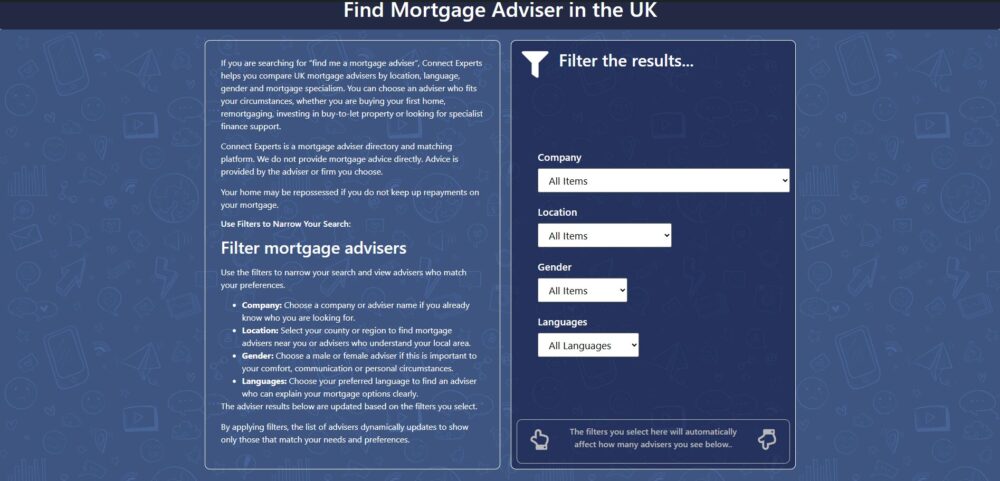
Some landlords also want to choose an adviser by location, language, or specialist experience. Connect Experts is part of Connect Group and lets users search for buy-to-let mortgage brokers across the UK.
You can also use Connect Experts to find your mortgage broker if you want to compare advisers before making contact.
Risks to Consider
A mortgage with no minimum income can be helpful, but it still carries risk.
Rental income can fall. Tenants can leave. Repairs can be expensive. Interest rates can change. Tax rules can affect profit. Property values can also rise or fall.
Before applying, landlords should consider:
- Void periods
- Letting agent fees
- Repairs and maintenance
- Insurance
- Licensing costs
- Tax position
- Rate changes
- Exit strategy
- Long-term property plans
A rental property should be treated as a financial commitment, not only an asset.
FAQs: Mortgage With No Minimum Income
Can I get a mortgage with no minimum income?
You may be able to get a buy-to-let mortgage with no fixed minimum personal income requirement. However, lenders may still check rental income, property type, deposit, credit history and wider financial risk.
Does no minimum income mean no income proof?
No. Some lenders may not ask for a set personal income level, but they can still ask for bank statements, rental evidence, deposit proof, portfolio details or company documents.
Is this available for residential mortgages?
Usually not in the same way. Residential mortgage lenders normally assess personal income and expenditure. This is because the borrower will live in the property and must show the mortgage is affordable.
Do all buy-to-let lenders offer no minimum income?
No. Some buy-to-let lenders require a minimum personal income. Others may not, if the rental income and overall application meet their criteria.
What is ICR?
ICR means interest cover ratio. It compares the expected monthly rent with the mortgage interest payment. Lenders use it to check whether rent can support the mortgage.
What ICR do lenders require?
Some lenders may use 125% to 145%, but this varies. The figure can depend on tax status, ownership structure, fixed-rate period, property type and lender policy.
Can self-employed applicants get no minimum income buy-to-let mortgages?
Yes, some self-employed applicants may be considered. The lender may focus more on rent and overall risk than a fixed personal income level.
Can retired landlords apply?
Some lenders may consider retired landlords if the rental cover, deposit, property and wider profile meet their rules. Age, term and exit strategy may also matter.
Does a limited company help?
A limited company may help some landlords, but it is not automatically better. It can affect tax, lender choice, legal work and product options. Tax advice should be taken before deciding.
Can I get a no minimum income mortgage for an HMO?
Possibly, but HMO lending is more specialist. Lenders may check the licence, room rents, property layout and landlord experience.
What deposit will I need?
Buy-to-let mortgages often need a larger deposit than residential mortgages. Many lenders require around 20% to 25%, but this can vary by case.
Can bad credit stop a no minimum income mortgage?
Bad credit can reduce lender choice. Some lenders may still consider the case, depending on the type, age and severity of the credit issue.
Is the cheapest rate always best?
No. The rate is only one part of the decision. Fees, stress testing, ICR, loan-to-value, early repayment charges and lender criteria can all affect suitability.