
First-Time Buyers Mortgage UK: Buying Your First Home – Buying your first home is not only a financial step. It is a decision about stability, responsibility and timing.
A first-time buyer mortgage helps you buy your first residential property. However, the right mortgage is not only about finding a low interest rate. Lenders will look at your deposit, income, credit history, monthly commitments and the property you want to buy.
That is why the first question should not be, “What rate can I get?”
It should be, “What mortgage can I afford, sustain and understand?”
First-Time Buyer Mortgage: Quick Answer
A first-time buyer mortgage is a residential mortgage for someone buying their first home.
You may be able to buy with a 5% deposit, subject to lender criteria, affordability checks, credit score, income and property type. Some buyers may need a larger deposit if the case is more complex.
Before you apply, it helps to check:
- How much deposit you have
- How much you may be able to borrow
- What your monthly repayments could look like
- Whether your credit file is ready
- What Stamp Duty may apply
- Which documents lenders may request
- Whether you need advice before making an offer
You can start with our First-Time Buyer Mortgage page if you want clear mortgage guidance before applying.
What Is a First-Time Buyer?
A first-time buyer is usually someone who has never owned a residential property before.
This can include property owned in the UK or abroad. It may also include property owned jointly with another person.
Your first-time buyer status matters because it can affect:
- Stamp Duty relief
- Mortgage product eligibility
- Government support options
- Deposit planning
- Lender criteria
- Shared ownership rules
If you are buying with another person, both buyers may need to meet first-time buyer rules for some reliefs.
For example, GOV.UK confirms that first-time buyer Stamp Duty relief in England and Northern Ireland can apply when all buyers meet the eligibility rules. Under current rules, qualifying first-time buyers pay no SDLT up to £300,000 and 5% on the portion from £300,001 to £500,000. If the property price is over £500,000, the relief cannot be claimed.
How Does a First-Time Buyer Mortgage Work?
A first-time buyer mortgage works like a standard residential mortgage.
You borrow money from a lender to buy your home. You then repay the loan over an agreed mortgage term. Many mortgage terms run between 25 and 40 years, depending on age, income, lender rules and affordability.
Most first-time buyers use a repayment mortgage. This means each monthly payment covers interest and part of the original loan.
Over time, the mortgage balance reduces, provided payments are made as agreed.
A lender will usually assess:
- Your income
- Your deposit
- Your credit history
- Your regular spending
- Existing loans or credit cards
- Childcare costs
- Dependants
- Employment type
- Mortgage term
- Property type
- Loan-to-value
The mortgage is secured against your home. Your home may be repossessed if you do not keep up with your mortgage repayments.
How Much Deposit Does a First-Time Buyer Need?
Many first-time buyers start with a deposit of at least 5% of the property price.
For example, if the property costs £250,000, a 5% deposit would be £12,500. The mortgage would cover the remaining £237,500, subject to lender approval.
A larger deposit can help by reducing the lender’s risk. It may also give you access to more mortgage products.
Common deposit examples:
- 5% deposit means a 95% loan-to-value mortgage
- 10% deposit means a 90% loan-to-value mortgage
- 15% deposit means an 85% loan-to-value mortgage
- 20% deposit means an 80% loan-to-value mortgage
Loan-to-value is often shortened to LTV. It shows the mortgage as a percentage of the property value.
The lower the LTV, the more equity you have from the start.
Can First-Time Buyers Get a Mortgage With a 5% Deposit?
Yes, some first-time buyers may be able to get a mortgage with a 5% deposit.
This is usually called a 95% LTV mortgage. It means the lender provides up to 95% of the property value, while the buyer contributes at least 5%.
The UK Government introduced a permanent Mortgage Guarantee Scheme in July 2025. The scheme supports availability of 91% to 95% LTV mortgages from participating lenders. It can help eligible first-time buyers and home movers buy with a deposit as small as 5%.
However, a 5% deposit does not guarantee approval.
The lender will still assess:
- Income
- Credit history
- Existing debts
- Monthly commitments
- Property type
- Mortgage term
- Affordability
- Deposit source
Some properties may also be harder to place at high LTV. This can include certain flats, new builds, unusual construction or properties with short leases.
How Much Can a First-Time Buyer Borrow?
How much you can borrow depends on your full financial position.
Lenders do not only look at salary. They look at whether the mortgage is affordable now and under possible future conditions.
They may consider:
- Basic salary
- Overtime
- Bonuses
- Commission
- Self-employed income
- Benefits, where acceptable
- Credit commitments
- Student loans
- Childcare
- Dependants
- Council Tax
- Ground rent
- Service charge
- Mortgage term
- Interest rate stress testing
Two buyers with the same income may receive different borrowing outcomes. This is because lenders use different affordability models.
You can use our Residential Affordability Calculator to estimate how much you may be able to borrow before speaking with an adviser.
Agreement in Principle: Why It Matters
An Agreement in Principle, also called an AIP, gives an early indication of what a lender may be prepared to lend.
It is not a full mortgage offer. However, it can help you understand your likely budget before viewing homes.
An AIP may help you:
- Set a realistic price range
- Show estate agents you are serious
- Make offers with more confidence
- Find issues before a full application
- Avoid viewing homes outside your budget
Some AIPs use a soft credit search. Others may use a hard search. It is worth checking before applying.
Mortgage Types First-Time Buyers Should Understand
A first-time buyer does not need to become a mortgage expert. However, understanding the main product types can help you ask better questions.
Fixed-Rate Mortgage
A fixed-rate mortgage keeps the interest rate the same for a set period.
This could be two, three, five or more years. The main benefit is payment certainty during the fixed period.
This can help first-time buyers budget after moving in.
Tracker Mortgage
A tracker mortgage usually follows a benchmark rate, such as the Bank of England base rate.
If the rate rises, payments may increase. If it falls, payments may reduce.
This can suit some buyers, but it carries more payment uncertainty.
Variable-Rate Mortgage
A variable-rate mortgage can change at the lender’s discretion.
This may include a standard variable rate after a deal ends. Payments can rise or fall, so buyers need to understand the risk.
Repayment Mortgage
Most first-time buyers use repayment mortgages.
Each payment covers interest and part of the loan. If all payments are made, the mortgage should be repaid by the end of the term.
Interest-Only Mortgage
Interest-only mortgages are less common for first-time residential buyers.
With this structure, monthly payments cover interest only. The original loan must be repaid at the end of the term. Lenders usually require a credible repayment plan.
First-Time Buyer Costs Beyond the Deposit
A deposit is only one part of the buying cost.
A practical budget should also include:
- Valuation fee
- Survey cost
- Solicitor or conveyancer fees
- Search fees
- Mortgage product fee, where charged
- Broker fee, where charged
- Stamp Duty, where applicable
- Buildings insurance
- Moving costs
- Furniture and appliances
- Initial repairs
- Service charge, if leasehold
- Ground rent, if applicable
It is better to know these costs early. A home can feel affordable on paper, but tight in practice if the wider budget is ignored.
You can estimate possible tax costs with our Stamp Duty Calculator.
Do First-Time Buyers Pay Stamp Duty?
Some first-time buyers pay no Stamp Duty. Others may pay some, depending on the purchase price and location.
In England and Northern Ireland, qualifying first-time buyers currently pay no SDLT on the first £300,000. They pay 5% on the portion from £300,001 to £500,000.
If the property price is over £500,000, first-time buyer relief does not apply.
Stamp Duty rules are different in Scotland and Wales. Buyers should always check the rules before making an offer, especially near a threshold.
Shared Ownership for First-Time Buyers
Shared ownership may help some buyers purchase a share of a home rather than the full property.
GOV.UK explains that shared ownership can apply when someone cannot afford all the deposit and mortgage payments for a home that meets their needs. Buyers purchase a share and pay rent on the remaining share.
A shared ownership buyer may usually buy a share between 10% and 75% of the home’s full market value. They may also need a deposit, often between 5% and 10% of the share being bought.
Shared ownership can reduce the initial mortgage size. However, buyers should also consider rent, service charges, lease terms and future staircasing costs.
Gifted Deposits and Family Support
Many first-time buyers receive help from family.
This may include:
- A gifted deposit
- Family-assisted mortgage products
- Joint borrower sole proprietor options
- Savings support
- Deposit boost arrangements
- Guarantor-style structures, where available
Lenders usually need clear evidence of where the money came from. They may also need a signed gifted deposit letter.
The person giving the gift may need to confirm that the money is not a loan and that they will not own part of the property.
Family help can be useful, but it should be structured properly from the start.
Credit File Checks Before Applying
Your credit file can affect mortgage options.
Before applying, it helps to check:
- Your address history
- Electoral roll registration
- Missed or late payments
- Credit card balances
- Personal loans
- Defaults or county court judgments
- Financial links to other people
- Errors on your report
A perfect credit score is not always required. However, lenders need to understand how you manage commitments.
Try to avoid taking new credit before applying for a mortgage, unless you have spoken to an adviser.
Documents a First-Time Buyer May Need
Lenders usually ask for documents to verify your income, identity, deposit and spending.
You may need:
- Proof of ID
- Proof of address
- Payslips
- Bank statements
- P60, where relevant
- Tax calculations, if self-employed
- Tax year overviews, if self-employed
- Company accounts, where relevant
- Proof of deposit
- Gifted deposit letter, if applicable
- Details of loans or credit commitments
Having documents ready can reduce delays. It can also help your adviser spot issues before the application reaches the lender.
New Build Homes and First-Time Buyers
Some first-time buyers choose new build homes.
New builds can offer modern layouts, energy efficiency and chain-free buying. However, lenders may apply different criteria.
They may consider:
- Build stage
- Warranty provider
- Property type
- Incentives from the developer
- Lease terms
- Deposit size
- Mortgage offer expiry date
Mortgage timing can be important with new builds. If completion is delayed, the mortgage offer may need extending.
Why Mortgage Advice Can Help First-Time Buyers
A first-time buyer mortgage is rarely just one decision.
It involves the deposit, lender criteria, monthly payments, property checks, legal work, insurance, deadlines and risk.
A mortgage adviser can help explain:
- How much you may be able to borrow
- Which lenders may fit your circumstances
- Whether your deposit source is acceptable
- Which product type may suit your plans
- What documents you need
- How the application process works
- What fees and costs to expect
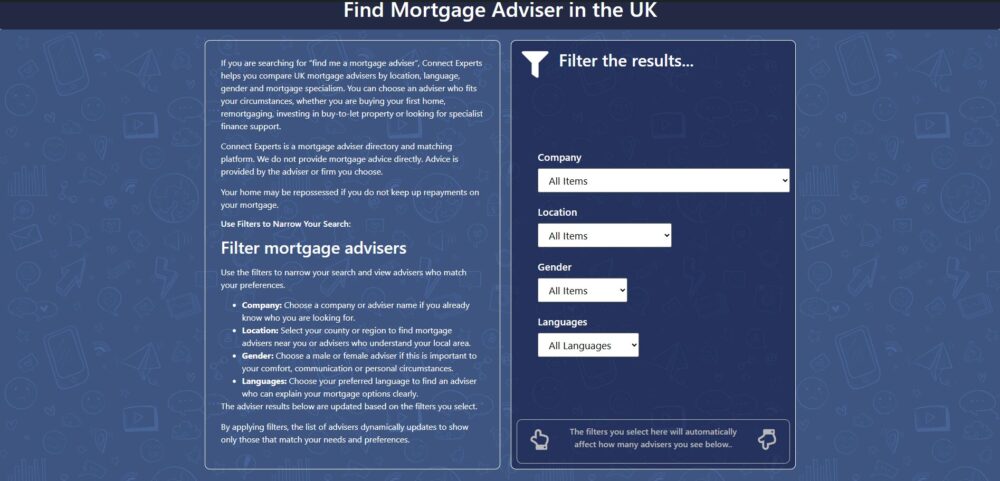
You can also compare first-time buyer advisers through Connect Experts first-time buyer mortgage advisers if you want to choose an adviser by profile, location or preference.
Protection: The Part First-Time Buyers Should Not Ignore
A mortgage creates a long-term financial commitment.
That is why protection should be part of the first-time buyer conversation. It is not only about getting the keys. It is also about keeping the home if life changes.
Protection may include:
- Life insurance
- Critical illness cover
- Income protection
- Buildings insurance
- Contents insurance
Buildings insurance is usually required when you exchange contracts on a freehold property. Other protection types depend on your needs, budget and circumstances.
You can read more about Mortgage Protection and Life Insurance before deciding what support you may need.
First-Time Buyer Checklist
Before you apply for a mortgage, check:
- Your deposit amount
- Your credit file
- Your income documents
- Your monthly budget
- Your likely borrowing range
- Your possible Stamp Duty cost
- Your moving costs
- Your solicitor costs
- Your insurance needs
- Your preferred mortgage type
- Whether family support is involved
- Whether the property has any lender concerns
A first home should not be rushed just because the market feels noisy.
The aim is not only to buy. The aim is to buy with enough clarity to stay confident after completion.
When Should You Speak to a Mortgage Adviser?
You can speak to a mortgage adviser before you start viewing properties.
This can help you understand your budget before emotions enter the process. It can also help avoid wasted time on properties that lenders may not support.
You may especially benefit from advice if:
- You have a small deposit
- You are self-employed
- You have credit issues
- You use overtime, bonus or commission
- You are buying with family help
- You are buying a new build
- You are considering shared ownership
- You are unsure about Stamp Duty
- You want to understand monthly payments clearly
You can also use Find a Mortgage Adviser Near You if location, language or contact style matters to your decision.
First-Time Buyer Mortgage FAQs
What is a first-time buyer mortgage?
A first-time buyer mortgage is a residential mortgage for someone buying their first home. Lenders assess income, deposit, credit history, affordability and the property before deciding whether to lend.
Can I get a mortgage with a 5% deposit?
Some buyers may be able to get a mortgage with a 5% deposit. This usually means a 95% LTV mortgage. Approval depends on lender criteria, income, credit history, commitments and property type.
What does LTV mean?
LTV means loan-to-value. It shows the mortgage as a percentage of the property value. A 95% LTV mortgage means the lender provides 95% and the buyer provides a 5% deposit.
How much can I borrow as a first-time buyer?
The amount depends on your income, spending, debts, credit history, deposit, mortgage term and lender criteria. Different lenders may offer different borrowing amounts.
Do first-time buyers pay Stamp Duty?
Some first-time buyers pay no Stamp Duty. In England and Northern Ireland, qualifying buyers pay no SDLT up to £300,000 and 5% on the portion from £300,001 to £500,000. Relief is not available if the price is over £500,000.
Is shared ownership suitable for first-time buyers?
Shared ownership may suit some buyers who cannot afford the full deposit and mortgage payments for a suitable home. However, buyers must consider rent, service charges, lease terms and future staircasing costs.
Do I need an Agreement in Principle?
An Agreement in Principle is not always required, but it can help you understand your budget. It may also show estate agents that you are serious before making an offer.
Should I use a mortgage adviser?
A mortgage adviser can help compare lenders, explain criteria, review affordability and guide you through the application. This can be useful if you are buying for the first time or have a more complex situation.