

£1 Million to £3 Million Mortgages: A mortgage between £1 million and £3 million may be available through a mainstream lender, specialist lender, dedicated large-loan team or private bank.
The correct route depends on more than the loan amount. Lenders may assess:
- Income and how it is earned.
- Existing debts and regular expenditure.
- Deposit and loan-to-value.
- The property’s type, condition and location.
- Wider assets and liquidity.
- The chosen repayment method.
- The credibility of an interest-only repayment strategy.
- Source of wealth and source of deposit.
- The borrower’s future plans.
A £1 million mortgage does not automatically require a private bank. Equally, a high income does not guarantee that every lender will accept a £2 million or £3 million application.
The decisive factor is often how well the lender’s criteria reflect the borrower’s true financial position.
The Number May Be Larger, but the Principle Remains Human
A mortgage is a promise carried forward through time.
At £200,000 or £2 million, the fundamental question remains the same: can the borrower maintain the commitment without placing their wider financial security under unreasonable pressure?
However, as the loan increases, small differences carry greater consequences.
A slight change in interest rate affects a larger balance. A misunderstood bonus can significantly affect affordability. A property title issue may restrict lender choice. An unclear repayment plan can prevent an otherwise strong application from proceeding.
A £1 million to £3 million mortgage is therefore not simply a standard mortgage with another zero attached. It may require a deeper review of the borrower, the property and the purpose behind the loan.
What is a £1 Million to £3 Million Mortgage?
The phrase describes a mortgage where the amount borrowed falls between £1 million and £3 million.
It could be used for:
- Purchasing a high-value main residence.
- Buying prime London or regional property.
- Moving to a larger family home.
- Purchasing a country, listed or rural property.
- Refinancing an existing large mortgage.
- Raising capital from a valuable home.
- Buying a second residence.
- Restructuring existing property borrowing.
- Relocating to the UK.
- Replacing short-term property finance.
There is no universal regulatory definition of a “large mortgage”. Lenders may use different thresholds for transferring applications to a large-loan or specialist underwriting team.
The loan amount also does not automatically make the applicant a high-net-worth mortgage customer under FCA rules.
Is Every £1 Million Borrower a High-Net-Worth Customer?
No.
The loan size and the FCA definition are separate matters.
The FCA Handbook definition of a high-net-worth mortgage customer includes someone with:
- Annual net income of at least £300,000.
- Net assets of at least £3 million.
- Mortgage obligations guaranteed by someone meeting either threshold.
An applicant could need a £1 million mortgage without meeting this definition. Another applicant could meet the definition while seeking a much smaller loan.
Likewise, meeting the threshold does not guarantee approval or determine how much someone can borrow.
The lender will still consider affordability, liabilities, credit history, property risk and the proposed repayment strategy.
You can use Connect Experts to find high-net-worth mortgage brokers who support applicants with large loans and complex financial circumstances.
Why Can Large Mortgage Underwriting Be More Detailed?
A larger mortgage creates greater financial exposure for both the borrower and the lender.
The lender may therefore examine three connected stories.
The income story
How is the income earned, documented and expected to continue?
The property story
Is the property suitable security for a mortgage of this size?
The repayment story
How will monthly payments and the original capital be repaid?
These elements must make sense together.
A borrower may have an exceptional salary but be purchasing a property that falls outside the lender’s appetite. Another applicant may have complex income but substantial assets, low expenditure and a conservative loan-to-value.
The strongest application is not always the simplest. It is the one in which every important figure can be explained and supported.
Which Lenders May Provide Mortgages Between £1 Million and £3 Million?
Several parts of the mortgage market may consider loans within this range.
Mainstream lenders
Some mainstream lenders accept large mortgage applications where the income, property and deposit satisfy their standard or large-loan criteria.
This route may be suitable for an applicant with:
- Clear employed income.
- A strong deposit.
- A conventional property.
- A good credit history.
- Straightforward expenditure.
- A repayment mortgage.
A dedicated large-loan team may assess the application even when the product comes from a familiar mainstream lender.
Specialist lenders
Specialist lenders may help where the application needs more detailed manual underwriting.
Relevant circumstances could include:
- Complex or irregular income.
- Self-employment.
- Partnership drawings.
- Retained company profits.
- Significant bonus income.
- Investment or rental income.
- Foreign-currency earnings.
- An unusual property.
- An interest-only repayment strategy.
- A need for greater flexibility.
A specialist product may carry different rates, fees and conditions. Specialist does not automatically mean suitable or unsuitable; it describes a route requiring closer assessment.
Our specialist mortgage guide explains why some applications need criteria beyond a standard lender checklist.
Private banks
A private bank may consider the mortgage within a broader banking or wealth-management relationship.
It might assess:
- Employment and business income.
- Investment portfolios.
- Cash holdings.
- Property assets.
- International wealth.
- Trust arrangements.
- Future capital events.
- The wider relationship being offered.
Some private banks may require the borrower to place investments or cash under management. This can create management fees, investment considerations and opportunity costs.
The mortgage rate should not therefore be considered alone. The borrower should understand the complete cost and commitment attached to the relationship.
How Much Income is Needed For a £1 Million Mortgage?
There is no single income figure that guarantees a £1 million, £2 million or £3 million mortgage.
Lenders do not all apply the same income multiple. The calculation may also change according to:
- Loan size.
- Loan-to-value.
- Interest rate.
- Mortgage term.
- Number of dependants.
- Household expenditure.
- Existing mortgage commitments.
- Loans and credit cards.
- Income type.
- Retirement age.
- Repayment method.
- Property risk.
- Credit history.
A basic income-multiple illustration can show why the required income changes so quickly.
| Desired mortgage | At 4 × income | At 4.5 × income | At 5 × income |
|---|---|---|---|
| £1,000,000 | £250,000 | £222,222 | £200,000 |
| £2,000,000 | £500,000 | £444,444 | £400,000 |
| £3,000,000 | £750,000 | £666,667 | £600,000 |
These figures are mathematical examples, not lending limits or an indication that a lender will use the stated multiple.
A lender’s affordability model may produce a lower or higher amount. The result depends on the entire application.
The FCA’s responsible lending rules require relevant lenders to assess whether a customer can afford the mortgage. A valuable property or large deposit does not remove that responsibility.
How Do Lenders Assess Complex Income?
High earners do not always receive one predictable monthly salary.
Their income may include:
- Basic salary.
- Annual or quarterly bonuses.
- Commission.
- Overtime.
- Company dividends.
- Retained company profit.
- Partnership drawings.
- Investment income.
- Rental income.
- Trust distributions.
- Foreign income.
- Carried interest.
- Vested share awards.
- Contract income.
One lender may use a large proportion of established bonus income. Another may average it or exclude parts considered uncertain.
A lender assessing a company director may focus on salary and dividends. Another may consider the applicant’s share of net profit or retained profit where its policy allows.
Professional partnerships can also require close examination. Drawings, profit shares, capital accounts and future promotion may all require different evidence.
A large income is valuable only when the lender understands it and accepts how it has been documented.
Self-employed applicants can read our self-employed mortgage guide before preparing their supporting documents.
How Important is the Deposit?
The deposit establishes the loan-to-value, known as LTV.
The formula is:
Mortgage amount ÷ property value × 100 = LTV
For example:
| Purchase position | Amount |
|---|---|
| Property price | £2,000,000 |
| Deposit | £600,000 |
| Mortgage | £1,400,000 |
| Loan-to-value | 70% |
A lower LTV may provide access to a wider choice of products or reduce the lender’s exposure. It does not replace the affordability assessment.
The lender will also need to verify where the deposit came from.
Possible sources include:
- Personal savings.
- Sale of another property.
- Investment proceeds.
- Inheritance.
- Business sale proceeds.
- A family gift.
- Equity from an existing home.
- A combination of resources.
Source-of-funds and source-of-wealth checks can be more detailed where the sums are large, held overseas or generated through several transactions.
The applicant should retain a clear evidence trail before moving money between accounts.
What Costs Sit Outside the Deposit?
A large deposit is only one part of the available cash required.
Other costs may include:
- Stamp Duty Land Tax or the relevant devolved property tax.
- Legal fees.
- Survey and valuation costs.
- Mortgage arrangement fees.
- Broker fees.
- Moving costs.
- Immediate repairs.
- Buildings insurance.
- Leasehold charges.
- Tax or legal advice.
- Early repayment charges on an existing mortgage.
For an English or Northern Irish purchase, the buyer should use the current GOV.UK Stamp Duty Land Tax rates. Scotland and Wales operate different property transaction taxes.
Higher rates may apply when the buyer will own more than one residential property. Non-UK resident surcharges may also apply in relevant cases.
Tax rules can change, so buyers should confirm their position with a solicitor or qualified tax adviser.
A mortgage should not consume every available pound. The property will continue to require money after completion.
Does the Property Affect a Large Mortgage Application?
Yes. The property is the lender’s security, and high-value homes are not always easy to compare.
A lender may examine:
- Location.
- Local demand.
- Construction type.
- Condition.
- Listed status.
- Remaining lease term.
- Service charges.
- Ground rent.
- Acreage.
- Outbuildings.
- Annexes.
- Equestrian facilities.
- Agricultural restrictions.
- Commercial use.
- Planning history.
- Rights of way.
- Restrictive covenants.
- Flood or environmental risk.
- Future resale market.
A beautiful home can still present a difficult mortgage risk.
A property may be unique enough to attract a buyer but too unusual for a lender seeking predictable resale demand. The same feature can therefore create personal value and financial complexity.
The lender’s valuation is completed for its own lending purposes. A buyer may also wish to commission an independent building survey, particularly for older, listed or extensively altered property.
Can a £1 Million to £3 Million Mortgage be Interest-Only?
Potentially.
An interest-only mortgage requires monthly interest payments, while the original capital normally remains outstanding until the end of the term.
A lender will usually require a credible and acceptable repayment strategy.
This might include:
- Sale of the mortgaged property.
- Sale of another property.
- An investment portfolio.
- Pension proceeds.
- Maturing investments.
- A future business sale.
- Accumulated bonuses.
- Another clearly evidenced capital event.
The proposed strategy must fit the lender’s criteria. Future investment growth is not guaranteed, and a business sale may not happen at the expected value or time.
MoneyHelper explains the differences between interest-only and repayment mortgages, including the need for a reliable way to repay the capital.
Our interest-only mortgage guide provides further information about repayment plans, risk and lender assessment.
Part-and-part borrowing
Some borrowers may use a part-repayment and part-interest-only structure.
For example, a £2 million mortgage could be divided between:
- £1.2 million on capital repayment.
- £800,000 on interest-only.
This may reduce monthly payments compared with placing the entire loan on repayment. It also reduces the capital remaining at the end compared with a fully interest-only mortgage.
The structure must still be affordable, and the interest-only balance requires an acceptable repayment plan.
Illustrative £2 Million Mortgage Structure
Consider a fictional household buying a £2.7 million main residence.
| Financial position | Illustrative amount |
|---|---|
| Purchase price | £2,700,000 |
| Deposit | £700,000 |
| Required mortgage | £2,000,000 |
| Loan-to-value | 74.1% |
| Combined annual income | £525,000 |
| Existing debts | £75,000 |
| Liquid investments retained | £650,000 |
The income consists of:
- £300,000 combined basic salary.
- A history of bonuses.
- Partnership profit.
- Investment income.
The applicants want part of the mortgage on interest-only because they expect a future partnership capital payment.
A lender or adviser would still need to investigate:
- How much bonus income can be recognised.
- Whether partnership income is sustainable.
- The applicants’ household expenditure.
- How the existing debt will be treated.
- Whether the lender accepts the proposed property.
- Whether £700,000 is a sufficient deposit under its policy.
- Whether the future capital payment is an acceptable repayment strategy.
- How affordability changes if rates or expenditure increase.
- Whether retaining the investments strengthens financial resilience.
The figures alone cannot determine the outcome.
This example is illustrative and does not represent a lending decision, available product or personal recommendation.
Repayment Mortgage or Interest-Only?
The repayment basis should reflect more than the lowest initial monthly payment.
| Capital repayment | Interest-only |
|---|---|
| Payments reduce interest and capital | Payments normally cover interest only |
| Balance should reduce over the term | Original capital normally remains outstanding |
| Monthly payments are generally higher | Monthly payments are generally lower |
| Less dependence on a separate repayment strategy | A credible capital repayment strategy is essential |
| Builds equity through regular capital reduction | Equity depends more heavily on deposit and property value |
| Total interest may be lower for the same rate and term | Total interest may be higher because the balance does not reduce |
Rates, fees and product conditions vary. A part-and-part mortgage may combine elements of both structures.
The lowest payment is not always the strongest decision. A lower payment today may leave a larger obligation for tomorrow.
What Documents Might Be Needed?
A £1 million to £3 million mortgage application may require:
Identity and conduct
- Proof of identity.
- Proof of address.
- Personal bank statements.
- Credit information.
- Details of existing commitments.
Employed income
- Payslips.
- P60s.
- Employment contracts.
- Bonus or commission records.
- Employer confirmation where required.
- Share-award or vesting statements.
Self-employed or partnership income
- Company or partnership accounts.
- Tax calculations.
- Tax Year Overviews.
- Business bank statements.
- Dividend records.
- Accountant details.
- Partnership agreements or profit statements.
Assets and deposit
- Savings statements.
- Investment portfolio statements.
- Property schedules.
- Existing mortgage statements.
- Evidence of inheritance or gifts.
- Business sale documents.
- Source-of-funds evidence.
- Source-of-wealth evidence.
Property and repayment
- Property particulars.
- Title information where available.
- Details of unusual construction or use.
- Evidence supporting an interest-only repayment strategy.
Preparing the documents early allows the adviser to identify inconsistencies before the lender sees them.
How Should a Large Mortgage Rate Be Compared?
The lowest advertised rate may not create the lowest overall cost.
A fair comparison should include:
- Initial interest rate.
- Reversion rate.
- Arrangement fee.
- Valuation fee.
- Legal costs.
- Broker fee.
- Early repayment charges.
- Mortgage term.
- Repayment basis.
- Required insurance.
- Any linked banking conditions.
- Asset-management fees.
- Total projected amount repayable.
On a large balance, an apparently small rate difference can materially affect the cost.
However, a cheaper product has little value if the lender will not accept the applicant’s income or property. Suitability begins with criteria, then moves to price.
What Can Cause a Large Mortgage Application to Fail?
Common problems may include:
- Applying to a lender that does not accept the income structure.
- Assuming every bonus will be counted.
- Moving deposit funds without preserving the evidence trail.
- Failing to disclose liabilities.
- Relying on an unsupported property valuation.
- Ignoring unusual title or planning matters.
- Choosing interest-only without an acceptable repayment strategy.
- Treating investment growth as certain.
- Leaving insufficient cash after completion.
- Making another credit application during underwriting.
- Providing inconsistent information.
- Waiting too long to assemble complex documents.
The size of the loan can make the borrower feel that the lender should work harder to win the business.
In practice, a substantial application still needs discipline. Wealth may create options, but clarity turns those options into decisions.
Remortgaging a £1 million to £3 million Loan
Large mortgage advice is also relevant when an existing deal approaches its end.
Possible routes include:
- A product transfer with the current lender.
- Remortgaging to a new lender.
- Changing the repayment basis.
- Reducing the balance with available capital.
- Raising additional funds.
- Restructuring interest-only borrowing.
- Combining or separating secured debts.
- Reviewing the term.
A product transfer may require less administration, but it should still be compared with the wider market where appropriate.
A remortgage may offer a different rate or structure, but valuation, legal work, affordability and early repayment charges must be considered.
Read our remortgage guide if your current large mortgage deal is approaching its end.
Starting the review several months before the expiry date may provide time to examine complicated income, property and repayment issues.
Questions to Ask Before Borrowing £1 million to £3 million
A responsible discussion should consider:
- What is the true purpose of the borrowing?
- How much deposit can be committed safely?
- What cash will remain after completion?
- Which income sources are reliable?
- How might the lender treat bonuses or business profits?
- What happens if interest rates increase?
- Could payments continue if one income falls?
- Is the property acceptable security?
- Would interest-only serve a clear purpose?
- How will any interest-only balance be repaid?
- Could the loan extend into retirement?
- What are the total fees and projected costs?
- Does a private-bank relationship provide genuine value?
- How might the mortgage affect investments or business plans?
- Would borrowing less create greater freedom?
A large mortgage may help secure an important home. It should not quietly take control of every future decision.
The Philosophy of a Large Mortgage
A high-value home can represent achievement, privacy, continuity and a place for a family’s next chapter.
Yet value and meaning are not the same.
The market gives the property a price. The household gives it a purpose.
Borrowing should connect those two ideas without allowing the price to weaken the purpose. A home intended to create security should not produce constant financial fear. A property chosen to support family life should leave room for that life to continue.
The most powerful mortgage is not necessarily the largest one available.
It is the mortgage that allows ambition to exist beside resilience.
Sometimes this means selecting a more flexible lender. Sometimes it means using a larger deposit, borrowing less or protecting more liquidity. Sometimes the wisest answer is to reconsider the property entirely.
Good advice does not begin by asking how far borrowing can be stretched.
It begins by asking what the mortgage is meant to make possible.
Why Speak to a High-Net-Worth Mortgage Broker?
A high-net-worth mortgage broker can help:
- Examine the complete financial position.
- Identify which lenders may accept the loan size.
- Assess complex income sources.
- Compare mainstream, specialist and private-bank routes.
- Review the property before an application.
- Test affordability under different conditions.
- Consider repayment, interest-only and part-and-part structures.
- Review the deposit and source-of-funds evidence.
- Prepare the application for underwriting.
- Coordinate with accountants, solicitors and tax advisers.
- Explain rates, fees and wider relationship costs.
Connect Experts helps borrowers search for high-net-worth mortgage advisers by expertise, location and other preferences.
Connect Experts is a directory and matching service. Mortgage advice is provided by the adviser or firm selected by the customer.
Frequently asked questions
Can I get a £1 million mortgage from a mainstream lender?
Possibly. Some mainstream lenders provide large mortgages where the income, deposit, credit profile and property meet their criteria. More complex applications may require a specialist lender or private bank.
How much must I earn for a £1 million mortgage?
There is no universal minimum. Lenders assess income, expenditure, debts, dependants, loan-to-value, mortgage term and repayment method. Income multiples provide only a broad mathematical illustration.
How much deposit do I need for a £2 million mortgage?
The required deposit depends on the property price, requested loan, lender and wider application. A larger deposit produces a lower loan-to-value, but affordability and property assessment remain essential.
Is a £1 million mortgage automatically a high-net-worth mortgage?
No. The loan size does not determine whether the borrower meets the FCA definition of a high-net-worth mortgage customer.
Are interest-only mortgages available above £1 million?
They may be. The lender will normally require a credible repayment strategy and evidence supporting it. Interest-only borrowing is not suitable for every applicant.
Can bonuses count towards a large mortgage?
Some lenders may consider regular bonuses where there is an acceptable history. The percentage used and evidence required vary between lenders.
Can retained company profit support a £1 million mortgage?
Some lenders may consider a company director’s share of retained or net profit. Others focus on salary and dividends. Company accounts and accountant confirmation may be required.
Do I need a private bank for a £3 million mortgage?
Not automatically. Mainstream large-loan teams and specialist lenders may also be relevant. A private bank may require a wider asset or banking relationship.
Will a listed property affect the application?
It can. The lender may assess the listing, condition, marketability, alterations and reinstatement risk. A specialist valuation or survey may be appropriate.
Can I remortgage a mortgage above £1 million?
Potentially. The lender will reassess the property, income, affordability, credit profile and repayment structure. Early repayment charges and wider costs should be included in the comparison.
How long does a large mortgage application take?
There is no fixed period. The timescale depends on underwriting, valuation, legal work, document quality, property complexity and whether several professional advisers are involved.
Does a large deposit guarantee acceptance?
No. A large deposit may reduce the loan-to-value, but the borrower must still satisfy affordability, credit, property and lender-policy requirements.
Internal linking allocation
| Anchor text | Destination | Recommended placement |
|---|---|---|
| specialist mortgage guide | https://connectmortgages.co.uk/specialist-mortgages/ |
Lender routes |
| high-net-worth mortgage brokers | https://connectexperts.co.uk/high-net-worth-mortgage-brokers/ |
FCA definition and CTA |
| self-employed mortgage guide | https://connectmortgages.co.uk/self-employed-mortgage-guide/ |
Complex income |
| interest-only mortgage guide | https://connectmortgages.co.uk/interest-only-mortgage/ |
Repayment structure |
| remortgage guide | https://connectmortgages.co.uk/remortgage/ |
Refinancing |
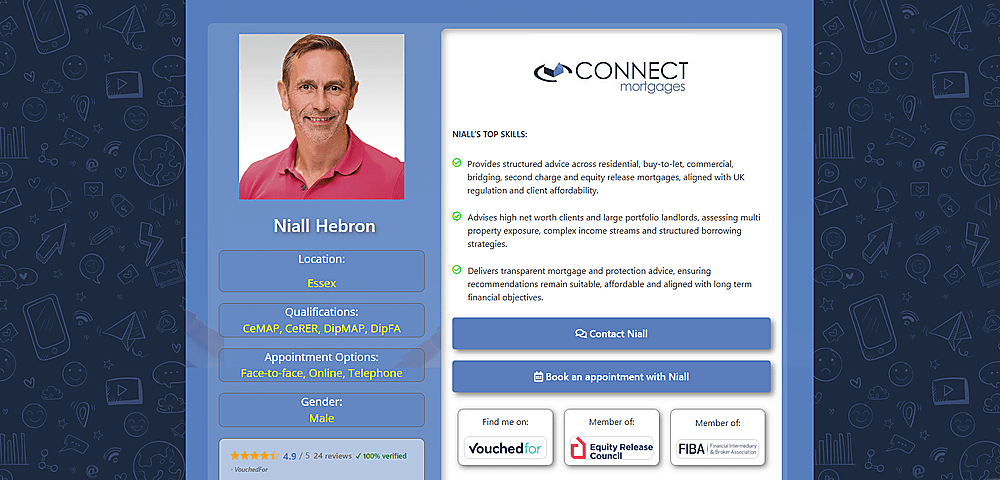
| Niall Hebron | https://connectexperts.co.uk/advisers/niall-hebron/ |
Named adviser CTA |
External source allocation
| Anchor text | Official source |
|---|---|
| FCA Handbook definition of a high-net-worth mortgage customer | https://handbook.fca.org.uk/glossary/G2953 |
| responsible lending rules | https://handbook.fca.org.uk/handbook/mcob11/mcob11s7 |
| GOV.UK Stamp Duty Land Tax rates | https://www.gov.uk/stamp-duty-land-tax/residential-property-rates |
| interest-only and repayment mortgages | https://www.moneyhelper.org.uk/en/homes/buying-a-home/mortgage-repayment-options |
Recommended structured data
Use:
ArticleFAQPageBreadcrumbListPersonfor the authorFinancialServiceorOrganizationfor Connect Mortgages
The visible FAQ wording and schema wording should match. Do not add reviews, rates or claims to structured data unless they are also visible and verifiable on the page.
Speak to Niall Hebron About a £1 million to £3 Million Mortgage
Niall Hebron supports high-net-worth and complex-income clients whose finances may involve dividends, retained profits, bonuses, property income or overseas assets.
He can review:
- The proposed loan and property.
- Income, expenditure and liabilities.
- Business or partnership earnings.
- Deposit and wider assets.
- Interest-only repayment strategies.
- Mainstream and specialist lender criteria.
- Relevant private-bank options.
- Required supporting documents.
- Costs, risks and long-term affordability.
Niall is based in Hornchurch, Essex. He also supports clients in London and other UK locations through remote appointments where appropriate.
A first conversation does not commit you to making an application. Its purpose is to determine whether the numbers, property and lender route can form a responsible plan.
Contact Niall Hebron to discuss your circumstances.
Important information
Connect Mortgages is a credit broker, not a lender. We have access to an extensive range of lenders. After assessing your needs, we may recommend a lender and product suited to your circumstances. You are not obliged to accept that recommendation.
A fee may be payable for arranging your mortgage. Your adviser will confirm the amount before you choose to proceed.
Your home or property may be repossessed if you do not keep up repayments on your mortgage or other loans secured against it.
The FCA does not regulate some forms of buy-to-let, commercial mortgage and bridging finance.
Tax treatment depends on individual circumstances and may change. Mortgage advice does not constitute tax, legal or investment advice.