
Second Charge Mortgages with Bad Credit: Financial difficulty often leaves a longer shadow than the event itself.
A missed payment may last a month. A default, CCJ, or debt management plan can affect borrowing choices for years. For homeowners, this can create a difficult question: what if you need to raise funds, but your credit history makes remortgaging harder?
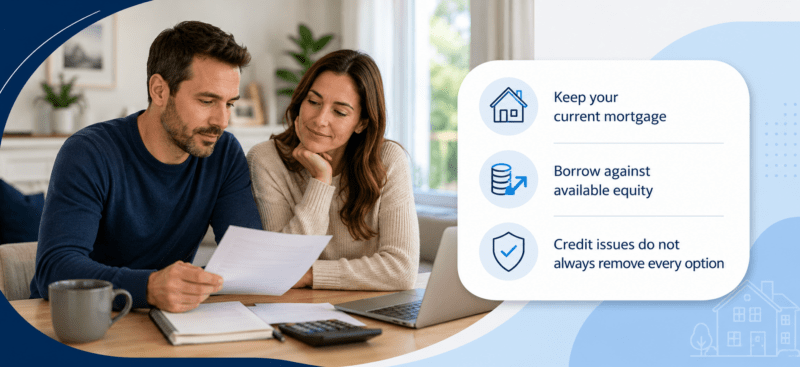
A second charge mortgage with bad credit may be one option. It allows a homeowner to borrow against available equity without replacing the existing mortgage. The current mortgage stays in place, and the new loan sits behind it as a second legal charge.
This is not a shortcut around poor credit. It is a secured lending product with detailed checks, added risk, and long-term responsibility.
Your home may be repossessed if you do not keep up repayments on your mortgage or any loan secured on it.
Second Charge Mortgages with Bad Credit
A second charge mortgage with bad credit may help homeowners raise funds without remortgaging.
It may be considered when:
- You have equity in your property
- Your current mortgage deal is worth keeping
- Remortgaging would trigger early repayment charges
- Your existing lender will not offer further borrowing
- Your credit file includes missed payments, defaults, CCJs, or other issues
- You need funds for home improvements, debt consolidation, or another legal purpose
However, it may not be suitable if:
- The new repayment would stretch your budget
- Debt consolidation would not solve the cause of the debt
- A remortgage, further advance, or unsecured loan would cost less overall
- Your income is unstable
- Your recent credit conduct shows ongoing repayment problems
A second charge mortgage is secured against your home. That makes affordability, suitability, and long-term cost essential.
What Is a Second Charge Mortgage?
A second charge mortgage is an additional loan secured against a property that already has a mortgage.
Your existing mortgage remains the first charge. The new lender registers a second charge behind it. If the property is sold after serious missed payments, the first mortgage lender is usually repaid before the second charge lender.
That repayment order matters. It means the second charge lender takes more risk than the first mortgage lender. As a result, rates may be higher, especially where bad credit is involved.
For a wider explanation of the product itself, read our guide to Second Charge Mortgages.
How Bad Credit Affects a Second Charge Mortgage
Bad credit does not always mean an automatic decline. However, it changes how the case is assessed.
Lenders usually want to understand what happened, when it happened, and whether the position has improved. They also want to see whether the new loan is affordable now, not just whether the property has enough equity.
Bad credit may include:
- Missed mortgage payments
- Missed loan or credit card payments
- Defaults
- County Court Judgments
- Debt management plans
- IVAs
- Bankruptcy history
- Payday loan use
- High credit utilisation
- Recent arrears
- Repeated overdraft reliance
The older, smaller, and better-explained the issue is, the more options may be available. Recent or ongoing missed payments can be more difficult.
Lenders are not only looking at the past. They are asking whether the future repayment is realistic.
Why Equity Matters
Equity is the difference between the property value and the amount still owed on the first mortgage.
For example, if your home is worth £350,000 and your mortgage balance is £230,000, the gross equity is £120,000.
However, this does not mean you can borrow the full £120,000. Lenders apply loan-to-value limits. They also assess affordability, credit history, income, existing debts, and the reason for borrowing.
With bad credit, the lender may reduce the maximum loan-to-value. This gives them more security if property values fall or repayments are missed.
Loan-to-Value and Combined Borrowing
Second charge lenders usually look at the combined borrowing secured against your home.
This means they consider:
- Your current mortgage balance
- The proposed second charge loan
- The property value
- The total secured borrowing after completion
This is known as combined loan-to-value.
For example:
- Property value: £400,000
- Current mortgage: £250,000
- Proposed second charge: £50,000
- Total secured borrowing: £300,000
- Combined loan-to-value: 75%
A lower combined loan-to-value can improve your options. However, it does not remove the need for affordability checks.
Affordability: The Most Important Test
Equity may open the door, but affordability determines whether it stays open.
A lender will usually assess:
- Employed or self-employed income
- Regular household spending
- Existing mortgage payments
- Credit cards, loans, and overdrafts
- Childcare or maintenance costs
- Insurance and household bills
- Dependants
- Future interest rate pressure
- The proposed second charge repayment
The question is not only whether you can pay this month. It is whether the repayment remains sustainable over time.
This is where advice matters. A second charge mortgage can provide breathing space, but only if it does not create a heavier burden later.
Why Homeowners Consider a Second Charge Mortgage with Bad Credit
Homeowners may consider this route when other options are limited.
Common reasons include:
- Home improvements
- Debt consolidation
- Essential property repairs
- Family support
- Tax bills
- Business funding
- Legal costs
- Large planned expenses
- Avoiding early repayment charges on the main mortgage
The reason for borrowing affects the assessment. Some purposes may be acceptable to one lender but not another.
Using a Second Charge Mortgage for Debt Consolidation
Debt consolidation is one of the most common reasons homeowners consider second-charge borrowing.
It can consolidate several payments into a single monthly repayment. This may make budgeting easier. It may also reduce monthly outgoings if the new repayment is lower than the combined existing debts.
However, there are important risks.
Debt consolidation can turn unsecured debt into debt secured against your home. It may also increase the total amount repaid if the term is longer. A lower monthly payment is not always a lower total cost.
Before using a second charge mortgage for debt consolidation, ask:
- Why did the debt build up?
- Has the cause of the debt changed?
- Will the existing credit cards or loans be closed?
- Is the new term much longer?
- What is the total cost over the full term?
- Could another option be safer?
- Would debt advice be more suitable?
For wider guidance on how consolidation loans work, MoneyHelper explains the key points about debt consolidation loans.
When a Second Charge Mortgage May Make Practical Sense
A second charge mortgage with bad credit may be worth exploring when the main mortgage should stay where it is.
This can happen if:
- Your current mortgage rate is lower than current market rates
- You would face early repayment charges by remortgaging
- Your existing lender will not offer a further advance
- A full remortgage would be affected by your credit history
- You need a larger amount than an unsecured loan would allow
- Your credit issue is historic and your current conduct has improved
In these cases, the second charge may provide a separate route to funds. However, it still needs to be compared against the alternatives.
When It May Not Be Suitable
A second charge mortgage may not be suitable if it solves today’s pressure by creating tomorrow’s problem.
It may not be right where:
- Payments are already unaffordable
- Credit problems are still ongoing
- The borrowing is for non-essential spending
- The total cost is too high
- The loan term runs too long
- You are consolidating debt without changing financial habits
- A remortgage or further advance would be cheaper
- Independent debt advice is needed first
A good lending decision should create clarity, not confusion.
Second Charge Mortgage vs Remortgage
A remortgage replaces your current mortgage with a new one. A second charge mortgage sits alongside your current mortgage.
A remortgage may be better if the new overall rate, fees, and terms are suitable. However, bad credit may reduce remortgage options. Early repayment charges can also make it expensive to leave your current deal.
A second charge mortgage may be useful if your existing mortgage is worth keeping. It can also avoid changing the full mortgage balance.
However, it means you will have two secured loans and two monthly payments.
If you are weighing up both routes, our Remortgage page explains how remortgaging works.
Second Charge Mortgage vs Further Advance
A further advance is extra borrowing from your existing mortgage lender.
It may be simpler because your current lender already holds the first charge. However, the lender may decline if your credit history has changed, your affordability has reduced, or your borrowing purpose does not fit their criteria.
A second charge mortgage uses a different lender. This can create more options, especially where specialist underwriting is needed.
The right route depends on cost, criteria, affordability, credit history, and the reason for borrowing.
Documents You May Need
A second charge mortgage application usually needs clear evidence.
You may be asked for:
- Proof of identity
- Proof of address
- Recent payslips or accounts
- Bank statements
- Mortgage statement
- Details of existing debts
- Credit report information
- Property value estimate
- Details of the borrowing purpose
- Proof of income for self-employed applicants
- Evidence that defaults or CCJs have been satisfied, where relevant
Preparation matters. A cleaner file helps the adviser understand the case before approaching lenders.
You can also review your credit position through our Credit File page before applying.
What Lenders May Look For
Second charge lenders may assess bad-credit applications differently.
Some lenders may focus on how recent the issue was. Others may look more closely at whether the issue has been settled. Some may accept older CCJs or defaults but decline recent mortgage arrears.
Key questions include:
- Is the credit issue historic or recent?
- Was it caused by a one-off event?
- Has the account been brought up to date?
- Are current payments being maintained?
- Is the new loan affordable?
- Is there enough equity?
- Is the borrowing purpose acceptable?
- Does the first mortgage lender give consent?
- Does the customer understand the risks?
This is why lender selection matters. A decline from one lender does not always mean every lender will decline.
The First Mortgage Lender’s Consent
A second charge mortgage normally needs the existing mortgage lender’s consent.
This is because another lender is placing a legal charge behind the first mortgage. The first lender remains in the priority position, but they may still need to agree to the second charge being registered.
If consent is refused, the adviser may need to review other options.
Fees, Rates, and Total Cost
Bad credit can affect the interest rate, the number of available lenders, fees, and the loan-to-value ratio.
You should understand:
- The interest rate
- Whether the rate is fixed or variable
- The monthly repayment
- The loan term
- Broker fees
- Lender fees
- Valuation fees
- Legal costs
- Early repayment charges
- Total amount repayable
- What happens if you repay early
The lowest monthly repayment is not always the best outcome. A longer term may reduce monthly pressure but increase total interest.
A second charge mortgage should be judged by suitability, not just speed.
How to Prepare Before Speaking to an Adviser
Before speaking to an adviser, it helps to build a clear picture.
You can prepare by:
- Checking your current mortgage balance
- Estimating your property value
- Listing all debts and monthly payments
- Reviewing your credit file
- Checking whether any defaults or CCJs are satisfied
- Knowing your current mortgage rate and end date
- Checking for early repayment charges
- Setting a realistic borrowing amount
- Understanding why the funds are needed
This makes the conversation more useful. It also reduces the risk of applying to the wrong lender.
You may also want to use our Mortgage Calculators to estimate repayments before taking advice.
Practical Example
A homeowner has a £280,000 property and a £170,000 mortgage.
They also have credit card debt, a settled default from two years ago, and a current fixed mortgage rate they do not want to lose. A remortgage may be expensive due to early repayment charges and prevailing market rates.
A second charge mortgage may be reviewed as an option.
The adviser would consider:
- Property value
- Current mortgage balance
- Available equity
- Existing mortgage rate
- Early repayment charges
- Credit history
- Current income
- Existing debts
- Proposed loan amount
- Total monthly repayment
- Total cost over the term
The outcome depends on the full picture. The settled default may not prevent borrowing, but it could affect lender choice, rate, and maximum loan-to-value.
Questions to Ask Before Applying
A second charge mortgage deserves careful questions.
Ask:
- Is this cheaper than remortgaging?
- Would a further advance work?
- What is the total cost over the full term?
- What happens if rates rise?
- Are there early repayment charges?
- Will unsecured debt become secured debt?
- Is debt advice needed first?
- What happens if my income falls?
- Can I repay the loan early?
- Is the borrowing purpose necessary?
A good mortgage decision is not only about access to money. It is about whether the decision still makes sense later.
Choosing an Adviser for a Bad-Credit Second Charge Mortgage
Second charge mortgages with bad credit usually need specialist advice.
The adviser should understand secured lending, adverse credit, affordability, and lender criteria. They should also compare alternatives rather than treating the second charge as the only route.
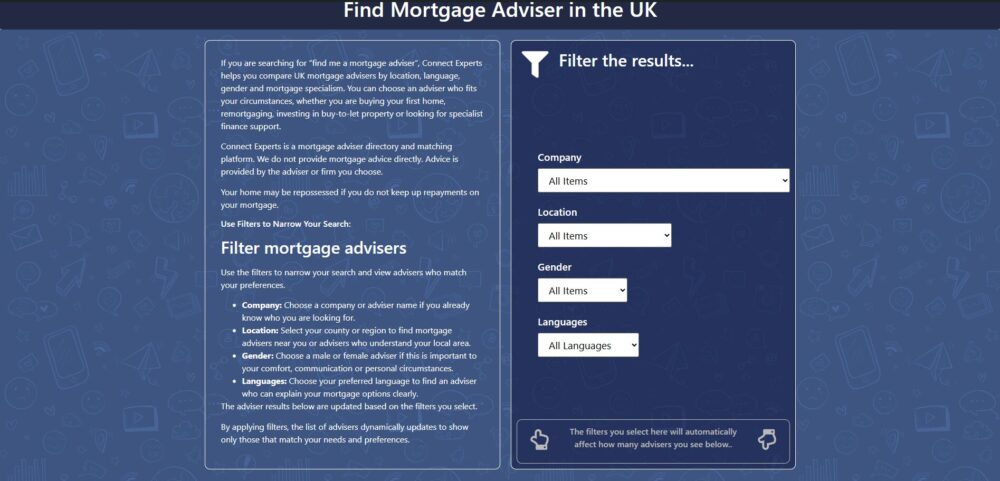
If you want to compare adviser profiles by location, language, or specialist area, you can use the Connect Experts Second Charge Mortgage Adviser Search.
Connect Experts is part of the Connect Group. It is a mortgage adviser directory and matching platform. Mortgage advice is provided by the adviser or firm you choose.
Why FCA Regulation Matters
Second charge mortgages secured against a main residence are regulated mortgage products.
This means lenders and intermediaries must assess suitability, affordability, fees, charges, and customer outcomes. The Financial Conduct Authority has also reviewed the second charge mortgage market and highlighted the need for good advice, robust affordability checks, and better outcomes for consumers.
You can read the FCA’s update on second charge mortgages and consumer outcomes.
Regulation does not remove risk. However, it sets expectations around how advice, affordability, and customer treatment should work.
Borrowing Against the Home You Already Own
A second charge mortgage with bad credit is not simply about borrowing more money.
It is about using the value in your home while accepting a new secured commitment. That requires care. The home may provide security for the lender, but it also carries meaning for the borrower.
Used properly, a second charge mortgage may help solve a practical problem. Used poorly, it may turn financial pressure into long-term risk.
The right question is not only “Can I get one?”
The better question is, “Should I get one, and is there a safer route?”
Connect Mortgages can help you review your options, compare possible routes, and understand whether a second charge mortgage is suitable for your circumstances.
FAQs: Second Charge Mortgages with Bad Credit
Can I get a second charge mortgage with bad credit?
Yes, it may be possible. Lenders will assess your equity, income, affordability, credit history, purpose of borrowing, and recent repayment history. Bad credit may reduce lender choice or increase the rate.
Does a second charge mortgage replace my current mortgage?
No. Your existing mortgage stays in place. The second charge mortgage runs alongside it as a separate secured loan.
Will bad credit mean a higher rate?
It can. Rates often reflect risk. Recent arrears, defaults, CCJs, or high debt levels may affect the rate and lender options.
Can I use a second charge mortgage to consolidate debt?
Yes, some homeowners use second charge mortgages for debt consolidation. However, this can turn unsecured debt into secured debt. It may also increase the total amount repaid if the loan runs over a longer term.
Is a second charge mortgage better than remortgaging?
Not always. It depends on your current mortgage rate, early repayment charges, credit history, affordability, and the total cost of each option.
Do I need equity in my property?
Yes. A second charge mortgage relies on available equity. The lender will assess the property value, current mortgage balance, and proposed new borrowing.
Can my first mortgage lender refuse a second charge?
Yes, the existing mortgage lender may need to give consent. If consent is refused, your adviser may need to review other options.
Will applying affect my credit file?
A full application may involve a hard credit search. Before that stage, an adviser may help you understand likely options and whether an application is sensible.
Is a second charge mortgage regulated?
Second charge mortgages secured against a main residence are regulated mortgage products. This means affordability, suitability, and customer outcomes are important parts of the process.
What is the biggest risk?
The main risk is that your home is used as security. If repayments are not maintained, your home may be repossessed.