
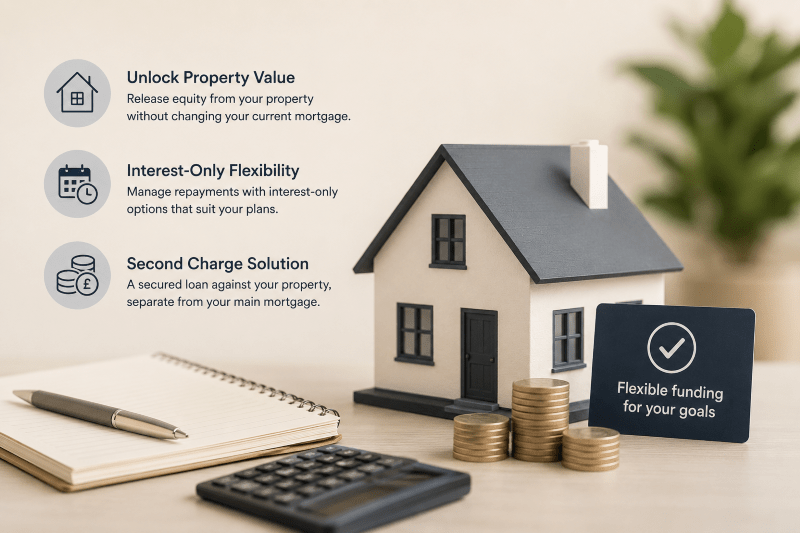
Interest-Only Second-Charge Mortgage: Costs, Risks and Repayment – An interest-only second-charge mortgage can look simple at first glance.
You borrow against the equity in your home. You keep your existing mortgage in place. Then, during the term, you pay interest only on the second loan.
However, the calmest products often need the clearest thinking.
With an interest-only second charge mortgage, the monthly payments may be lower than with a capital repayment loan. Yet the capital does not reduce during the term. The amount borrowed must still be repaid in full.
That is why the repayment plan matters as much as the loan itself.
At a Glance
An interest-only second charge mortgage is an extra loan secured against your property.
It sits behind your current mortgage, which remains the first charge. You usually pay the interest each month, while the original loan amount is repaid later.
This may help if you want to raise funds without remortgaging. For example, you may want to keep your current mortgage rate or avoid early repayment charges.
However, the capital still needs to be repaid. You should have a clear repayment strategy before applying.
What Is an Interest-Only Second-Charge Mortgage?
An interest-only second charge mortgage is a secured loan arranged against a property that already has a mortgage.
Your existing mortgage stays in place. The new loan is added behind it as a second legal charge.
This means the first mortgage lender has priority if the property is sold due to missed payments. The second charge lender is repaid after the first lender.
That order matters. It affects risk, pricing and lender appetite.
With an interest-only structure, your monthly payment usually covers interest only. The capital balance remains outstanding until the agreed repayment point.
For a broader explanation of how secured homeowner borrowing works, read our guide to Second Charge Mortgages.
How The Interest-Only Structure Works
A repayment second charge reduces the loan balance over time.
An interest-only second charge works differently.
You may pay the interest each month, but the original amount borrowed remains in place. If you borrow £50,000, the balance may still be £50,000 at the end of the term, unless you make separate capital reductions.
This can reduce monthly payments compared with a repayment structure. However, it does not remove the debt.
That is the central point.
Interest-only borrowing can help with cash flow, but it needs discipline. The lower payment is not a discount. It is a delay in capital repayment.
The Different Types of Interest-Only Mortgages Available

Two main types of interest-only mortgages are available:
- Fixed interest rate
- Variable interest rate.
A fixed-interest-rate mortgage ensures your loan’s interest rate stays unchanged for a set period. This remains unchanged regardless of economic conditions. It may benefit borrowers if interest rates increase, as repayments will not rise.
A variable-interest-rate mortgage means your loan’s interest rate can change based on market conditions. If rates decrease, your repayments may also go down. However, higher payments could occur if rates increase. When choosing an interest-only second-charge mortgage, it’s important to decide which rate suits your needs. If unsure, consult a financial advisor to explore your options.
Why Homeowners Consider Interest-Only Second Charge Borrowing
Homeowners may consider this product when they need extra borrowing but do not want to disturb their existing mortgage.
Common reasons include:
- Keeping a low fixed rate on the main mortgage.
- Avoiding early repayment charges.
- Raising funds for home improvements.
- Supporting a short or medium-term financial plan.
- Keeping the extra borrowing separate from the main mortgage.
- Borrowing when the current lender will not offer a further advance.
- Managing monthly payments where affordability supports the arrangement.
A second charge may also be considered when remortgaging the whole balance would be expensive.
For example, a homeowner may have a low first mortgage rate. Remortgaging could transfer the full mortgage balance onto a higher-rate loan. A second charge may allow only the extra borrowing to be priced separately.
That does not make it automatically suitable. It simply provides another route for comparison. You can read more about this wider borrowing route in our guide to Raising Capital Using a Second Charge.
The Repayment Strategy Is The Heart Of The Product
An interest-only second charge mortgage should not be judged by the monthly payment alone.
The key question is simple:
How will the capital be repaid?
A repayment strategy may involve:
- Sale of the property.
- Sale of another asset.
- Savings or investments.
- Pension funds, where suitable and available.
- Expected future income.
- Downsizing.
- Switching to a repayment structure later.
- Refinancing, where this is realistic.
The repayment strategy should be credible. It should not depend on hope alone.
Property values can change. Income can change. Personal plans can change. Therefore, the exit route needs to be reviewed carefully before the loan starts.
The Financial Conduct Authority has reviewed second charge mortgage advice, fees, charges and affordability assessments. You can read the FCA’s findings on second charge mortgages and consumer outcomes.
Affordability: What Lenders May Review
Lenders do not usually look only at the equity in your home.
They may assess whether the loan is affordable based on your income, spending, commitments and future payment risk.
This may include:
- Your income.
- Your existing mortgage payment.
- The proposed second charge payment.
- Credit commitments.
- Household bills.
- Dependants.
- Credit history.
- Employment or self-employed income evidence.
- Property value.
- Existing mortgage balance.
- Loan purpose.
- Loan-to-value.
- Exit or repayment strategy.
Where the loan is interest-only, the lender may also look closely at how the capital will be repaid.
This is important because the loan does not reduce in the usual way.
The Application Process for an Interest-Only Second-Charge Mortgage
The process of applying for an interest-only second-charge mortgage is straightforward. You will need to complete forms and share details about your financial situation. Lenders typically ask about your income, savings, outstanding debts, and other financial commitments. This helps them decide if you qualify for the loan.
After you submit your application, the lender will assess it and confirm whether the loan can be offered. If approved, you must sign the required paperwork and make regular monthly payments as agreed.
It is important to compare different lenders before applying. Researching options ensures you find the most suitable deal for your needs.
Interest-Only Second Charge Mortgage Vs Repayment Second Charge
The difference is not just monthly cost. It is the way risk moves through time.
| Feature | Interest-Only Second Charge | Repayment Second Charge |
|---|---|---|
| Monthly payments | Usually lower | Usually higher |
| Capital balance | Usually remains outstanding | Reduces over time |
| End-of-term risk | Higher if repayment strategy fails | Lower if payments are maintained |
| Cash flow | May be easier monthly | Less flexible monthly |
| Total planning need | Strong repayment strategy needed | Built-in capital repayment |
| Suitability | Depends on purpose and exit plan | Depends on affordability and term |
An interest-only option may suit some borrowers. Yet a repayment option may give more certainty.
The right choice depends on your budget, term, purpose and long-term plan.
Interest-Only Second Charge Mortgage Vs Remortgage
A remortgage replaces your current mortgage.
A second charge mortgage runs alongside it.
This difference can be important when your current mortgage still works well.
A second charge may be worth reviewing if:
- Your current mortgage rate is low.
- You face early repayment charges.
- Your current lender will not offer more borrowing.
- You only need the extra funds separately.
- Your income or credit profile needs specialist review.
A remortgage may be worth reviewing if:
- Your current deal is ending.
- There are no early repayment charges.
- One mortgage payment would be simpler.
- A new overall rate is better.
- You want to restructure the full mortgage balance.
For a wider explanation of how second mortgages work, read our guide to Second Mortgage.
Interest-Only Second Charge Mortgage For Home Improvements
Home improvements are a common reason for secured borrowing.
A homeowner may want to fund an extension, a kitchen renovation, a loft conversion, or essential property work.
An interest-only second charge may reduce the monthly cost during the works. This can help when the household is managing project costs at the same time.
However, renovation budgets often move.
Before applying, it helps to ask:
- Is the full project cost clear?
- Has a contingency been included?
- Are planning or building control issues settled?
- Will the work improve how the home is used?
- Could the payment remain affordable if costs rise?
- How will the second charge capital be repaid?
The property may feel like the reason for borrowing. Yet the repayment plan remains the foundation.
Interest-Only Second Charge Mortgage For Debt Consolidation
Debt consolidation needs careful advice.
A second charge mortgage may reduce monthly payments by spreading debt over a longer term. However, this can increase the total amount paid back.
It can also turn unsecured debt into debt secured against your home.
That changes the risk.
Credit cards and personal loans are usually unsecured. A second charge mortgage is secured against your property.
Before consolidating debts, consider:
- Why the debt built up.
- Whether spending habits have changed.
- The total cost over the full term.
- Whether existing debts will be cleared.
- Whether you may use the cleared credit again.
- The risk of securing short-term debt over a long period.
- Whether free debt advice is needed before borrowing more.
MoneyHelper explains that second mortgages are secured on the property and that failing to repay could put the property at risk. Its guide to second charge or second mortgages is useful for borrowers reviewing the basics.
Costs To Consider
The headline interest rate is only one part of the cost.
You may also need to consider:
- Lender arrangement fees.
- Broker fees.
- Valuation fees.
- Legal costs.
- Early repayment charges.
- Exit fees.
- Product fees.
- Higher total interest over a longer term.
- The cost of keeping two secured loans.
The cheapest monthly payment may not be the cheapest loan.
A longer term can reduce the monthly payment but increase the total interest paid. An interest-only structure can reduce monthly payments, but the capital still has to be repaid.
This is where the technical and practical sides meet.
A mortgage is not just a product. It is a commitment that must survive ordinary life.
Who Might An Interest-Only Second Charge Mortgage Suit?
It may suit some homeowners who:
- Have enough property equity.
- Can afford the monthly interest payments.
- Have a credible repayment strategy.
- Want to keep their current mortgage.
- Face high early repayment charges.
- Need funds for a specific purpose.
- Understand that the capital remains outstanding.
- Have reviewed alternatives before applying.
It may not suit borrowers who:
- Do not have a clear repayment plan.
- Are already struggling with payments.
- Want to consolidate debts without changing spending habits.
- Need long-term certainty.
- Would be better served by a further advance or remortgage.
- Do not understand the risk of secured borrowing.
- Are relying only on future property growth.
What Alternatives Should Be Compared?
An interest-only second charge mortgage should be compared with other routes.
These may include:
- A repayment second charge mortgage.
- A remortgage.
- A further advance from your current lender.
- A personal loan.
- Savings.
- Bridging finance, where short-term finance is suitable.
- Waiting until your current mortgage deal ends.
- Reducing the amount borrowed.
The right route depends on cost, risk, purpose and timing.
You can use our mortgage calculators to review basic repayment figures before speaking with an adviser.
Practical Questions To Ask Before Applying
Before applying, ask yourself:
- Why do I need the money?
- Is the loan purpose clear?
- Can I afford two secured loans?
- What happens if my income falls?
- What happens if rates change?
- What fees apply?
- What is the total cost?
- How will I repay the capital?
- Is the repayment strategy realistic?
- Have I compared a remortgage and further advance?
- Do I understand the risk to my home?
These questions are not designed to stop you borrowing.
They are designed to slow the decision down enough for it to become clearer.
Speaking To A Second Charge Mortgage Adviser
Interest-only second charge mortgages can be technical.
The adviser needs to understand your current mortgage, your borrowing purpose, your repayment strategy, your affordability and your long-term plans.
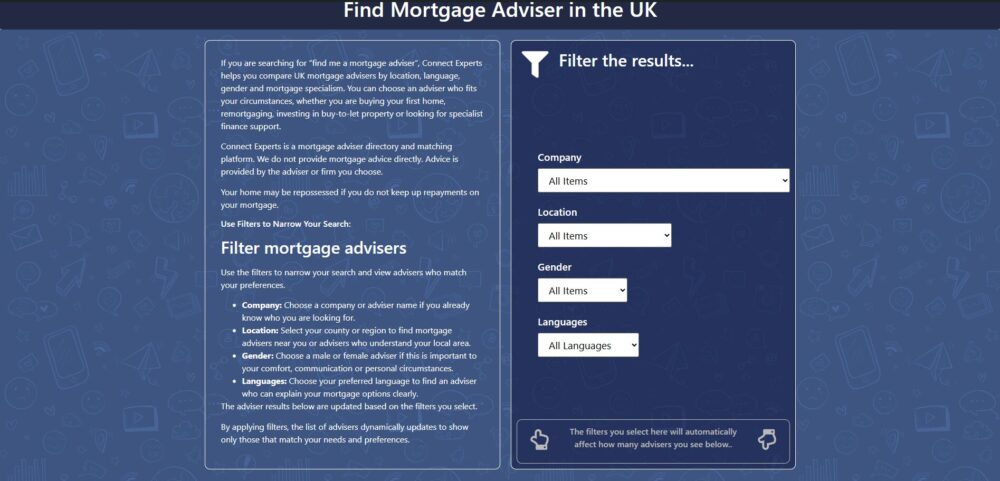
Some borrowers also prefer to choose an adviser by location, language or specialist experience. You can use Connect Experts to find Second Charge Brokers across the UK.
Connect Experts is a mortgage adviser directory and matching platform. Mortgage advice is provided by the adviser or firm you choose.
Interest-Only Second Charge Mortgage FAQs
What is an interest-only second charge mortgage?
It is an additional loan secured against a property that already has a mortgage. The current mortgage remains in place. The second charge sits behind it. With an interest-only structure, you usually pay interest each month and repay the capital later.
Does my existing mortgage change?
Usually, your existing mortgage stays in place. The second charge mortgage is arranged separately and runs alongside it.
Why would someone choose interest-only?
Some borrowers choose interest-only to reduce monthly payments. However, the capital still needs to be repaid. This means the repayment strategy is very important.
Is an interest-only second charge mortgage cheaper?
Not always. It may have lower monthly payments than a repayment loan, but the capital does not reduce. The total cost depends on the rate, fees, term and how the loan is repaid.
Can I use it for home improvements?
Yes, some borrowers use second charge borrowing for home improvements. Suitability depends on affordability, property equity, lender criteria and the repayment plan.
Can I use it for debt consolidation?
It may be possible, but debt consolidation needs careful advice. You may reduce monthly payments, but you could pay more over time. You may also turn unsecured debts into debt secured against your home.
What happens at the end of the term?
The capital balance must be repaid. This is why lenders and advisers will usually want to understand your repayment strategy before the loan starts.
Is my home at risk?
Yes. A second charge mortgage is secured against your property. Your home may be repossessed if you do not keep up repayments on your mortgage or any loan secured against it.
Is this better than remortgaging?
It depends. A second charge may help if you want to keep your current mortgage rate or avoid early repayment charges. A remortgage may be better if your current deal is ending or if one loan is more suitable.
Do I need advice?
Advice is strongly recommended. Interest-only second charge borrowing involves affordability, secured lending risk, repayment planning and product comparison.