
How a Mortgage Specialist Helps You Buy a Home: Buying a home is not only a financial decision.
It is a practical test of timing, evidence, affordability and judgement.
A property may feel right when you first view it. Yet the mortgage has to work on paper. A lender must assess your income, outgoings, deposit, credit profile, property type and future affordability before they agree to lend.
That is where a mortgage specialist can make a real difference.
A mortgage specialist helps you understand what lenders look for, how your application may be assessed, and what documents you need before you apply. They can also explain which mortgage routes may suit your situation, from a standard residential purchase to a more complex case involving variable income, self-employment or past credit issues.
At a Glance
A mortgage specialist helps you buy a home by checking affordability, comparing suitable mortgage options, preparing your documents and managing the application with the lender.
They can help you understand loan-to-value, fixed and variable rates, lender criteria, credit checks, valuations, legal stages and protection needs.
This can be especially useful if you are a first-time buyer, self-employed, moving home, buying with another person or dealing with a more complex income or credit profile.
Before you make an offer, it can help to understand the basics of a residential mortgage and how lenders assess risk.
What Does a Mortgage Specialist Actually Do?
A mortgage specialist reviews your circumstances before matching them to lender criteria.
That sounds simple. In practice, it involves many moving parts.
They may review:
- Your income
- Your employment type
- Your deposit
- Your credit history
- Your monthly commitments
- Your property plans
- The mortgage term
- The repayment method
- The lender’s affordability model
- The property type and condition
A mortgage is not just about finding a low rate. A low rate has little value if the lender will not accept your income, property type or credit profile.
The right mortgage route should match both the person and the property.
Why Lender Criteria Matters
Every lender has its own rules.
One lender may accept certain income. Another may ignore it. One lender may be comfortable with a gifted deposit. Another may ask more questions. Some lenders may accept one year of accounts for self-employed applicants. Others may want a longer trading record.
A mortgage specialist helps you avoid wasted applications by checking lender criteria before you proceed.
This matters because a mortgage application is not only about whether you can afford the repayments. It is also about whether your case fits the lender’s policy.
A strong application is usually built before it is submitted.
How Affordability Is Assessed
Affordability is one of the most important parts of the mortgage process.
Lenders usually assess your income against your regular commitments and living costs. They may also consider future rate changes, dependants, credit commitments and the length of the mortgage term.
A mortgage specialist can help you understand how these details may affect your borrowing position.
For example, two applicants with the same salary may receive different borrowing outcomes. One may have childcare costs, car finance and credit card balances. The other may have fewer commitments and a larger deposit.
The salary may look the same. The lending risk may not.
You can use the residential affordability calculator to get an early guide before speaking with an adviser.
Deposit, Loan-to-Value and Product Choice
Your deposit affects the loan-to-value, often called LTV.
Loan-to-value is the percentage of the property price you need to borrow. For example, if you buy a home for £300,000 and need a £270,000 mortgage, your LTV is 90%.
LTV can affect:
- The mortgage rates available
- The lender options
- The affordability result
- The level of risk to the lender
- The size of your monthly repayments
A larger deposit may improve your product options. However, this is not the only factor. Income, credit history, property type and commitments still matter.
A mortgage specialist can help you compare the practical differences between a smaller deposit and a larger deposit. This can help you decide whether to buy now or save longer.
If you are buying your first property, the first-time buyer mortgage page explains key points for new buyers.
Fixed Rate, Tracker Rate or Variable Rate?
Mortgage product type matters because it affects cost, certainty and flexibility.
A fixed-rate mortgage gives a set interest rate for a chosen period. This can help with budgeting because payments stay stable during the fixed term.
A tracker mortgage usually follows a rate such as the Bank of England base rate, plus a set percentage. Payments can rise or fall.
A variable rate can also change. This may suit some borrowers, but it can create less certainty.
A mortgage specialist can explain:
- How long the rate lasts
- Whether early repayment charges apply
- What happens when the deal ends
- Whether the product has arrangement fees
- How the monthly payment may change
- Whether overpayments are allowed
The cheapest-looking rate is not always the most suitable option.
Fees, flexibility and timing can change the real cost.
The Documents You May Need
Mortgage applications rely on evidence.
A mortgage specialist can help you prepare the required documents before the lender requests them. This can reduce delays and help the application move more smoothly.
You may need:
- Proof of identity
- Proof of address
- Recent payslips
- Bank statements
- Proof of deposit
- Credit commitments
- Employment details
- Tax calculations
- Company accounts
- Gifted deposit evidence
- Details of the property
Self-employed applicants may need more detailed income evidence. This can include tax documents, accounts, business bank statements or accountant details.
If your income is not straightforward, the self-employed mortgage page explains how lenders may assess trading income.
Credit History and Mortgage Applications
Credit history can affect lender choice.
A missed payment, default, county court judgment or debt management plan may reduce the number of available lenders. However, it does not always mean you cannot get a mortgage.
The timing, amount, reason and current position all matter.
A mortgage specialist can help you understand which lenders may consider your case and what evidence may be needed.
They can also help you avoid applying to lenders that are unlikely to accept your profile.
This is important because a declined application can waste time and may create stress during a property purchase.
If you have previous credit issues, read more about an adverse credit mortgage before you apply.
Agreement in Principle: Useful, But Not a Guarantee
An agreement in principle can help show an estate agent that you may be able to borrow.
However, it is not a formal mortgage offer.
A lender still needs to assess the full application, property valuation and supporting documents. The final decision can change if the details do not match the original information.
A mortgage specialist can help you understand what an agreement in principle does and does not confirm.
This helps you make offers with more awareness.
Confidence matters when buying a home. False certainty can be expensive.
The Property Also Has To Fit
Mortgage approval is not only about the buyer.
The property must also be acceptable to the lender.
Lenders may look at:
- Property condition
- Construction type
- Lease length
- Location
- Valuation
- Flood risk
- Title issues
- Nearby commercial use
- Structural concerns
Some properties can be harder to mortgage. This may include certain flats, short leases, unusual construction or properties needing major repairs.
A mortgage specialist can help flag potential concerns before you become too committed.
A beautiful home still has to pass a lender’s test.
Valuation, Survey and Legal Work
Once you apply, the lender will usually arrange a valuation.
This is for the lender’s benefit. It helps them decide whether the property is suitable security for the mortgage.
A buyer may also choose a separate survey. This can provide more detail about the condition of the property.
Your solicitor or conveyancer will handle the legal work. This may include title checks, searches, contract review and completion arrangements.
A mortgage specialist does not replace your solicitor. However, they can help keep the mortgage side moving while the legal work progresses.
How a Mortgage Specialist Helps With Timing
Timing can shape the whole buying process.
A mortgage specialist can help you understand when to:
- Check affordability
- Prepare documents
- Get an agreement in principle
- Make an offer
- Submit the mortgage application
- Review the mortgage offer
- Plan for completion
They can also explain when a product may need to be secured and how long an offer may last.
This matters because buying a home often involves several people. The buyer, seller, estate agent, lender, valuer and solicitor all move at different speeds.
A calm process often starts with better preparation.
Practical Costs Beyond the Mortgage
A mortgage payment is only one part of buying a home.
You may also need to budget for:
- Deposit
- Stamp duty
- Legal fees
- Survey costs
- Valuation fees
- Product fees
- Broker fees
- Moving costs
- Insurance
- Repairs or furniture
A mortgage specialist can help you see the wider cost picture before you commit.
You can also use the stamp duty calculator to estimate one of the main purchase costs.
Protection After Completion
Buying a home creates responsibility.
A mortgage can last for many years. During that time, life can change. Illness, injury, death, job changes or family changes may affect how affordable the mortgage remains.
That is why protection should be considered as part of the wider mortgage conversation.
Protection may include life cover, critical illness cover, income protection, buildings insurance or contents insurance.
Not every buyer needs the same cover. However, every buyer should understand the risk of having no plan.
You can read more about mortgage protection and life insurance before deciding what may suit your circumstances.
When Should You Speak To a Mortgage Specialist?
You do not need to wait until you have found a property.
In many cases, it is better to speak with a mortgage specialist before viewing homes seriously.
This can help you understand:
- Your realistic budget
- Your deposit position
- Your likely lender options
- Your documentation needs
- Your monthly payment range
- Any issues to resolve early
This is especially useful if your case is not simple.
You may benefit from specialist advice if:
- You are buying your first home
- You are self-employed
- You earn variable income
- You have commission or bonuses
- You have credit commitments
- You have previous credit issues
- You are buying with another person
- Your deposit is gifted
- The property is unusual
- You need a clear view before making an offer
A mortgage specialist does not make the decision for you. They help you understand the decision in front of you.
That is the practical value.
How Connect Mortgages Can Help
Connect Mortgages helps UK clients explore mortgage and protection options based on their circumstances.
The aim is not to make the process sound simpler than it is. The aim is to make it clearer.
A mortgage specialist can explain what lenders may look for, what documents you may need and which mortgage route may be suitable.
They can also help you understand the difference between what you want to borrow and what a lender may responsibly offer.
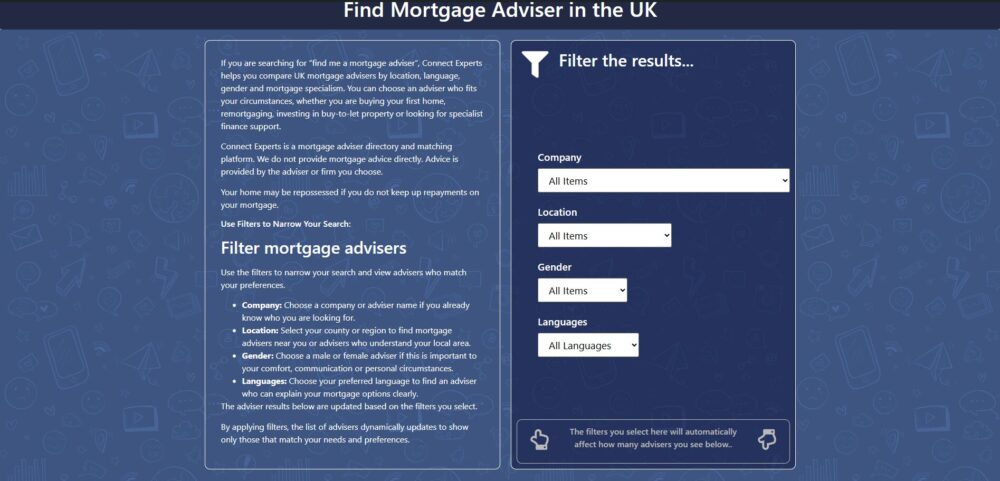
If you would like to compare advisers by location, language or mortgage expertise, you can also use Connect Experts to find your mortgage broker.
FAQs: How a Mortgage Specialist Helps You Buy a Home
What is a mortgage specialist?
A mortgage specialist is a qualified adviser who helps clients understand mortgage options, lender criteria and the application process.
They can assess your circumstances and recommend a suitable mortgage route.
Is a mortgage specialist the same as a mortgage broker?
The terms are often used in similar ways.
A mortgage broker usually compares mortgage products from different lenders. A mortgage specialist may also have deeper experience with more complex cases, such as self-employed income, adverse credit or unusual property types.
Can a mortgage specialist help before I make an offer?
Yes.
It can be helpful to speak with a mortgage specialist before making an offer. This may help you understand your budget, deposit, lender options and likely documentation needs.
Does an agreement in principle mean I will get the mortgage?
No.
An agreement in principle is not a formal mortgage offer. The lender still needs to assess the full application, supporting documents and property valuation.
What documents do I need for a mortgage?
You may need proof of identity, proof of address, income evidence, bank statements, deposit evidence and details of your commitments.
Self-employed applicants may need tax documents, accounts or business records.
Can a mortgage specialist help with bad credit?
Yes.
A mortgage specialist can help identify lenders that may consider applicants with previous credit issues. The outcome will depend on the detail, timing and severity of the credit problem.
Can a mortgage specialist help self-employed buyers?
Yes.
Self-employed buyers may need to provide different income evidence. A mortgage specialist can help explain how lenders may assess trading income, company accounts or tax documents.
Why does lender criteria matter?
Lender criteria decides who a lender may accept and under what conditions.
Criteria can affect income assessment, deposit rules, property type, credit history and affordability.
Should I choose the mortgage with the lowest rate?
Not always.
The lowest rate may include fees, restrictions or criteria that do not suit your situation. A mortgage specialist can help compare the wider cost and practical fit.
What is the main benefit of using a mortgage specialist?
The main benefit is clarity.
A mortgage specialist can help you understand what is possible, what evidence is needed and how to approach the application with fewer surprises.
Your home may be repossessed if you do not keep up repayments on your mortgage or loans secured on it.