Fixed vs Variable Mortgage: Should You Choose a Fixed or Variable Mortgage Rate?
Choosing between a fixed and variable mortgage is not just a rate decision.
It is a question of certainty, risk, timing and monthly affordability. A lower rate may look attractive today. However, the right mortgage should still work if your income changes, costs rise, or interest rates move.
A fixed-rate mortgage gives you set monthly payments for an agreed period. A variable-rate mortgage can rise or fall, depending on the product type and the lender’s terms.
This guide explains how fixed, tracker, discount and standard variable rate mortgages work. It also shows what to compare before you decide.
If you are buying your first home, our first-time buyer mortgage guide may also help. If your current deal is ending, read our remortgage advice before you move onto a new rate.
Fixed Vs Variable Mortgage
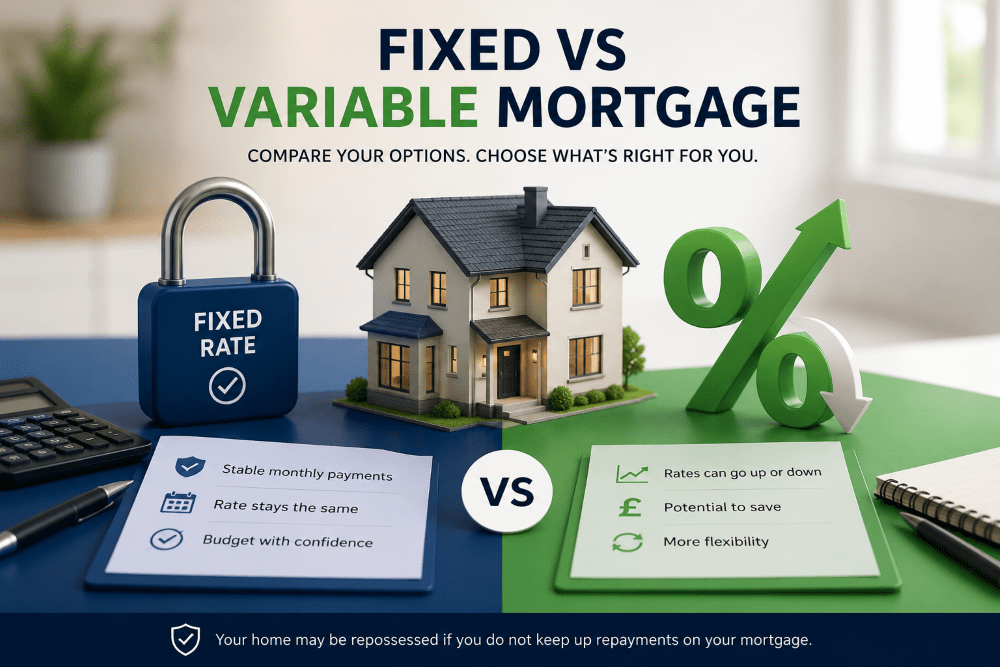
A fixed-rate mortgage may suit you if you want predictable monthly repayments.
A variable-rate mortgage may suit you if you can accept payment changes and want more flexibility.
A tracker mortgage usually follows the Bank of England base rate.
A discount mortgage usually follows a lender’s standard variable rate, minus a set discount.
A standard variable rate can change at the lender’s discretion.
The lowest initial rate is not always the best deal. Fees, early repayment charges, overpayment rules and your future plans all matter.
Use our mortgage calculators to test repayment changes before choosing a rate.
What is a fixed-rate mortgage?
A fixed-rate mortgage keeps your interest rate the same for an agreed period.
Common fixed periods include two, three, five and ten years. During that period, your monthly mortgage repayments stay the same.
This can help if you want a stable budget. It can also help if you are concerned that interest rates may rise.
For example, a borrower with childcare costs, school fees or one main household income may value fixed payments. A fixed rate can make monthly planning easier.
However, fixed rates can have limits. Many fixed-rate deals include early repayment charges. These may apply if you repay, switch or move away from the deal early.
Fixed Rate Mortgage Benefits
- Your monthly repayments stay the same during the fixed period.
- You are protected from rate rises during the fixed period.
- Budgeting is easier because payments are predictable.
- A fixed rate can help first-time buyers plan with more confidence.
- It may suit borrowers who do not want their payments to change regularly.
Fixed-Rate Mortgage Points To Check
- You may not benefit if interest rates fall.
- You may pay an early repayment charge if you leave early.
- You may have limits on mortgage overpayments.
- The rate may move to your lender’s SVR when the fixed period ends.
- Longer fixed rates may reduce flexibility if your plans change.
If you expect to move home soon, check whether the mortgage is portable. Our moving home mortgage guide explains what to consider when your plans may change.
What Is A Variable Rate Mortgage?
A variable-rate mortgage has an interest rate that can change.
This means your monthly repayments may rise or fall. The way the rate changes depends on the type of variable mortgage.
The main types are:
- Tracker mortgage
- Discount mortgage
- Standard variable rate mortgage
- Capped rate mortgage, where available
Variable rates can appeal to borrowers who want flexibility. However, they can be harder to budget for because payments are not guaranteed.
Before choosing a variable rate, check whether your monthly budget could absorb a payment rise. Our residential affordability calculator can help you review borrowing in relation to your income and outgoings.
What Is A Tracker Mortgage?
A tracker mortgage usually follows an external rate.
In the UK, this is often the Bank of England base rate. The lender then adds a set percentage above that rate.
For example, a tracker may be priced at Bank Rate plus 0.75%.
If the Bank of England base rate rises, your mortgage rate usually rises. If the base rate falls, your mortgage rate usually falls.
Tracker mortgages can be useful if you want the chance to benefit from falling rates. They may also offer fewer early repayment charges than fixed products, but this is not guaranteed.
Tracker Mortgage Benefits
- Your payments may fall if the tracked rate falls.
- Some tracker deals offer more flexibility.
- Some trackers have lower or no early repayment charges.
- They can suit borrowers who may switch again soon.
Tracker Mortgage Points To Check
- Your payments may rise if the tracked rate rises.
- You need room in your budget for higher repayments.
- The deal may still include fees or charges.
- The tracker margin may make the deal less competitive.
- It may not suit borrowers who need payment certainty.
What Is A Discount Mortgage?
A discount mortgage gives you a discount from the lender’s standard variable rate.
For example, if the lender’s SVR is 7% and your discount is 2%, your pay rate would be 5%.
The discount may be fixed, but the lender’s SVR can change. This means your actual payment can still rise or fall.
Discount mortgages can look attractive at the start. However, you need to understand the lender’s SVR and how often it could change.
Discount Mortgage Benefits
- The starting rate may be lower than that of some other products.
- Your payments may fall if the lender reduces its SVR.
- It may suit borrowers who accept some payment movement.
- Some deals may offer useful short-term flexibility.
Discount Mortgage Points To Check
- The lender can change its SVR.
- Your payments can rise even if the Bank of England base rate does not change.
- The discount period may end before your mortgage term.
- You may move to a higher rate after the deal ends.
- There may still be early repayment charges.
What Is a Standard Variable-Rate Mortgage?
A standard variable rate, often called SVR, is the lender’s standard mortgage rate.
Borrowers often move onto SVR when a fixed, tracker or discount deal ends. The lender can change its SVR, and it may be higher than new mortgage deals.
Being on SVR is not always wrong. It may give flexibility if you plan to repay, sell or remortgage shortly.
However, many borrowers review their options before moving on to SVR. This is because payments can rise, and the rate may be less competitive.
If your current deal is ending soon, review your options early through our remortgage advice.
Fixed Vs Variable Mortgage Comparison
| Feature | Fixed Rate Mortgage | Variable Rate Mortgage |
|---|---|---|
| Monthly repayments | Stay the same during the fixed period | Can rise or fall |
| Budget certainty | Higher | Lower |
| Link to interest rates | Not during the fixed period | Often linked to Bank Rate or lender’s SVR |
| Flexibility | Often lower | Often higher |
| Early repayment charges | Common during the fixed period | Maybe lower, but check the deal |
| Benefit if rates fall | Usually no | Possible |
| Risk if rates rise | Protected during the fixed period | Payments may increase |
| Best suited to | Borrowers who want certainty | Borrowers who can manage payment changes |
| Important check | What happens when the fixed period ends | How high could payments rise |
Which Mortgage Rate May Suit You?
There is no single best answer.
A fixed mortgage may suit you if you need certainty. A variable mortgage may suit you if you can accept risk and want flexibility.
The better question is this:
Can your household cope if your mortgage payment increases?
If the answer is no, payment certainty may matter more than chasing a lower starting rate.
If the answer is yes, a variable or tracker rate may be worth comparing. However, you should still check total cost, fees and exit terms.
When a Fixed-Rate Mortgage May Be Better
A fixed rate may be more suitable if:
- You want stable monthly repayments.
- You are buying your first home.
- Your budget has limited spare income.
- You expect rates may rise.
- You do not plan to move soon.
- You prefer certainty over flexibility.
- You want easier household planning.
A fixed rate can be especially useful when affordability is tight. It can also support borrowers who want clear monthly figures before committing.
When A Variable Rate Mortgage May Be Better
A variable rate may be more suitable if:
- You can cope with higher repayments.
- You may move, sell or repay soon.
- You expect rates may fall.
- You want more flexibility.
- You are comfortable reviewing the market regularly.
- You have savings or income room to absorb changes.
- You understand how your rate is calculated.
Variable rates can work well for some borrowers. However, they need active review and a clear budget buffer.
Fixed Or Variable Mortgage For First-Time Buyers
First-time buyers often value certainty.
A fixed rate can help you plan your first household budget. It may also reduce the stress of payment changes during the early years of ownership.
However, some first-time buyers still consider variable options. This may apply if they have strong savings, flexible income or a shorter-term plan.
Before deciding, compare repayments against your full monthly budget. Include council tax, utilities, insurance, service charges and maintenance.
You can also read our first-time buyer mortgage guide for a wider view of the buying process.
Fixed Or Variable Mortgage When Remortgaging
Remortgaging is often when this decision becomes most important.
If your fixed rate is ending, your lender may move you onto its SVR unless you choose a new deal. That could increase your monthly payment.
A new fixed rate may protect your budget. A tracker or variable rate may offer flexibility if you think rates could fall.
The right option depends on:
- Your current rate end date.
- Your remaining mortgage balance.
- Your loan-to-value.
- Your income and outgoings.
- Your credit profile.
- Your moving plans.
- Any early repayment charges.
- Any arrangement or valuation fees.
If your credit file has changed since your last application, read our credit file guide before applying.
The Role Of The Bank Of England Base Rate
The Bank of England base rate matters because it can influence borrowing costs.
Tracker mortgages usually move directly with the rate they follow. Other variable rates may also be affected by wider rate changes.
Fixed rates are different. Once your fixed rate starts, your monthly payment does not change for the duration of the fixed period. However, new fixed-rate deals can still change before you apply.
This is why timing matters. A deal available today may not be available later.
Look Beyond The Interest Rate
A mortgage with the lowest rate is not always the cheapest mortgage.
You should also check:
- Arrangement fees.
- Valuation fees.
- Legal costs.
- Early repayment charges.
- Overpayment limits.
- Cashback offers.
- The rate after the deal ends.
- Whether the deal can be ported.
- The total cost over the deal period.
A slightly higher rate with lower fees may be better in some cases. A lower rate with a high fee may only work for larger mortgage balances.
Payment Certainty Vs Flexibility
This is the heart of the fixed vs variable mortgage decision.
A fixed rate gives certainty. You know what you will pay each month during the fixed period.
A variable rate gives movement. Your payment can change, which may help or hurt your budget.
Neither option is automatically better. The right choice depends on your income, savings, plans and attitude to risk.
Mortgage Protection And Rate Choice
Your mortgage payment is only one part of the household risk.
If your income stopped due to illness, injury or death, even a fixed payment could become difficult to maintain.
That is why many borrowers review protection when arranging a mortgage. You can read more in our mortgage protection and life insurance guide.
Questions To Ask Before Choosing
Ask these questions before choosing a fixed or variable mortgage:
- Do I need payment certainty?
- Could I afford a higher monthly payment?
- How long do I expect to stay in the property?
- Am I likely to repay, overpay or move soon?
- Does the mortgage include early repayment charges?
- What happens when the deal ends?
- How does the total cost compare?
- Is the product suitable for my wider plans?
- Have I checked fees as well as the rate?
If you want regulated advice, you can find a mortgage adviser through Connect Experts.
Common Mistakes To Avoid
Avoid choosing a mortgage based only on the headline rate.
Also avoid leaving the decision until your current deal has already ended. You may move onto SVR if you do not act in time.
Common mistakes include:
- Comparing rates without comparing fees.
- Ignoring early repayment charges.
- Assuming variable payments will only fall.
- Fixing for too long without considering future plans.
- Choosing flexibility without a payment buffer.
- Forgetting what happens after the deal period.
- Not checking whether overpayments are allowed.
So, Fixed Or Variable?
Choose fixed if certainty matters most.
Choose variable if flexibility matters more and you can manage payment changes.
Choose tracker if you understand how Bank Rate movements could affect repayments.
Be cautious with SVR unless you have a short-term reason to stay there.
Most borrowers should compare several options before deciding. The right mortgage is not just the one with the lowest starting rate. It is the one that fits your payment risk, plans and long-term affordability.
Speak To Connect Mortgages
Connect Mortgages can help you compare fixed, tracker, discount and variable mortgage options.
We can review your circumstances, explain the risks and help you understand the total cost of each route.
Important Information
Your home may be repossessed if you do not keep up repayments on your mortgage.
Connect Mortgages is a trading style of Connect IFA Ltd, which is authorised and regulated by the Financial Conduct Authority.
Mortgage advice should be based on your personal circumstances. Rates, fees and lending criteria can change.