

A limited company buy-to-let remortgage is not just a rate review.
It can affect lender choice, rental stress testing, company structure, legal work, tax planning and future portfolio plans.
At Connect Mortgages, we help UK landlords review buy-to-let remortgage options for properties held through limited companies, including Special Purpose Vehicles, often called SPVs.
We can also explain the mortgage route if you are considering moving a personally owned buy-to-let into a limited company. However, you should always take tax and legal advice before changing ownership.
Contact Connect Mortgages to speak with a mortgage adviser.
Limited Company Buy-to-Let Remortgage At A Glance
A limited company buy-to-let remortgage may be used to refinance a rental property owned by a company.
It may also be considered when a landlord wants to move a personally owned rental property into a company structure.
Landlords often review this route when:
- Their current mortgage deal is ending
- They want to review the current interest rate
- They want to raise capital from a rental property
- They want to refinance a property held in an SPV
- Their rent has changed
- Their portfolio has grown
- They want to review lender choice
- They are restructuring wider buy-to-let borrowing
HMRC guidance explains that property businesses carried on through companies are treated within Corporation Tax rules. GOV.UK also explains that Corporation Tax applies to company profits.
This is why mortgage advice and tax advice should be kept separate.
Connect Mortgages can advise on mortgage options and lender criteria. A qualified accountant or tax adviser should advise on tax, ownership and profit planning.
What Is A Limited Company Buy-to-Let Remortgage?
A limited company buy-to-let remortgage is a new mortgage on a rental property owned by a limited company.
The new mortgage may replace the current lender, change the product, raise funds or support a wider portfolio plan.
The company is usually the borrower. Directors may also need to give personal guarantees, depending on lender criteria.
Lenders will usually assess:
- The limited company
- The directors
- The shareholders
- The property
- The rental income
- The loan-to-value ratio
- The company SIC codes
- The current mortgage balance
- The wider buy-to-let portfolio
- The reason for remortgaging
For wider guidance, read our Limited Company Buy-to-Let Mortgages page.
Why Landlords Remortgage A Limited Company Buy-to-Let
Landlords remortgage for different reasons.
Some want to avoid moving onto a lender’s reversion rate. Others want to release equity, review debt, or move to a lender that better fits their company structure.
A limited company buy-to-let remortgage may help with:
- Reviewing the current mortgage rate
- Raising funds for another rental property
- Moving from one lender to another
- Refinancing after property value changes
- Reviewing borrowing after rent increases
- Changing from a short-term product to a longer fixed rate
- Restructuring portfolio borrowing
- Moving an existing buy-to-let into a company structure
If you want general remortgage guidance, visit our Remortgage page.
Remortgaging A Property Already Held In A Limited Company
This is usually the simpler type of limited company buy-to-let remortgage.
The company already owns the property. The new lender reviews the company, directors, shareholders, rent and property.
You may want to review this option before your current deal ends.
This can give more time to compare lender criteria, product fees, valuation rules and legal requirements.
A lender may ask for:
- Company registration details
- Company bank statements
- Director identification
- Proof of rental income
- Tenancy agreement
- Mortgage statement
- Property valuation
- Details of shareholders
- Portfolio schedule, if relevant
- Company accounts, where available
Not every lender asks for the same documents. Good preparation can reduce delays.
Moving A Personally Owned Buy-to-Let Into A Limited Company
Moving a personally owned buy-to-let into a limited company is not a simple name change.
In many cases, the company buys the property from you. This can create legal, tax and mortgage consequences.
You may need to consider:
- Stamp Duty Land Tax
- Capital Gains Tax
- Legal fees
- Valuation costs
- Existing mortgage charges
- Early repayment charges
- New lender underwriting
- Company setup costs
- Accountant advice
- New affordability checks
GOV.UK explains that Capital Gains Tax may apply when selling property that is not your main home. GOV.UK also confirms that companies pay Corporation Tax on company profits.
Speak to a qualified accountant and solicitor before transferring a property into a company.
Connect Mortgages can explain the mortgage process and lender route.
How Lenders Assess A Limited Company Remortgage
Lenders usually look beyond the headline rate.
They want to know whether the company, directors, rent and property fit their criteria.
They may review:
- Company name and registration number
- Company structure
- SIC codes
- Director credit history
- Shareholder structure
- Personal guarantees
- Monthly rental income
- Property value
- Current mortgage balance
- Loan-to-value ratio
- Tenancy type
- Landlord experience
- Portfolio size
Some lenders prefer SPV companies. Others may consider trading companies, but the criteria can be more limited.
If you own several mortgaged rental properties, read our Buy-to-Let Portfolio Mortgages guide.
Rental Income And Stress Testing
Buy-to-let lenders usually check whether rent supports the mortgage.
This is often called rental stress testing.
The calculation can vary between lenders. It may depend on:
- Monthly rent
- Loan amount
- Product type
- Fixed-rate period
- Loan-to-value ratio
- Property type
- Company structure
- Wider portfolio borrowing
- Director profile
This is why one lender may decline a case that another lender may consider.
You can use our Buy-to-Let Affordability Calculator to estimate rental-based borrowing before speaking with an adviser.
Can You Release Equity From A Limited Company Buy-to-Let?
Some landlords remortgage to release equity from a rental property.
This may be used to support another property purchase, property works, debt restructuring or wider portfolio plans.
The lender will still need to check affordability, rental income, property value and loan-to-value.
Equity release from a buy-to-let property is not guaranteed.
The lender may ask why funds are being raised. They may also restrict the funds’ purpose.
If the funds are being used for another rental property, the lender may also review the wider portfolio.
Limited Company Remortgage Costs To Check
The cheapest rate is not always the best outcome.
A limited company buy-to-let remortgage can include several costs.
Check the following before applying:
- Arrangement fees
- Valuation fees
- Legal fees
- Early repayment charges
- Broker fees
- Product fees
- Company administration costs
- Accountant costs
- Reversion rate
- Personal guarantee requirements
Some products may have a lower rate but higher fees.
The right option should be reviewed against the loan size, rent, product length and future plans.
Personal Name Buy-to-Let Remortgage vs Limited Company Remortgage
| Area | Personal Name Buy-to-Let | Limited Company Buy-to-Let |
|---|---|---|
| Borrower | Individual landlord | Limited company |
| Tax position | Rental income forms part of personal tax position | Company profits are usually assessed under Corporation Tax rules |
| Lender assessment | Applicant and property | Company, directors, shareholders and property |
| Admin | Usually simpler | More company records and filing duties |
| Legal work | Usually simpler | Can be more detailed |
| Portfolio planning | May suit simpler cases | May suit some portfolio landlords |
| Advice needed | Mortgage and tax advice | Mortgage, tax, legal and accountancy advice |
The right route depends on your wider position.
A limited company structure is not automatically better. Take tax advice before deciding.
When A Limited Company Buy-to-Let Remortgage May Suit You
A limited company buy-to-let remortgage may suit you if:
- Your current company mortgage deal is ending
- You want to compare limited company buy-to-let lenders
- You want to raise funds from a company-owned rental property
- Your rental income has changed
- Your property value has changed
- You want to review portfolio borrowing
- Your accountant supports the company structure
- You own the property through an SPV
- You want to finance an HMO through a company
It may not suit you if:
- The tax costs outweigh the benefits
- Your accountant advises against it
- The lender fees are too high
- The rent does not pass stress testing
- You need a simpler personal borrowing route
- You want to avoid company administration
Limited Company HMO Remortgages
Some landlords hold HMO properties through limited companies.
These cases may need more detailed underwriting.
A lender may review:
- HMO licence position
- Number of tenants
- Number of lettable rooms
- Room-by-room rent
- Property layout
- Fire safety requirements
- Landlord experience
- Local authority rules
- Valuation method
If your rental property is an HMO, read our HMO Property guide.
Landlord Insurance And Remortgage Planning
A remortgage is a useful time to review the wider rental property setup.
This may include insurance, rent, tenancy documents, property condition and future borrowing plans.
Landlord insurance is separate from a mortgage. However, lenders may still expect suitable buildings insurance.
You can read more on our Landlord Insurance page.
Find A Limited Company Buy-to-Let Mortgage Adviser
Some landlords prefer to speak directly with Connect Mortgages.
Others may want to compare adviser profiles first.
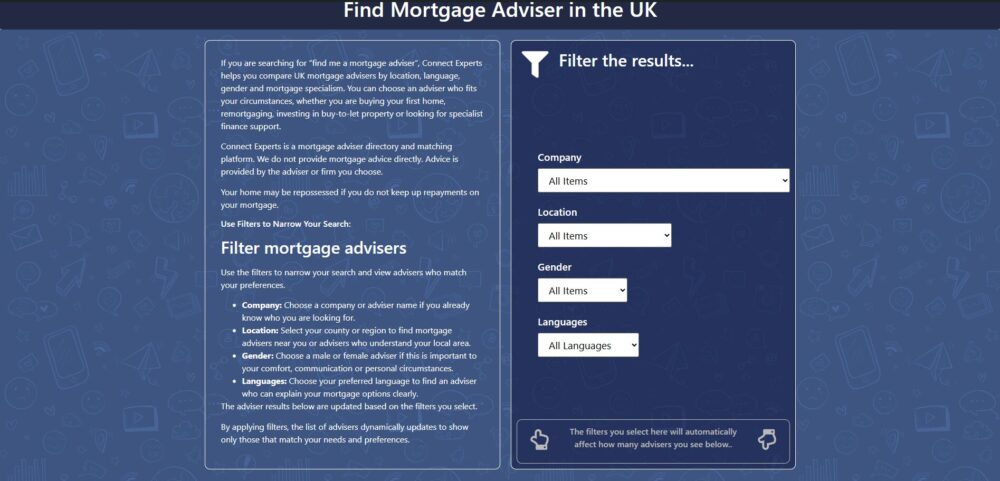
Through Connect Experts, you can search for buy-to-let mortgage brokers by location, language and adviser experience.
You can also compare buy-to-let mortgage advisers if you want to review adviser profiles before making contact.
Connect Experts is part of Connect Group. Mortgage advice is provided by the adviser or firm selected by the customer.
Why Use Connect Mortgages?
Limited company buy-to-let remortgages need careful lender matching.
At Connect Mortgages, we help landlords understand which lenders may consider their company structure, property type, rent and future plans.
We can help with:
- Limited company buy-to-let remortgages
- SPV buy-to-let remortgages
- Portfolio landlord refinancing
- HMO remortgages
- Equity release from rental property
- Rental stress testing
- Lender criteria checks
- Product comparisons
- Remortgage preparation
We are a credit broker, not a lender.
We will assess your needs and recommend suitable mortgage options based on your circumstances.
FAQs: Limited Company Buy-to-Let Remortgage
Can a limited company remortgage a buy-to-let property?
Yes. A limited company can remortgage a buy-to-let property if it meets lender criteria.
The lender will usually assess the company, directors, shareholders, rent, property value and mortgage purpose.
Is a limited company buy-to-let remortgage regulated?
Many business buy-to-let mortgages are not regulated by the FCA.
Some cases may be regulated if they meet consumer buy-to-let rules. Your adviser can explain how your case is treated.
Can I move my existing buy-to-let into a limited company?
You may be able to, but it can involve a sale to the company.
This may create tax, legal, valuation and mortgage costs. Always take tax and legal advice first.
Do lenders prefer SPV companies?
Many lenders prefer SPV companies because the company has a clear property purpose.
Some lenders may consider trading companies, but criteria can be more limited.
Can I release equity from a limited company buy-to-let?
Possibly. This depends on the property value, rent, loan-to-value ratio, lender criteria and purpose of funds.
The lender will still need the case to pass affordability and rental checks.
What documents may I need?
You may need company details, director ID, bank statements, rental evidence, tenancy agreements, mortgage statements and a portfolio schedule.
The exact documents depend on the lender.
Should I speak to an accountant before applying?
Yes. Mortgage advisers can explain lender options.
An accountant or tax adviser should explain tax, profit extraction, company structure and ownership consequences.
Speak To Connect Mortgages
If you are reviewing a limited company buy-to-let remortgage, speak with Connect Mortgages.
We can help you understand lender options, likely criteria, rental stress testing and the documents you may need.
Contact Connect Mortgages or call 01708 676111.