Self-Employed Mortgages: Income, Evidence and Criteria – Self-employed mortgages are not a separate type of mortgage. They are usually standard residential mortgages where the lender assesses income differently.
That difference matters.
A salaried applicant may prove income with payslips and a P60. A self-employed applicant may need tax calculations, Tax Year Overviews, accounts, bank statements, contracts or business records. The question is not only “how much do you earn?” It is also “how reliable is that income, and can it support the mortgage over time?”
That is why preparation is so important. A strong self-employed mortgage application is built before the lender sees it.
At a Glance
You may be able to get a mortgage if you are self-employed, but lenders will usually need clear proof of income.
Most lenders look at:
- Your trading history
- Your taxable income or business profit
- Your latest accounts or tax documents
- Your bank statements
- Your deposit
- Your credit history
- Your regular spending
- Whether your income is stable, rising or falling
Some lenders may use an average over two or three years. Others may use the latest year if the figures are strong and supported by evidence.
If you are preparing to apply, it may help to review your income documents early and speak with an adviser who understands self-employed cases. You can read more about self-employed mortgage advice before starting an application.
Can You Get a Mortgage If You Are Self-Employed?
Yes, self-employed people can get mortgages.
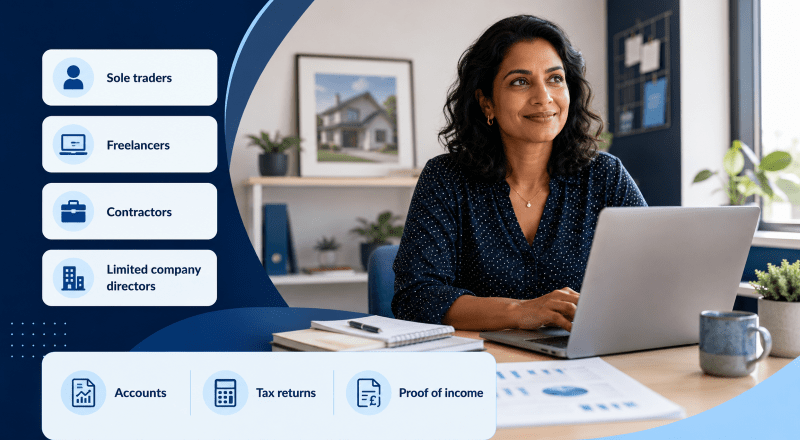
Being self-employed does not automatically make a borrower unsuitable. The issue is evidence. Lenders must be able to assess affordability and verify income. This applies whether the applicant is a sole trader, freelancer, contractor, limited company director, partner or shareholder.
The lender’s task is practical. It needs to understand whether the income used today is likely to continue tomorrow.
That is why self-employed mortgage applications often need more context than employed applications. A good year, a lower year, retained profit, new contracts or changing business costs may all need explaining.
Why Self-Employed Income Is Assessed Differently
Self-employed income can move from year to year. Some businesses are seasonal. Some contractors work through fixed-term agreements. Some company directors take a smaller salary and dividends. Some business owners leave profit in the company rather than drawing it personally.
These details can affect how much income a lender may use.
For example, two people may both earn £70,000 through their business. One may be a sole trader with net profit shown on their tax calculation. Another may be a limited company director taking salary, dividends and leaving retained profit in the company. The lender may assess those cases differently.
This is where the technical part of a self-employed mortgage becomes important. It is not only about income level. It is about income structure.
What Documents May Be Needed?
The documents requested can vary by lender and applicant type.
Common documents may include:
- SA302 tax calculations
- Tax Year Overviews
- Finalised accounts
- Business bank statements
- Personal bank statements
- Accountant’s details
- Contracts or invoices
- Proof of deposit
- ID and address evidence
- Credit commitments and expenditure details
HMRC explains that SA302 tax calculations and Tax Year Overviews can be used as evidence of earnings, including where someone is applying for a mortgage and is self-employed.
Applicants should check that the figures across tax documents, accounts and bank statements are consistent. Small differences can be explainable, but unexplained gaps may delay the application.
How Lenders May Calculate Self-Employed Income
Different business structures are assessed differently.
| Applicant type | Income lenders may review | Common evidence |
|---|---|---|
| Sole trader | Net profit | SA302, Tax Year Overview, accounts, bank statements |
| Freelancer | Declared income or net profit | Tax documents, contracts, invoices, statements |
| Contractor | Day rate, contract value or accounts | Contract, invoices, bank statements, tax records |
| Limited company director | Salary, dividends, sometimes retained profit | Accounts, payslips, dividend vouchers, tax documents |
| Partnership | Share of partnership profit | Partnership accounts, SA302, Tax Year Overview |
| CIS worker | Gross or net income, depending on lender | CIS statements, tax records, bank statements |
Some lenders average income across two or three years. Others may consider the latest year where the trend is clear and sustainable.
A falling income pattern may need more explanation. A rising income pattern may also need evidence, because the lender must decide whether the increase is likely to continue.
Why Affordability Still Matters
Income is only one part of the mortgage decision.
Lenders also look at affordability. This includes regular spending, debts, family commitments, credit commitments and future changes that may affect the borrower’s ability to pay.
This is important because UK mortgage rules are built around responsible lending. The lender needs to assess whether the borrower can afford the mortgage, not just whether the income appears high enough on paper.
For self-employed applicants, lenders may also look at the strength of the business. This can include cash flow, business liabilities, trading pattern and whether income depends heavily on one client or contract.
A mortgage application is therefore not just a form. It is a financial picture.
How Many Years’ Accounts Do You Need?
Many lenders prefer two years of trading history. Some may ask for three years. A smaller number may consider one year, depending on the applicant, income type, deposit, credit profile and lender criteria.
One year’s accounts may be more difficult, but not always impossible. The case may need stronger supporting evidence.
This could include:
- A clear business history
- Strong previous employment in the same industry
- Consistent contracts
- Good bank conduct
- A larger deposit
- Low debts
- A clear accountant-prepared record
The key point is that lender criteria are not identical. A decline from one lender does not always mean the whole market is closed.
Self-Employed Remortgages
Self-employed borrowers may also need updated income evidence when remortgaging.
This can matter if your current deal is ending, your income has changed or you want to release equity. Lenders may ask for current accounts, tax documents and bank statements even if you already own the property.
A remortgage review can help you understand whether your income still supports the borrowing required. You can explore wider remortgage options if your existing deal is due to finish.
First-Time Buyers Who Are Self-Employed
First-time buyers who are self-employed often need to prepare earlier than employed applicants.
The deposit, credit file and income evidence all need to work together. A strong income figure may not be enough if bank statements show high unsecured debt or irregular spending.
Before applying, it may help to check:
- Whether your latest tax return has been submitted
- Whether your SA302 and Tax Year Overview are available
- Whether business and personal spending are clearly separated
- Whether your deposit source can be evidenced
- Whether credit commitments are up to date
- Whether any recent income change can be explained
If the mortgage is for a home to live in, the starting point is usually residential mortgage advice.
What Can Delay a Self-Employed Mortgage Application?
Delays often happen when the evidence is unclear.
Common issues include:
- Missing Tax Year Overviews
- Accounts not yet finalised
- Bank statements that do not match declared income
- Recent changes in trading style
- Falling income without explanation
- Business debts not clearly shown
- High personal commitments
- Late tax returns
- Inconsistent figures between documents
A delay does not always mean the case is weak. It may simply mean the lender needs a clearer explanation.
The best approach is to prepare the file before application. That way, the adviser can identify gaps early.
What If You Have Adverse Credit?
Adverse credit does not always stop a self-employed mortgage application.
However, it can affect lender choice, deposit requirements and the rate available. The lender may look at what happened, when it happened, how much was involved and whether the issue has been resolved.
If you are self-employed and have credit issues, both areas need to be presented clearly. You may find it useful to read the adverse credit mortgage guide before applying.
Should Protection Be Considered?
Self-employed borrowers may not have the same employee benefits as those in paid work. Sick pay, death-in-service cover and employer support may be limited or unavailable.
This makes protection part of the wider mortgage conversation.
Protection does not make a mortgage more affordable. But it can help a household think about what may happen if illness, injury or death affects income. You can read more about mortgage protection insurance as part of your planning.
When To Speak With A Mortgage Adviser
A self-employed mortgage application can be straightforward when the evidence is clear. It can become more complex where income is new, variable, retained in a company or affected by recent changes.
An adviser can help you understand:
- Which income figure lenders may use
- What documents may be needed
- How your business structure may affect the case
- Which lenders may consider your circumstances
- What could delay the application
- How much you may be able to borrow
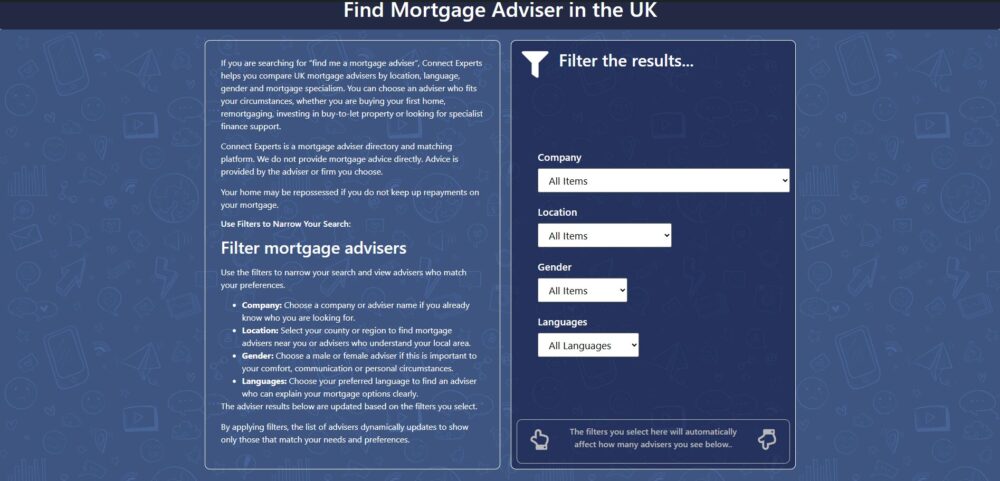
Some applicants also want to choose an adviser based on location, language or experience. Connect Experts is part of Connect Group and allows users to search for advisers by practical filters. You can find a self-employed mortgage broker or use the self-employed residential mortgage adviser search to compare suitable advisers.
FAQs About Self-Employed Mortgages
Are self-employed mortgages harder to get?
They can involve more evidence, but they are not automatically harder. The main issue is how clearly income can be verified and explained.
Do lenders use gross income or net profit?
It depends on the business structure. Sole traders are often assessed on net profit. Limited company directors may be assessed using salary, dividends and sometimes other company figures, depending on lender criteria.
Can I get a mortgage with one year’s accounts?
Some lenders may consider one year’s accounts, but it depends on the wider case. Deposit, credit history, previous experience, business strength and income sustainability can all matter.
Do I need an accountant?
Not always, but accountant-prepared accounts can help where the case is more complex. Some lenders may ask for accountant details or certified accounts.
Can retained profit help a mortgage application?
Some lenders may consider retained profit for limited company directors. Others may not. The business accounts and lender criteria will be important.
Can I remortgage if I am self-employed?
Yes, but the lender may still need updated income evidence. This can include tax documents, accounts and bank statements.
Is there a special mortgage product for self-employed people?
Usually, no. Most self-employed borrowers apply for standard mortgage products. The difference is the way income is assessed.