Solar Panels and Mortgages: What UK Buyers Need to Know – Solar panels can affect how a home is assessed for a mortgage.
Not always in a negative way. Not always in a positive way either.
The real question is practical: who owns the panels, how were they installed, what documents exist, and does the lender accept the arrangement?
A roof is not just part of a house. For a lender, it is part of the security. When solar panels are fixed to that roof, the details matter.
At a Glance
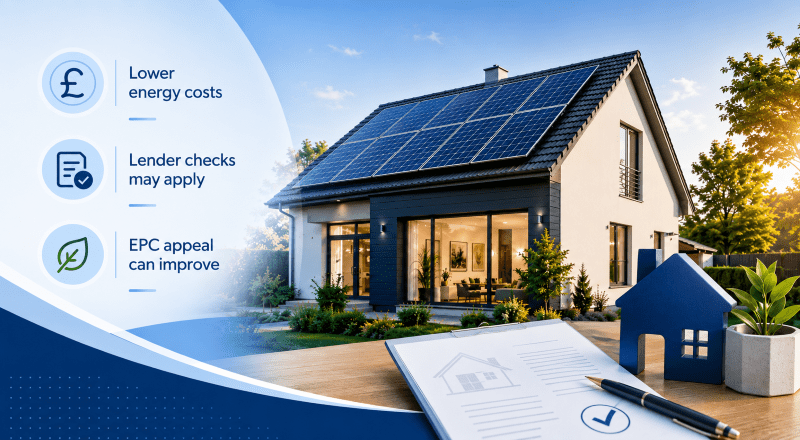
Solar panels may support lower energy costs and improve a home’s energy profile, but lenders will want to understand the installation.
The main mortgage points are:
- Whether the solar panels are owned outright, financed, or leased
- Whether there is a roof-space lease
- Whether lender consent was needed or obtained
- Whether the installation has the right certificates and warranties
- Whether buildings insurance covers the panels
- Whether the panels affect valuation, resale or remortgage options
- Whether any green mortgage product is available
If you are buying, selling, remortgaging or raising funds on a property with solar panels, the paperwork matters as much as the panels.
Why Solar Panels Matter In A Mortgage Application
A mortgage is secured against the property.
That means the lender is not only looking at your income, deposit and credit profile. It is also looking at the property itself.
Solar panels can affect that review because they may involve:
- Roof alterations
- A third-party lease
- Maintenance rights
- Access rights
- Insurance conditions
- Warranty terms
- Energy performance information
- Future saleability
This is why a solar panel system should never be treated as a simple household extra. It can form part of the lender’s risk assessment.
A well-documented solar installation can be straightforward. A poorly documented one can slow the mortgage process.
Owned Solar Panels Vs Leased Solar Panels
The first question is simple.
Who owns the solar panels?
If the homeowner owns the panels outright, the position may be easier to understand. The panels form part of the property and the buyer’s solicitor can review the installation documents, guarantees and insurance position.
If the panels are leased, the position needs more care.
Some older solar panel arrangements involved a company installing panels for little or no upfront cost. In return, the company retained certain rights to the roof space and the income from electricity generation.
That can affect a mortgage because the lender must understand who has rights over the roof.
The UK Finance Mortgage Lenders’ Handbook says most lenders’ mortgage conditions require lender consent for a lease, including a lease of roof space for solar panels. The lender’s requirements are set out in the solar panel section of the Handbook.
For borrowers, this means one thing: the lease must be checked before the mortgage offer can safely proceed.
What Lenders May Check
Each lender has its own criteria, but the checks often focus on practical risk.
A lender may want to know:
- Whether the panels are owned or leased
- Whether the lease meets lender requirements
- Whether the installation was completed by a suitable installer
- Whether the roof remains structurally sound
- Whether planning or building control issues apply
- Whether there is an MCS certificate or other installation evidence
- Whether warranties can be transferred to the buyer
- Whether maintenance access affects the property
- Whether the panels are covered by buildings insurance
- Whether removal or repair obligations are clear
This is where the mortgage process becomes less about “green living” and more about evidence.
Solar panels may be a good household decision. The lender still needs a clear legal and technical trail.
Documents To Find Before Applying
If you are buying or remortgaging a property with solar panels, gather the documents early.
Useful documents may include:
- Proof of ownership
- Solar panel lease, if one exists
- MCS certificate or installation certificate
- Building control documents, where relevant
- Planning documents, where relevant
- Product warranties
- Inverter warranty
- Battery warranty, if battery storage is included
- Maintenance information
- Insurance confirmation
- Smart Export Guarantee documents, if applicable
- Energy bills showing usage and export data
- EPC certificate
These documents help your adviser, solicitor and lender understand the property.
They may also reduce delays later in the mortgage process.
Do Solar Panels Improve Mortgage Affordability?
Solar panels may reduce electricity bills.
That can help household budgeting, but it does not mean every lender will increase borrowing because panels are installed. Mortgage affordability still depends on income, committed expenditure, credit profile, interest-rate stress testing, loan size, and lender criteria.
Some lenders may view energy-efficient homes more positively through green mortgage products. These products may offer lower rates, cashback or other features for homes that meet set energy standards.
If your main aim is to reduce monthly outgoings, it may be worth comparing normal mortgage options with green mortgage options.
The right answer depends on the full mortgage case, not the solar panels alone.
Can Solar Panels Affect Property Valuation?
Solar panels may enhance a home’s appeal, especially for buyers focused on energy efficiency and running costs.
However, a valuation is not based only on the presence of panels.
A valuer may consider:
- The age of the system
- The condition of the roof
- Whether panels are owned or leased
- The property’s EPC rating
- Local buyer demand
- Comparable sales
- Any legal rights attached to the roof
- Whether the system is easy to maintain
This is why strong documentation is important.
A good installation with clear ownership may be viewed differently from a leased system with unclear rights.
Buying A House With Solar Panels
If you are buying a home with solar panels, ask questions before you get too far into the process.
The key questions are:
- Are the panels owned outright?
- Is there a roof-space lease?
- Was lender consent obtained when required?
- Who receives export payments?
- Are warranties transferable?
- Who maintains the system?
- Is the installer still trading?
- Is the system covered by buildings insurance?
- Does the roof need repair soon?
- Could the panels make future resale more complex?
These questions are not there to put buyers off.
They are there to protect the purchase.
A home can look efficient on the surface, but the legal position must still be clear.
Remortgaging A Home With Solar Panels
If the panels were installed after you bought the property, the new lender may ask questions during remortgage.
This can happen even if your current lender accepted the property before the installation.
A remortgage lender may review:
- Whether consent was needed before installation
- Whether the panels are owned, financed or leased
- Whether a roof-space lease exists
- Whether the system affects valuation
- Whether the property remains suitable security
If you are planning to remortgage soon, review the documents before applying.
You can also read more about how the wider process works in our remortgage guide.
Solar Panels, Further Borrowing and Home Improvements
Some homeowners may want to borrow more to fund solar panels.
This may be possible through a further advance, a remortgage, a second-charge mortgage, or another form of finance. The right route depends on the amount needed, current mortgage deal, early repayment charges, property value and affordability.
The lowest monthly payment is not always the best long-term answer.
A homeowner should consider:
- Total interest over the full term
- Product fees
- Early repayment charges
- Installation cost
- Expected energy savings
- Warranty length
- Battery storage costs
- How long they plan to stay in the home
Solar panels are a long-term improvement. The finance should be judged in the same way.
Smart Export Guarantee And Mortgage Planning
The Smart Export Guarantee allows eligible small-scale low-carbon generators to receive payments for electricity exported to the National Grid.
This can support the financial case for solar panels, but it should not be treated as guaranteed mortgage income.
Tariffs can vary. Export levels can vary. Household usage can also change.
For mortgage planning, export payments should be seen as a useful benefit rather than the foundation of affordability.
You can read the official Ofgem information on the Smart Export Guarantee.
Why MCS Certification Matters
MCS is the UK quality mark for small-scale renewable energy technologies, including solar panels and battery storage.
An MCS certificate can help show that an installation was completed under recognised standards.
This may be useful for:
- Lender checks
- Solicitor review
- Warranty records
- Smart Export Guarantee access
- Future sale or remortgage discussions
You can check official information through MCS Certified.
When Solar Panels May Cause Mortgage Delays
Solar panels may delay a mortgage case when documents are missing or unclear.
Common issues include:
- No proof of ownership
- Missing lease documents
- A roof-space lease that does not meet lender requirements
- Unclear maintenance rights
- No evidence of installer accreditation
- No warranty information
- Insurance not updated
- Roof condition concerns
- Seller unsure who receives export payments
Most delays are not caused by the panels themselves.
They are caused by uncertainty.
A Practical Checklist Before You Apply
Before applying for a mortgage, remortgage or further borrowing, check the following:
- Confirm who owns the solar panels
- Find the installation documents
- Check if a lease exists
- Ask your solicitor to review any roof-space lease
- Confirm the panels are insured
- Keep warranty documents safe
- Check if export payments apply
- Review your EPC
- Ask whether green mortgage options are available
- Speak to an adviser before making a mortgage decision
If you need support with a residential mortgage case, our residential mortgage page explains how mortgage advice can help.
Where Advice Fits In
Solar panels can be a sensible home improvement.
They can also introduce legal, technical and lending questions.
That is why advice matters.
A mortgage adviser can help you understand how lenders may treat the property. A solicitor can review the lease and legal title. A qualified installer can explain the system, warranties and maintenance.
Each part has its place.
The philosophical point is simple: progress should not outrun understanding.
A greener home still needs a secure mortgage route, clear documents and a decision that works for the borrower.
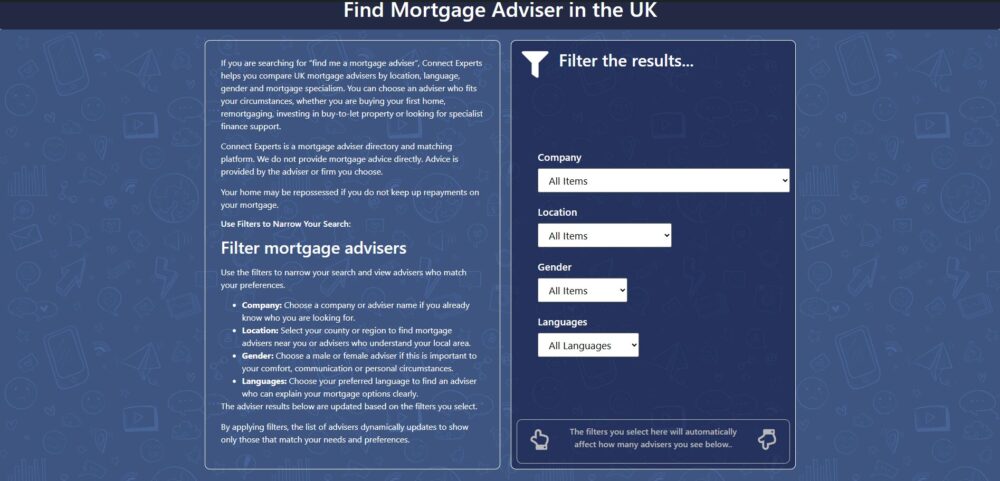
If you want to compare adviser options, you can use Connect Experts to find mortgage advisers by location, language and mortgage need.
FAQs: Solar Panels And Mortgages
Do solar panels affect getting a mortgage?
Solar panels can affect a mortgage if they involve a lease, unclear ownership, missing documents or roof access rights. If the panels are owned and properly documented, the process may be more straightforward.
Is it harder to get a mortgage on a house with leased solar panels?
It can be more complex. Lenders may need to check whether the roof-space lease meets their requirements. The buyer’s solicitor will usually review the lease as part of the legal process.
Do lenders accept solar panels?
Many lenders may accept properties with solar panels, but criteria can vary. Ownership, installation quality, lease terms, insurance and documentation all matter.
Can I remortgage after installing solar panels?
Yes, but the new lender may ask for documents. This may include proof of ownership, installation certificates, warranties and any lease details.
Can solar panels increase how much I can borrow?
Not usually by themselves. Lower energy bills may help household budgeting, but mortgage affordability is still based on income, expenditure, credit profile and lender criteria.
Are solar panels included in a property valuation?
They may be considered as part of the property, but the effect depends on ownership, condition, age, documentation, local demand and the valuer’s view.
What is the biggest mortgage risk with solar panels?
The biggest risk is often a roof-space lease that does not meet lender requirements. Missing documents can also delay the mortgage process.
Should I install solar panels before remortgaging?
It depends on your mortgage position, costs, early repayment charges, property plans and lender criteria. Speak to an adviser before taking on extra finance.
Can I use a green mortgage for solar panels?
Some lenders offer green mortgage products or incentives linked to energy-efficient homes or upgrades. Criteria vary, so the product must be checked against your circumstances.
What documents should I keep after installing solar panels?
Keep proof of ownership, installation certificates, warranties, maintenance records, insurance confirmation, export tariff documents and any planning or building control records.