
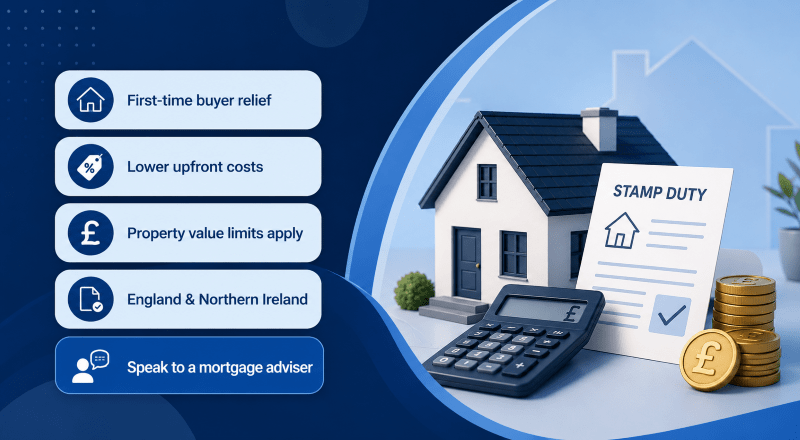
Stamp Duty Land Tax Relief can reduce the tax a first-time buyer pays on a home purchase in England or Northern Ireland.
As at June 2022, first-time buyers paid no SDLT on the first £300,000 of an eligible property purchase. A 5% rate applied to the portion from £300,001 to £500,000. If the purchase price was above £500,000, first-time buyer relief did not apply.
This mattered because stamp duty is usually paid from the buyer’s own funds. It can affect deposit planning, completion money and how much cash is left after moving.
Stamp duty relief is not a mortgage product. It is a tax relief claimed through the SDLT return, usually handled by the buyer’s solicitor or conveyancer.
Stamp Duty Land Tax Relief Explained
Buying a first home often begins with a mortgage question.
How much can I borrow?
How much deposit do I need?
What will the monthly payments look like?
Yet the quieter question can be just as important.
How much cash will I need to complete?
Stamp Duty Land Tax Relief helps answer that question. It can reduce the amount of tax payable when an eligible first-time buyer purchases a residential property in England or Northern Ireland.
For a first-time buyer, this relief can make the early numbers clearer. It may not change the mortgage rate. It may not change the lender’s criteria. But it can change the cash needed at completion.
That is why SDLT relief belongs in the mortgage planning conversation.
A mortgage is about borrowing. Stamp duty is about buying. The two are separate, but they meet at the same point: affordability, deposit planning and completion.
You can read the official SDLT guidance on GOV.UK Stamp Duty Land Tax.
What Is Stamp Duty Land Tax?
Stamp Duty Land Tax, often shortened to SDLT, is a tax that can apply when land or property is bought in England or Northern Ireland.
It is not the same as a mortgage fee.
It is not charged by the lender.
It is not usually added automatically to the mortgage.
In most cases, SDLT is paid as part of the purchase process. The buyer’s solicitor or conveyancer usually submits the SDLT return and arranges payment to HMRC.
For mortgage planning, SDLT matters because it forms part of the buyer’s total purchase cost.
A first-time buyer may have saved a deposit, arranged a mortgage decision in principle and found a property. But if stamp duty has not been considered, the completion funds may not be fully understood.
What Was the First-Time Buyer SDLT Relief in June 2022?
As of June 2022, first-time buyer SDLT relief applied to eligible residential purchases in England and Northern Ireland.
The key thresholds were:
- No SDLT on the first £300,000
- 5% SDLT on the portion from £300,001 to £500,000
- No first-time buyer relief if the purchase price was above £500,000
This article reflects the rules relevant to the original publication period. SDLT rules and thresholds can change, so buyers should always check the latest position before making a decision.
Who Could Qualify For First-Time Buyer Relief?
A buyer generally needs to meet the first-time buyer conditions.
This meant:
- The buyer had not previously owned a residential property
- The property was being bought as the buyer’s only or main residence
- The property was in England or Northern Ireland
- The purchase price was within the relief limit
- All buyers in a joint purchase met the first-time buyer conditions
The joint purchase point is important.
If two people buy together and one has owned a home before, first-time buyer relief may not apply. This can affect couples, family-assisted purchases and friends buying together.
It is not enough for one applicant to be a first-time buyer. The position of each buyer must be checked.
How SDLT Relief Can Affect Mortgage Planning
Stamp duty relief does not usually change the mortgage product itself.
It does not mean a lender will offer a lower interest rate.
It does not remove the need for affordability checks.
It does not replace the deposit.
Its effect is more practical.
If less tax is due, the buyer may need less cash to complete. That can help with:
- Deposit planning
- Solicitor and conveyancing costs
- Moving costs
- Survey and valuation costs
- Furniture and essential repairs
- Keeping an emergency fund after completion
This is where first-time buyer planning becomes more than a loan application.
The mortgage answers one part of the purchase. SDLT relief may affect the money needed around the mortgage.
For buyers at the start of the process, our First-Time Buyer Mortgage guide explains how mortgage advice can support the wider buying journey.
A Simple Example
A first-time buyer purchases a home for £350,000 in England in June 2022.
Under the first-time buyer relief rules at that time:
- £0 SDLT would apply to the first £300,000
- 5% SDLT would apply to the remaining £50,000
- The SDLT payable would be £2,500
Without understanding this early, the buyer may only focus on the mortgage deposit. That can create pressure later when the solicitor confirms the completion statement.
The lesson is simple.
A first-time buyer should not only ask, “Can I get the mortgage?”
They should also ask, “Can I complete the purchase comfortably?”
What Stamp Duty Relief Does Not Do
Stamp Duty Land Tax Relief should not be confused with a mortgage discount or lender incentive.
It does not:
- Increase your mortgage affordability
- Guarantee mortgage approval
- Reduce your mortgage balance
- Remove solicitor fees
- Replace deposit requirements
- Apply to every property purchase
- Apply automatically without the correct SDLT return
It is also separate from the higher rates that may apply to additional properties.
A first-time buyer who has never owned property is usually looking at first-time buyer relief. Someone buying an additional property may be looking at higher SDLT rates instead. These are different rules.
England, Northern Ireland, Scotland and Wales
SDLT applies in England and Northern Ireland.
Scotland and Wales have different property tax systems.
In Scotland, buyers should check Land and Buildings Transaction Tax.
In Wales, buyers should check Land Transaction Tax.
This matters for searchers because “stamp duty” is often used as a general phrase. The legal tax system depends on where the property is located.
This article is about Stamp Duty Land Tax Relief for England and Northern Ireland.
When Should a Buyer Check SDLT Relief?
A buyer should consider SDLT early.
The best point is before making an offer, or at least before submitting a full mortgage application.
That does not mean the buyer needs to become a tax expert. It means the buyer should know whether stamp duty could affect their total funds.
The adviser, solicitor and buyer each play a different role.
The mortgage adviser can help the buyer understand how purchase costs sit alongside the mortgage. The solicitor or conveyancer normally deals with the SDLT return and relief claim. The buyer must give accurate information about previous property ownership and intended use.
If you are comparing purchase costs, the Stamp Duty Calculator can help you understand the possible SDLT position before speaking to your solicitor.
Why SDLT Relief Matters For First-Time Buyers
A first home is often treated as an emotional milestone. But the numbers still matter.
Stamp duty relief can be the difference between feeling ready and finding a gap in completion funds. It can affect whether savings are used only for the deposit or whether enough remains for the practical costs of moving.
That is why SDLT relief should be seen as part of the full purchase structure.
A mortgage gives the buyer access to borrowing. Relief may reduce one of the costs around the purchase. Together, they shape the buyer’s route to completion.
If you want support from an adviser who works with first-time buyers, you can search through Find First-Time Buyer Mortgage Advisers.
Stamp Duty Relief And Moving Home
First-time buyer relief is not the same as moving home.
A homeowner selling one main residence and buying another may have a different SDLT position. The rules can also be affected by timing, ownership, additional properties and whether a previous main home has been sold.
For buyers who already own a property, our Moving Home Mortgages page may be more relevant than this first-time buyer guide.
Practical Checklist For First-Time Buyers
Before relying on SDLT relief, check:
- The property is in England or Northern Ireland
- The purchase price is within the relief limit
- Every buyer qualifies as a first-time buyer
- The home will be used as the buyer’s only or main residence
- The solicitor knows relief may apply
- Completion funds include deposit, fees, SDLT and moving costs
- The SDLT position has been checked against the rules at the time of purchase
This checklist helps keep the purchase grounded.
The aim is not only to buy. The aim is to complete with clarity.
FAQs
What is Stamp Duty Land Tax Relief?
Stamp Duty Land Tax Relief is a tax relief that can reduce the SDLT payable on certain property purchases. For first-time buyers, it can reduce the tax due when buying an eligible first home in England or Northern Ireland.
Was first-time buyer SDLT relief available in June 2022?
Yes. In June 2022, first-time buyer relief could apply to eligible purchases up to £500,000. No SDLT applied to the first £300,000, and 5% applied to the portion from £300,001 to £500,000.
Does Stamp Duty Land Tax Relief affect my mortgage?
It does not usually affect the mortgage product itself. However, it can affect how much cash you need to complete the purchase. This can help with deposit planning and wider purchase costs.
Who claims SDLT relief?
The SDLT return is usually handled by the buyer’s solicitor or conveyancer. The buyer must give accurate information so the correct relief can be claimed.
Does first-time buyer relief apply if one buyer owned a property before?
Usually, all buyers must meet the first-time buyer conditions. If one buyer has owned residential property before, the relief may not apply.
Does SDLT apply in Scotland and Wales?
SDLT applies in England and Northern Ireland. Scotland and Wales have separate property tax systems.
Should I check SDLT before applying for a mortgage?
Yes. It is sensible to check SDLT early because it can affect the money needed at completion. A mortgage adviser can help you understand the wider purchase costs, while a solicitor can confirm the SDLT position.