
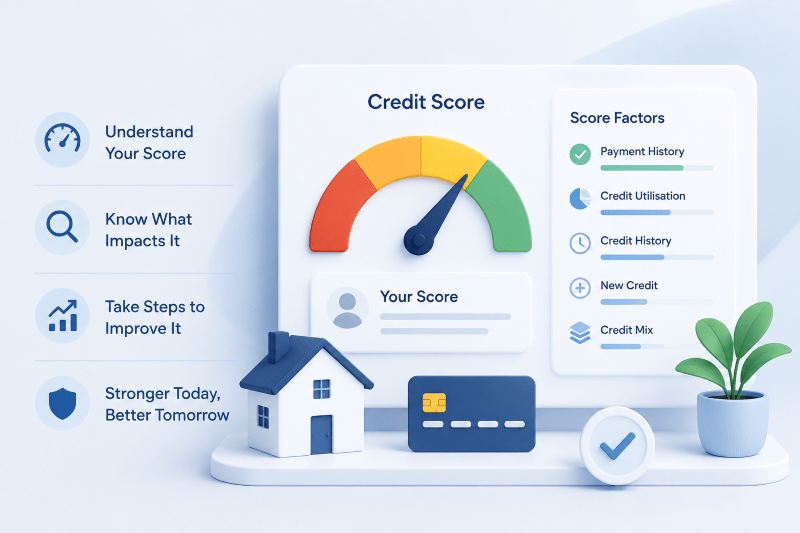
What Is a Bad Credit Score? A bad credit score is not just a number. It is a signal.
It tells lenders that something in your credit history may need closer review. That could be missed payments, defaults, a County Court Judgment, high credit use, an IVA, bankruptcy, or repeated short-term borrowing.
However, a low score does not tell the whole story. It does not explain why the issue happened. It does not show whether your position has improved. It does not decide your mortgage future on its own.
For mortgage purposes, the question is not only “What is my score?”
The better question is:
What does my credit file say, and how will a lender read it?
Quick answer: What Counts as a Bad Credit Score?
A bad credit score usually means your score falls into the lowest band used by a credit reference agency.
In the UK, there is no single credit score. Experian, Equifax and TransUnion all use different scoring systems. Therefore, a number that looks low with one agency may not mean the same thing with another.
A bad credit score may mean you find it harder to get credit, face higher interest rates, need a larger deposit, or have fewer mortgage lenders available.
For mortgages, lenders usually look beyond the score. They may also assess your income, deposit, affordability, bank statements, recent payment conduct and the details behind any credit issues.
UK Credit Score Ranges Explained
Credit scores are designed to estimate risk. A higher score usually suggests lower risk. A lower score usually suggests higher risk.
However, each credit reference agency has its own scale.
| Credit reference agency | Score scale | Lower-score wording |
|---|---|---|
| Experian | 0 to 1250 | Low |
| Equifax | 0 to 1000 | Poor |
| TransUnion | 0 to 710 | Very poor or poor |
You can read more about the current Experian scale in the Experian credit score guide.
The important point is simple. Do not compare your Experian score directly with your Equifax or TransUnion score. The scales are different.
Instead, check which band your score sits in with each agency.
Why a Bad Credit Score Matters For a Mortgage
A mortgage is a long-term financial commitment. Lenders need to decide whether the loan is affordable and whether the risk fits their criteria.
A bad credit score can affect:
- The number of lenders available
- The interest rate you may be offered
- The deposit level required
- The maximum loan size
- The documents requested
- Whether manual underwriting is needed
- Whether the lender accepts your credit issue type
This is where the technical side matters. A lender may not treat all bad credit in the same way.
A missed mobile phone payment from three years ago may be viewed differently from recent mortgage arrears. A satisfied default may be treated differently from an unpaid default. A small CCJ may be assessed differently from a recent large CCJ.
The score opens the conversation. The credit file explains the details.
What Causes a Bad Credit Score?
A bad credit score may be caused by one issue or several smaller patterns.
Common causes include:
- Missed payments
- Late payments
- Defaults
- County Court Judgments, also called CCJs
- Debt Management Plans
- Individual Voluntary Arrangements, also called IVAs
- Bankruptcy
- Repossession
- Payday loans
- High credit card balances
- Regular overdraft use
- Too many recent credit applications
- Errors on your credit report
- Financial links to another person
Some causes are more serious than others. Some become less important as time passes. Some may still affect lender choice even after being settled.
That is why checking your credit file before applying is practical, not optional.
Is Bad Credit the Same as Adverse Credit?
Bad credit and adverse credit are often used interchangeably.
In mortgage terms, adverse credit usually means your credit history includes previous borrowing or payment problems. This can include defaults, CCJs, missed payments, debt plans, IVAs, bankruptcy, repossession, or other credit concerns.
You can learn more about this route on our Adverse Credit Mortgage page.
The language matters because lenders may not use the phrase “bad credit” in the same way a customer does. Some lenders assess adverse credit by type, age, value, and settlement status.
So, the real question is not only whether you have bad credit.
It is whether your credit history fits a lender’s criteria.
How Mortgage Lenders Assess a Bad Credit Score
Mortgage lenders usually review several points before making a decision.
They may look at:
- The type of credit issue
- When it happened
- Whether it has been settled
- The amount involved
- Whether it was isolated or repeated
- Your income and employment position
- Your current monthly commitments
- Your deposit or equity
- Your bank statements
- Your recent conduct
- The property you want to buy or remortgage
A lender may also consider the reason behind the issue. For example, a credit problem caused by redundancy, illness, divorce, business closure, or temporary financial pressure may need explanation.
This does not guarantee approval. However, it can help an adviser present the case more clearly.
Can You Get a Mortgage with a Bad Credit Score?
Yes, it may be possible to get a mortgage with a bad credit score.
However, your options will depend on your full circumstances. A lender may want to see that your position has stabilised. They may also want a larger deposit, a clear explanation of past issues, and evidence that current commitments are being managed well.
Some high-street lenders may decline applications with recent or serious credit issues. Specialist lenders may take a broader view, subject to criteria and affordability.
If you want to understand this in more detail, read our guide on getting a mortgage with bad credit.
Does a Bad Credit Score Always Mean a Higher Mortgage Rate?
Not always, but it can.
Lenders price risk in different ways. If your credit history suggests higher risk, the lender may charge a higher interest rate. They may also limit the loan-to-value available.
For example, a borrower with a strong credit history may have access to a wider range of products. A borrower with recent defaults, CCJs or missed payments may need a more specialist product.
The practical issue is not only the rate. It is whether the product is suitable, affordable and available at the time you apply.
Can First-Time Buyers Get a Mortgage with Bad Credit?
Some first-time buyers can get a mortgage with bad credit. It depends on the deposit, income, affordability and credit history.
A first-time buyer with a low score may need to prepare more carefully before applying. This may include checking all credit reports, correcting errors, reducing debt where possible, and avoiding unnecessary credit applications.
If you are buying your first home, our First-Time Buyer Mortgage page explains the wider mortgage process.
A low score can narrow the route. It does not always close the door.
Can You Remortgage with a Bad Credit Score?
You may be able to remortgage with bad credit, but the options can vary.
Lenders may look at your current mortgage conduct, equity, income, reason for remortgaging and recent credit history. Mortgage arrears may be treated more seriously than some unsecured credit issues.
Some people remortgage after credit problems to secure a new deal, raise funds, or consolidate debt. However, debt consolidation needs careful advice because it may increase the total amount paid over the mortgage term.
You can read more on our Remortgage with Bad Credit page.
Soft Search vs Hard Search
A soft search usually does not affect your credit score. It may be used for eligibility checks, quotes, or checking your own report.
A hard search can be visible to other lenders. It usually happens when you make a full credit application.
Too many hard searches in a short period can concern lenders. It may suggest financial pressure or repeated declined applications.
This is why advice matters before applying. A mortgage adviser can help you avoid unsuitable applications and reduce avoidable credit footprints.
How to improve a Bad Credit Score Before Applying
Improving your credit score takes time. However, practical steps can help.
Start with your credit reports. Check the information held by Experian, Equifax and TransUnion. Look for errors, old addresses, incorrect balances, unknown accounts, or financial links that no longer apply.
Then focus on current conduct.
You may be able to improve your position by:
- Paying bills on time
- Registering on the electoral roll
- Reducing credit card balances
- Avoiding new borrowing before applying
- Keeping overdraft use under control
- Settling defaults where possible
- Correcting report errors
- Updating old address information
- Removing incorrect financial associations
- Keeping regular payments consistent
For more practical steps, read our guide to improving bad credit for a mortgage.
The philosophy is simple. A score is a snapshot. Conduct creates the next picture.
When Should You Speak to a Mortgage Adviser?
You should consider speaking to a mortgage adviser before making a full application if:
- You have been declined before
- Your score is low with one or more agencies
- You have a CCJ, default, IVA, or debt plan
- You have missed payments in the last two years
- You are unsure whether your deposit is enoughconnectexperts.co.uk/adverse-credit-mortgage-brokers
- You want to avoid unnecessary hard searches
- You need to understand which lenders may consider you
Some borrowers want to compare advisers before making contact. You can search for adverse credit mortgage brokers through Connect Experts.
Connect Experts is part of the Connect Group. It is a mortgage adviser directory and matching platform. Mortgage advice is provided by the adviser or firm you choose.
You can also read the Connect Experts Adverse Credit Mortgage Guide for wider background before choosing an adviser.
Why Bad Credit Needs Context
A bad credit score can feel final. Yet lending decisions are rarely that simple.
A number may show that something happened. It does not always show why it happened, whether it has been resolved, or how you manage money today.
This matters because mortgage lending is not only about the past. It is also about the risk of the future.
The strongest applications are usually clear, well-evidenced and well-prepared. They show income, affordability, deposit, conduct and explanation.
A low credit score may slow the journey. It should not stop you from understanding the route.
FAQ: What is a Bad Credit Score?
What is classed as a bad credit score in the UK?
A bad credit score is usually a score in the lowest band used by a credit reference agency. However, Experian, Equifax and TransUnion use different scoring systems, so there is no single UK number that always means bad credit.
Does a bad credit score mean I cannot get a mortgage?
No. A bad credit score does not always stop you getting a mortgage. Lenders may also review your income, deposit, affordability, recent conduct and the type of credit issue.
Which credit score do mortgage lenders use?
Different lenders use different credit reference agencies. Some may check one agency, while others may use more than one. Lenders also apply their own internal criteria.
Is a CCJ always bad for a mortgage?
A CCJ can affect your mortgage options. Lenders may look at the date, amount, reason, settlement status and your wider financial position.
Do defaults affect mortgage applications?
Yes, defaults can affect mortgage applications. The impact may depend on how recent the default is, the value, whether it has been satisfied and the lender’s criteria.
Can I improve my score quickly?
You may be able to make some improvements quickly, such as correcting errors or registering on the electoral roll. However, stronger credit repair usually takes consistent conduct over time.
Should I apply for a mortgage before checking my credit file?
It is usually better to check your credit file before applying. This can help you spot errors, prepare explanations and avoid avoidable declines.
Does checking my own credit score damage it?
Checking your own credit score is usually a soft search. It should not damage your credit score.
Can a broker guarantee approval with bad credit?
No broker can guarantee approval. However, a mortgage adviser can help you understand which lenders may be more likely to consider your circumstances.
Why do credit scores differ between agencies?
Credit scores differ because each agency uses its own data, scoring model and scale. Lenders may also report information differently across agencies.
The FCA has also highlighted the need for more consistent and complete credit information across the market, underscoring the importance of accurate credit data for borrowers and lenders alike. You can read more in the FCA credit information market consultation.