

Average Two-Year Mortgage Rate Falls Below 6% in 2023: The average UK two-year fixed mortgage rate fell to 5.99% in December 2023.
It was the first time the average had dropped below 6% since June 2023.
The fall followed lower inflation, stable Bank Rate expectations and changes in wholesale funding costs.
However, an average rate was not available to every borrower.
Actual mortgage pricing still depended on deposit size, credit history, product fees, income and lender criteria.
Average two-year mortgage rate drops below 6%
The average two-year fixed mortgage rate fell from 6.01% to 5.99% in December 2023.
According to Moneyfacts’ mortgage market data, this was the first reading below 6% since 16 June 2023.
The movement was modest in numerical terms. However, crossing below 6% carried wider significance.
It suggested that the fixed-rate market was beginning to move away from the higher pricing recorded during summer 2023.
The average two-year rate had reached 6.86% in late July. Therefore, the December figure represented a clearer downward movement over several months.
Lower average pricing did not mean mortgages had become inexpensive. It showed that lenders were gradually adjusting their products as funding expectations changed.
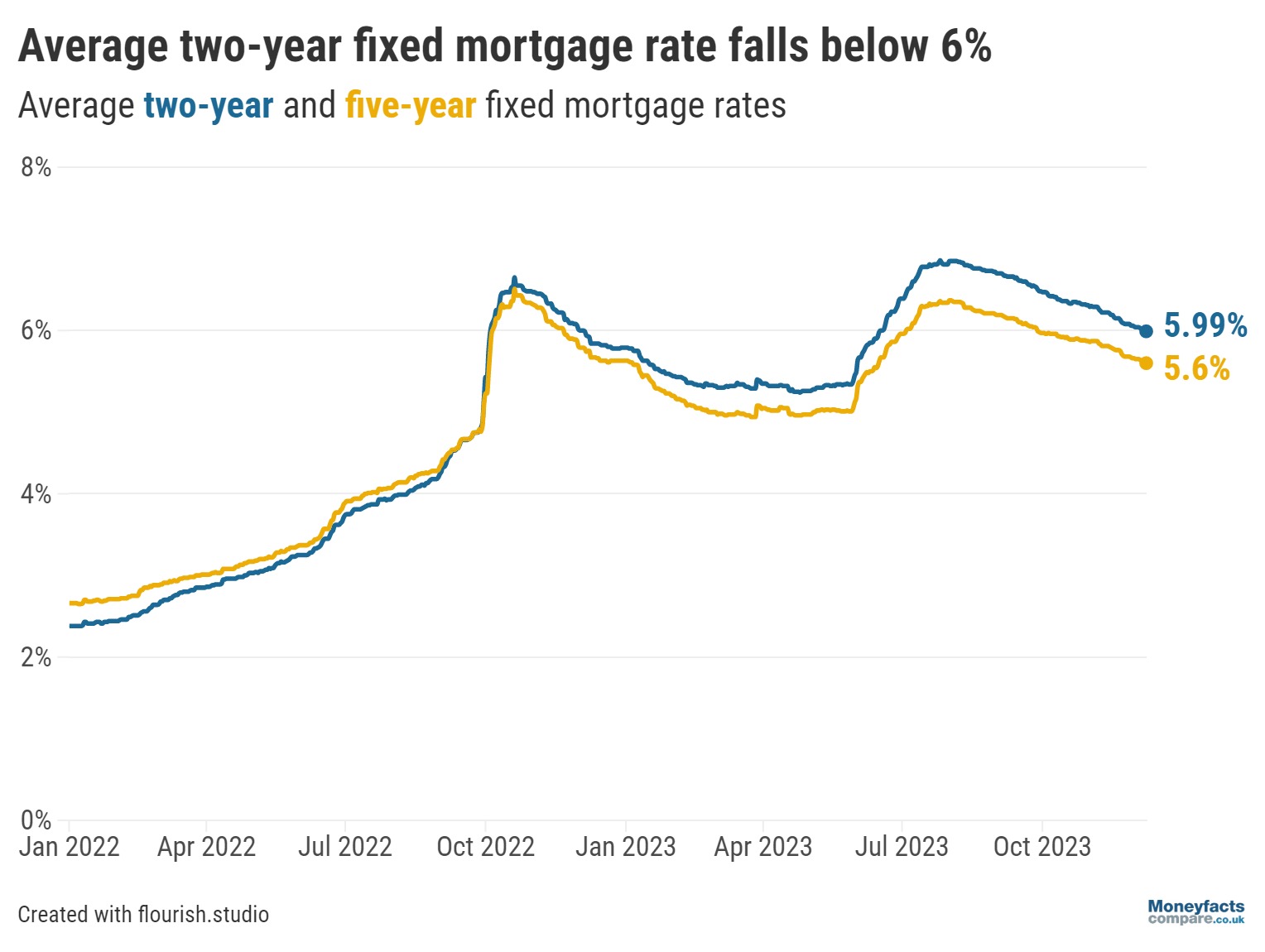
Source: Moneyfacts
What did the average rate represent?
The 5.99% figure was a market average, not a universal mortgage offer.
Some products were available at below-average prices. Others were considerably higher.
The rate offered to an individual borrower could depend on:
- The size of their deposit or available equity
- Their loan-to-value ratio
- Their income and regular financial commitments
- Their credit history
- The property type
- The mortgage amount and term
- The lender’s affordability assessment
- Arrangement fees and other product costs
A lower headline rate could also carry a higher arrangement fee.
For this reason, borrowers needed to compare the total mortgage cost rather than selecting a product through its interest rate alone.
Our mortgage calculator can provide an initial payment estimate. It does not replace a lender’s affordability assessment.
Why did two-year fixed mortgage rates fall?
Several connected factors influenced the rate movement.
Inflation had started to ease
UK Consumer Prices Index inflation fell to 4.6% during the 12 months to October 2023.
That was down from 6.7% in September 2023. It was also substantially below the 11.1% peak recorded in October 2022.
Lower inflation reduced some expectations of further sharp increases in Bank Rate.
However, inflation remained above the Bank of England’s 2% target. Therefore, the fall did not remove all economic uncertainty.
Bank Rate remained at 5.25%
The Bank of England had increased Bank Rate to 5.25% in August 2023. It then held that rate during its November meeting.
That pause gave financial markets more information about the possible direction of future borrowing costs.
Bank Rate can influence mortgage pricing. However, fixed mortgage rates do not always move at the same time or by the same amount.
Swap rates had fallen
Lenders commonly consider swap rates when pricing fixed-rate mortgages.
A swap rate reflects market expectations about future interest costs over a set period. It is not a mortgage rate offered directly to consumers.
When swap rates fall, lenders may be able to reduce fixed mortgage pricing. They must still account for risk, operating costs and commercial margins.
Competition between lenders increased
Mortgage lenders also compete for business.
A lender may reduce rates to attract more applications or meet its lending targets. Another may withdraw a product after receiving enough business.
Consequently, mortgage rates can move even when Bank Rate remains unchanged.
Was the rate drop good news for borrowers?
The fall was an encouraging market signal, but its practical effect varied.
A lower average rate could reduce the estimated monthly payment on a new mortgage. It could also improve the options available to some remortgage customers.
However, borrowers still faced higher rates than many had secured before 2022.
Someone leaving a low fixed rate could still experience a significant payment increase, despite the December rate drop.
The change was therefore better understood as an improvement in direction, rather than a return to historically low borrowing costs.
Progress in a mortgage market is often gradual. A small rate movement can matter, but only when considered beside the borrower’s complete financial position.
What did the fall mean for first-time buyers?
For first-time buyers, lower fixed rates could improve projected monthly payments.
However, the deposit remained a major factor.
A buyer with a larger deposit might qualify for a lower loan-to-value product. A smaller deposit could mean higher pricing and tighter affordability requirements.
First-time buyers also needed to budget for:
- Legal fees
- Valuation or survey costs
- Product fees
- Moving costs
- Buildings insurance
- Repairs and ongoing property expenses
Our first-time buyer mortgage guide explains the wider application and purchasing process.
What did the fall mean for remortgage customers?
A falling average rate could create more choice for borrowers approaching the end of a fixed deal.
However, waiting for a further rate reduction carried uncertainty. Rates could fall, remain unchanged or rise before an existing mortgage ended.
Borrowers could compare:
- A new deal from their current lender
- A mortgage from another lender
- Two-year and five-year fixed options
- Product fees and early repayment charges
- The cost of moving onto the lender’s standard variable rate
- Whether borrowing more would change the available pricing
Our remortgage guide explains the points borrowers may need to review before changing their mortgage.
Connect Lifetime also provides further information about remortgaging or borrowing more.
Two-year fixed rate or five-year fixed rate?
In December 2023, the average five-year fixed mortgage rate was below the average two-year rate.
A five-year fix could offer longer payment certainty. However, the borrower could remain tied to that product for longer.
A two-year fix provided a shorter period of certainty. It could allow an earlier review if rates later improved.
Neither term was automatically better.
The decision depended on the borrower’s plans, attitude to payment changes and likely need for flexibility.
Early repayment charges were also important. These charges could apply when selling, remortgaging or repaying part of the loan during the fixed period.
Why the lowest mortgage rate was not always the cheapest
A mortgage with a lower interest rate could have:
- A larger arrangement fee
- A higher valuation fee
- Restricted overpayment terms
- Early repayment charges
- Less suitable lending criteria
For example, a small rate saving might not recover a substantial product fee on a modest mortgage balance.
The total cost should be assessed over the expected holding period.
Borrowers should also consider whether fees will be paid upfront or added to the mortgage. Adding fees to the loan means interest may be charged on them.
Our residential mortgage guide provides more information about comparing mortgage options.
Did the rate fall prove the mortgage market had recovered?
No single daily average could prove that the mortgage market had fully recovered.
The fall below 6% indicated that pricing pressure had eased from the summer peak.
However, mortgage affordability still depended on household income, property prices and lender stress testing.
Inflation also remained above target, while Bank Rate remained at 5.25%.
The market had changed direction, but uncertainty had not disappeared.
What should borrowers have considered?
Borrowers reviewing a mortgage in December 2023 needed to consider the complete product rather than one market average.
Important questions included:
- What would the monthly payment be?
- How much would the mortgage cost during the fixed period?
- What fees would apply?
- Could the borrower make overpayments?
- What early repayment charges applied?
- Would the mortgage remain suitable after a future life change?
- How quickly could the product be withdrawn?
A mortgage decision should reflect the borrower’s circumstances, not only the direction of the wider market.
How Connect Mortgages could help
Connect Mortgages could compare available products against the applicant’s circumstances and borrowing requirements.
The review could consider interest rates, product fees, lender criteria, affordability and early repayment charges.
A recommendation would depend on the borrower’s needs and the products available at the time of the application.
Speak to a mortgage adviser before making a decision based only on an average market rate.