

Bridging Loans: Short-Term Property Finance Explained – Bridging finance is built around one simple idea.
Sometimes, the right property decision cannot wait for a standard mortgage process. However, speed should never replace structure.
A bridging loan can help cover a short-term funding gap. It may support an auction purchase, a chain break, a refurbishment, a refinance, or a time-sensitive property opportunity.
Yet the question is not only, “Can the money be raised quickly?”
The better question is, “How will the loan be repaid?”
That is where bridging finance becomes technical. The exit route, security, valuation, loan term, interest method, legal work, and borrower profile all matter.
Connect Mortgages helps UK borrowers understand bridging loans clearly before they proceed.
Bridging Loans at a Glance
A bridging loan is short-term property finance secured against property or land.
It is usually used when funding is needed quickly or when a standard mortgage is not yet suitable.
Common uses include auction purchases, buying before selling, refinancing, light refurbishment, and short-term capital raising.
Bridging loans can be arranged on a first-charge or second-charge basis.
Interest may be serviced monthly, rolled up, or retained from the loan facility.
A clear exit strategy is essential.
The exit route may be sale, refinance, or another agreed repayment method.
Bridging loans can cost more than standard mortgages.
They are not designed for long-term borrowing.
Your property may be repossessed if you do not repay a loan secured against it.
What Is a Bridging Loan?
A bridging loan is short-term finance used to bridge a funding gap.
It is usually secured against property or land. The loan is then repaid when a planned event happens.
That event is called the exit.
The exit may be the sale of a property, a refinance onto a longer-term mortgage, or completion of another finance route.
Bridging finance is often used when timing, property condition, or transaction structure makes a standard mortgage difficult.
It may help when a borrower needs to move quickly, but the long-term plan is not ready yet.
For commercial property needs, you may also want to read our commercial mortgage guide.
When Might a Bridging Loan Be Used?
Bridging loans may be considered for several property situations.
- Buying a property at auction
- Completing before a current property has sold
- Breaking a property chain
- Funding light refurbishment
- Buying an unmortgageable property
- Refinancing short-term debt
- Raising capital against property
- Buying a commercial or semi-commercial property
- Supporting a buy-to-let purchase before longer-term finance
- Repaying an existing facility before a sale completes
A bridging loan should fit a defined purpose.
It should not be used simply because it is available.
The stronger the purpose, the stronger the case usually becomes.
How Bridging Loans Work
A bridging loan is secured against property.
The lender assesses the property, the borrower, the security position, the loan size, the term, and the exit strategy.
The process usually includes:
- Initial enquiry
- Property and borrower assessment
- Indicative terms
- Valuation
- Legal review
- Formal offer
- Completion
- Drawdown of funds
- Repayment through the agreed exit
The lender’s decision is usually based on risk.
That risk is linked to the property value, loan-to-value, borrower profile, and repayment plan.
First Charge and Second Charge Bridging Loans
A bridging loan may be arranged as a first- or second-charge loan.
A first charge loan is secured against the property as the main loan.
This may apply when there is no existing mortgage on the property.
A second charge loan sits behind an existing mortgage.
This may apply when the borrower wants to raise funds without replacing the current mortgage.
If you already have a mortgage and need extra borrowing, our second charge mortgage guide may help you compare the route.
Second charge bridging loans can be more complex.
The existing lender’s position, consent, affordability, and repayment route may all need review.
Open Bridge and Closed Bridge
Bridging loans are often described as open or closed.
A closed bridge has a clear repayment date or confirmed exit event.
For example, contracts may have exchanged on a property sale.
An open bridge has an expected exit route, but no fixed completion date.
For example, a property may be on the market but not yet sold.
Closed bridges may feel stronger to lenders because the repayment route is clearer.
Open bridges can still be considered, but the lender will review the exit more closely.
Loan-to-Value and Security
Loan-to-value, often called LTV, compares the loan amount with the property value.
For example, a £300,000 loan secured against a £500,000 property is 60% LTV.
LTV matters because it affects risk.
A lower LTV may give lenders more comfort.
A higher LTV may reduce lender options or increase the cost.
Lenders may assess:
- Current property value
- Purchase price
- Open market value
- Forced sale position
- Property condition
- Legal title
- Existing charges
- Exit strength
- Borrower experience
The valuation is important because the loan depends on the security.
How Interest May Be Charged
Bridging loan interest is usually calculated monthly.
There are three common ways interest may be handled.
Serviced Interest
With serviced interest, the borrower pays interest each month.
This can reduce the final repayment amount.
However, the borrower must show the lender that monthly payments are affordable.
Rolled-Up Interest
With rolled-up interest, the interest is added to the loan.
The borrower usually repays the loan and interest at the end of the term.
This can help cash flow during the loan period.
However, the total repayment can increase.
Retained Interest
With retained interest, the lender sets aside interest from the loan facility.
This can cover interest payments for an agreed period.
However, the borrower may receive less money at completion.
The best method depends on the case, the lender, and the exit strategy.
What Costs Should Borrowers Consider?
Bridging loans can be more expensive than standard mortgages.
The cost should be reviewed before any commitment is made.
Costs may include:
- Monthly interest
- Arrangement fee
- Valuation fee
- Legal fees
- Broker fee
- Exit fee, if applicable
- Telegraphic transfer fee
- Administration fee
- Extension fee, if the loan overruns
The headline interest rate is not the whole cost.
The total cost depends on the loan size, term, fees, interest method, and repayment date.
Why the Exit Strategy Matters
The exit strategy is the repayment plan.
It is one of the most important parts of a bridging loan.
A lender will usually want to know how the loan will be repaid before agreeing terms.
Common exit routes include:
- Selling the property
- Selling another property
- Refinancing onto a residential mortgage
- Refinancing onto a buy-to-let mortgage
- Refinancing onto a commercial mortgage
- Moving onto development finance
- Repayment from another agreed source
If the exit is refinance, the lender may check whether the future mortgage looks realistic.
If the exit is sale, the lender may look at market demand, valuation, and timescale.
A weak exit can make a bridging loan unsuitable.
A strong exit can turn short-term finance into a structured plan.
Bridging Loans for Auction Purchases
Auction purchases often move quickly.
Buyers may need to complete within a short deadline after a successful bid.
A standard mortgage may not be ready in time.
A bridging loan may help the buyer complete first, then refinance or sell later.
However, auction buyers should prepare before bidding.
They should check the legal pack, likely valuation, deposit, fees, and exit route.
They should also consider stamp duty before bidding. Our stamp duty calculator can help estimate the tax position.
Bridging Loans for Refurbishment
Some properties are not suitable for a standard mortgage at purchase.
This may be due to condition, missing facilities, structural concerns, or incomplete works.
A bridging loan may support the purchase and improvement phase.
The borrower may then refinance once the property becomes mortgageable.
For larger works, structural changes, or staged funding, development finance may be more suitable.
The difference matters.
Bridging finance is usually better for short-term funding gaps or lighter works.
Development finance is usually better for major projects with staged drawdowns.
Bridging Loans for Buy-to-Let Investors
Property investors may use bridging finance when speed or property condition creates a challenge.
This may include auction purchases, refurbishment, chain breaks, or short-term refinancing.
The exit may be a sale or refinance onto a buy-to-let mortgage.
If the property will be retained as a rental investment, our buy-to-let mortgage guide may help explain the longer-term route.
Lenders may consider expected rental income, property type, ownership structure, and borrower experience.
Limited company ownership may also affect lender choice.
Regulated and Unregulated Bridging Loans
Some bridging loans are regulated. Others are not.
The position depends on the borrower, property, security, and intended use.
A bridging loan may be regulated when it is secured against a property used, or intended to be used, as a dwelling by the borrower or a relevant family member.
The FCA Handbook explains that a regulated mortgage contract involves credit secured on UK land where at least 40% is used, or intended to be used, as a dwelling.
You can read the FCA’s guidance on regulated mortgage contracts.
Many commercial, investment, and business-purpose bridging loans may fall outside regulated mortgage rules.
However, regulation should never be guessed.
The facts of the case should be checked before any recommendation is made.
What Lenders May Assess
Bridging lenders usually look at the whole case.
They may assess:
- Borrower identity and background
- Credit profile
- Property value
- Property condition
- Security position
- Existing mortgage details
- Loan amount
- Loan-to-value
- Term required
- Interest method
- Legal title
- Valuation outcome
- Exit strategy
- Sale or refinance evidence
- Experience with similar property transactions
The lender wants to understand whether the loan can be repaid within the agreed term.
Speed matters, but evidence still matters.
Practical Documents Often Needed
The documents needed will depend on the case.
However, borrowers may need to provide:
- Proof of identity
- Proof of address
- Property details
- Existing mortgage statement
- Purchase contract or memorandum of sale
- Auction legal pack, if relevant
- Refurbishment schedule, if relevant
- Evidence of deposit
- Evidence supporting the exit route
- Details of income, where required
- Company documents, where a limited company is involved
Preparing documents early can reduce delays.
This is especially important when completion dates are fixed.
Main Risks of Bridging Finance
Bridging finance can be useful, but it carries risk.
The main risks include:
- Higher costs than standard mortgages
- Short repayment timescales
- Sale delays
- Refinance delays
- Valuation issues
- Legal title problems
- Planning or refurbishment delays
- Extension fees
- Repossession risk if repayment fails
A bridge should not be treated as a long-term loan.
It should be a temporary route with a clear end point.
Your home or property may be repossessed if you do not keep up repayments on a mortgage or loan secured on it.
Bridging Loan vs Commercial Mortgage
A bridging loan is usually short-term.
A commercial mortgage is usually longer-term.
A bridging loan may help when funds are needed quickly, or the property is not ready for long-term finance.
A commercial mortgage may be more suitable when the property is ready, income is clear, and long-term borrowing is needed.
The right route depends on timing, property use, affordability, and exit.
Bridging Loan vs Development Finance
Bridging finance and development finance both support property projects.
However, they are not the same.
Bridging finance is often used for short-term purchase, refinance, or light refurbishment needs.
Development finance is usually used for larger works, conversions, construction, or staged projects.
If the project needs funds released in stages, development finance may be more suitable.
If the project needs short-term funding now, bridging finance may be considered.
Bridging Loan vs Standard Mortgage
A standard mortgage is usually designed for long-term borrowing.
It often has lower rates than bridging finance.
However, it may take longer and may not suit every property.
A bridging loan may help when the borrower needs short-term speed, flexibility, or time.
It is not a replacement for a standard mortgage.
It is a temporary structure used before the longer-term position is ready.
You can use our quick mortgage calculator to estimate longer-term mortgage payments after a bridging loan ends.
Why Use a Broker for Bridging Loans?
Bridging loans vary widely between lenders.
Criteria, fees, valuation requirements, legal process, exit rules, and speed can differ.
A broker can help assess whether bridging finance fits the situation.
They can also help compare lender options and explain the risks.
This matters because the wrong bridge can be expensive.
The right bridge should have a clear purpose, clear evidence, and a clear exit.
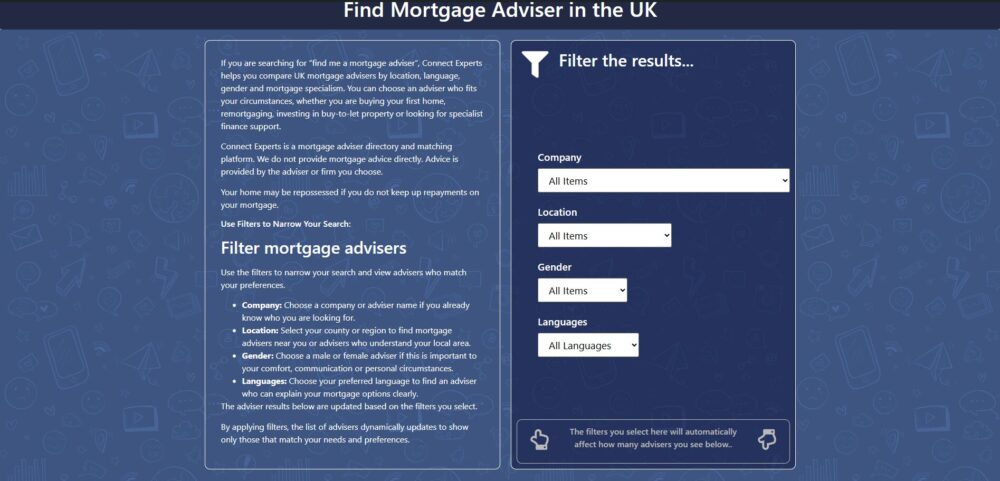
If you want to compare advisers by specialist area, Connect Experts lets you search for bridging loan mortgage brokers across the UK.
Connect Experts is a mortgage adviser directory. Advice is provided by the adviser or firm you choose.
Is a Bridging Loan Right for You?
A bridging loan may be worth exploring if you need short-term property finance and have a clear repayment plan.
Before applying, ask:
- What is the loan for?
- How much is needed?
- How long is the money needed for?
- What property will secure the loan?
- Is the exit sale or refinance?
- Is the exit realistic?
- What happens if the exit is delayed?
- What are the total costs?
- Could another finance route work better?
A bridging loan should solve a timing problem.
It should not create a bigger financial problem later.
Speak to Connect Mortgages
Connect Mortgages can help you review your short-term property finance options.
We can explain how bridging loans work, what lenders may assess, and what risks need consideration.
We are a credit broker, not a lender.
Your adviser will explain your options based on your property, circumstances, and repayment plan.
If you would like to discuss a bridging loan, contact Connect Mortgages.
FAQs: Bridging Loans
What is a bridging loan?
A bridging loan is short-term finance secured against property or land.
It is usually used to cover a funding gap until a sale, refinance, or other exit happens.
How long does a bridging loan last?
Terms vary by lender and case.
Many bridging loans are arranged for short periods, often between a few months and 12 months.
Some facilities may run longer, depending on the lender and loan type.
Are bridging loans expensive?
Bridging loans can be more expensive than standard mortgages.
Borrowers should review interest, fees, valuation costs, legal fees, and possible exit fees.
The total cost matters more than the headline rate.
Can I use a bridging loan to buy at auction?
Yes, bridging finance may be used for auction purchases.
This can help when completion is needed faster than a standard mortgage allows.
You should review the legal pack, valuation, deposit, fees, and exit route before bidding.
Can I get a bridging loan for refurbishment?
Yes, bridging finance may support light refurbishment or short-term property improvement.
For major works, structural changes, or staged funding, development finance may be more suitable.
What is an exit strategy?
An exit strategy is the plan for repaying the bridging loan.
Common exits include sale, refinance, or another agreed repayment source.
Lenders usually require a clear exit before agreeing terms.
Are bridging loans regulated?
Some bridging loans are regulated, and others are not.
This depends on the borrower, property, security, and intended use.
Cases involving a borrower’s home or a family dwelling may need careful regulatory review.
Can a bridging loan be secured as a second charge?
Yes, some bridging loans can be arranged as second charge loans.
This may apply when an existing mortgage remains in place.
The existing lender’s position and consent may need review.
What happens if I cannot repay the bridge?
If the loan is not repaid, the lender may charge fees, extend the facility, or take recovery action.
In serious cases, the secured property may be repossessed.
This is why the exit route is essential.
Do I need a broker for a bridging loan?
You are not always required to use a broker.
However, bridging finance is technical and lender criteria vary.
A broker can help review suitability, costs, lender options, risks, and repayment structure.