
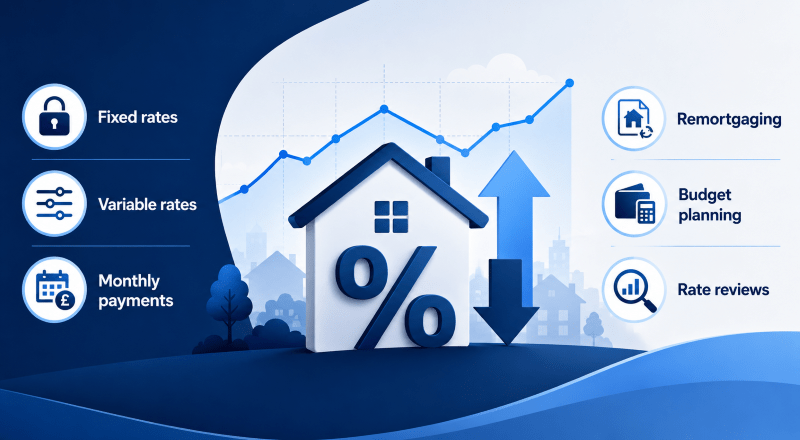
Mortgage Interest Rate Changes Explained: Mortgage interest rate changes can feel abstract until they reach the monthly payment.
A rate decision may be announced by the Bank of England. A lender may then change a tracker rate, a standard variable rate or the price of new mortgage deals. For a homeowner, the real question is simple: what does this mean for the mortgage I have, or the mortgage I may need next?
This guide explains how mortgage interest rate changes work, which mortgage types are affected, and what borrowers should check before making a decision.
At a Glance
Mortgage interest rate changes can affect borrowers in different ways.
- Fixed-rate mortgage payments usually stay the same until the fixed period ends.
- Tracker mortgages usually move when the linked rate changes.
- Standard variable rates can change at the lender’s discretion.
- New mortgage deals may be priced differently when market conditions change.
- Even a small rate rise can affect monthly payments and affordability.
- Reviewing your mortgage early can give you more time to compare options.
Interest rates are not just numbers on a screen. They shape household budgets, borrowing choices and long-term financial plans.
Why Mortgage Interest Rates Change
Mortgage rates can change for several reasons.
The Bank of England sets Bank Rate, which influences wider borrowing and savings rates across the UK. When Bank Rate rises, borrowing often becomes more expensive. When it falls, some borrowing costs may reduce, although mortgage rates do not always move at the same speed.
The Bank of England explains how Bank Rate affects the interest rates banks and building societies charge on loans. You can read its explanation of Bank Rate and interest rates.
Mortgage lenders also consider other factors when setting rates. These can include:
- Funding costs
- Swap rates
- Inflation expectations
- Competition between lenders
- The borrower’s loan-to-value
- Credit profile and affordability
- Product fees and lender criteria
- The length of the fixed or tracker period
This is why mortgage rates may change before or after a Bank of England announcement. It is also why two lenders may offer different rates at the same time.
How Rate Changes Affect Different Mortgage Types
The effect depends on the type of mortgage you have.
Fixed-rate mortgages
A fixed-rate mortgage gives you a set interest rate for an agreed period.
If wider rates rise during that fixed period, your monthly payment usually stays the same. That can help with budgeting. However, the fixed rate does not last forever.
When the fixed period ends, your mortgage will usually move onto the lender’s standard variable rate unless you arrange a new deal. This is where rate changes can matter sharply. A borrower who fixed several years ago may find that new deals are priced differently when the fixed period ends.
If your fixed-rate deal is ending soon, read our guide to what happens when a fixed-rate deal ends.
Tracker mortgages
A tracker mortgage usually follows a linked rate, often the Bank of England base rate, plus a set percentage.
For example, a tracker may be base rate plus 1%. If the base rate changes, the mortgage rate usually changes too. This can mean payments rise or fall during the mortgage term.
Trackers may suit borrowers who can manage payment changes. They may not suit borrowers who need a fixed monthly cost.
Standard variable rates
A standard variable rate, often called an SVR, is set by the lender.
It can change at the lender’s discretion. It may move when wider rates change, but it does not always track the Bank of England base rate directly.
Borrowers often move onto SVR when an introductory mortgage deal ends. SVR can offer flexibility, but it may be more expensive than other available options.
Discounted variable rates
A discounted variable rate gives a discount from the lender’s variable rate for a set period.
The payment can still change because the lender’s variable rate can change. This means the borrower gets an initial discount, but not full payment certainty.
For a wider comparison, read our guide to fixed vs variable mortgages.
How a rate rise can affect monthly payments
A rate change affects borrowers differently depending on the balance, term, repayment type and current rate.
For example, a borrower with a £100,000 interest-only mortgage would see the interest part of the monthly payment change if the rate increased.
| Rate increase | Approximate monthly increase |
|---|---|
| 0.50% | £41 |
| 1.00% | £83 |
| 2.00% | £166 |
A repayment mortgage is different because the monthly payment includes both interest and capital repayment. The impact depends on the remaining term.
For example, on a £100,000 repayment mortgage with 10 years remaining, a rate change could still increase the monthly payment, but the exact figure depends on the starting rate and lender calculation.
The key point is not the example itself. It is the principle behind it.
A mortgage rate change can alter the cost of the same debt. The borrower has not borrowed more, but the price of borrowing may have changed.
You can test different scenarios using the Connect Mortgages mortgage calculator.
Why timing matters when rates change
Mortgage timing can be as important as the rate itself.
If your current deal is ending, it may help to review your options several months in advance. This gives you time to compare rates, fees and lender criteria.
A lower rate is not always the cheapest option overall. Product fees, valuation costs, legal work, early repayment charges and cashback can all affect the total cost.
Borrowers should check:
- When the current deal ends
- Whether early repayment charges apply
- The current mortgage balance
- The remaining mortgage term
- The property value
- The loan-to-value
- Whether income or credit has changed
- Whether future plans may affect the mortgage choice
Some borrowers may want a new fixed rate for certainty. Others may consider a tracker or variable rate if flexibility matters more.
View current UK mortgage rates
What if higher rates affect affordability?
Higher mortgage rates can affect affordability in two ways.
First, they can increase the monthly payment on some mortgage types. Second, they can affect how much a lender may be willing to offer on a new application.
Lenders assess income, commitments, credit history and future payment risk. If rates are higher, the same borrower may have a lower borrowing capacity than before.
This matters for:
- First-time buyers
- Home movers
- Remortgage borrowers
- Self-employed applicants
- Borrowers with credit issues
- Landlords and portfolio landlords
- Borrowers seeking additional borrowing
If you are reviewing a residential mortgage, our residential mortgage guide explains the main routes for homebuyers and homeowners.
Remortgage, product transfer or wait?
When rates change, borrowers often ask whether they should remortgage.
A remortgage means replacing your current mortgage with a new one, usually with a different lender. A product transfer means moving to a new deal with your current lender.
Both options can be suitable, but they work differently.
A remortgage may offer access to wider lender options. It may also involve more checks, legal work and valuation requirements.
A product transfer may be simpler, but it may not always be the cheapest or most suitable option.
If your rate is ending, our remortgage guide explains how the process works.
Support if you are worried about rising payments
If mortgage payments become difficult, speak to your lender as early as possible.
The Mortgage Charter set out support measures for eligible residential mortgage borrowers, including options that may help some customers manage short-term pressure. You can read the official GOV.UK Mortgage Charter.
Support will depend on your lender, mortgage type and circumstances. It is important to understand the effect of any change before agreeing to it. Some options may reduce monthly payments now but increase total interest over time.
Speak to a mortgage adviser
Rate changes do not affect every borrower in the same way.
A fixed-rate borrower may need to plan ahead. A tracker borrower may need to prepare for payment movement. A borrower on SVR may need to check whether staying there still makes sense.
The right answer depends on the mortgage, the household budget and the borrower’s plans.
Connect Mortgages can help you review your mortgage options and understand how rate changes may affect your repayments. You can also use Connect Experts to find a mortgage adviser by location, language or mortgage need.
FAQs: Mortgage interest rate changes
Do mortgage payments always rise when interest rates rise?
No. It depends on the mortgage type. A fixed-rate mortgage usually stays the same during the fixed period. A tracker or variable mortgage may change sooner.
Does the Bank of England set mortgage rates?
The Bank of England sets Bank Rate. Mortgage lenders set their own mortgage rates, but Bank Rate can influence the cost of borrowing across the market.
Will my fixed-rate mortgage change if rates rise?
Usually not during the fixed period. Your payment may change when the fixed period ends if your next rate is higher or lower.
What happens to a tracker mortgage when rates change?
A tracker mortgage usually moves in line with the rate it tracks. If the linked rate rises, the mortgage rate usually rises. If it falls, the mortgage rate may fall.
Is SVR the same as a tracker rate?
No. A tracker follows a linked rate. An SVR is set by the lender and can change at the lender’s discretion.
Should I remortgage when interest rates change?
Not always. You should compare the rate, fees, early repayment charges, timing and your future plans. Advice can help you compare the total cost, not just the headline rate.
How early should I review my mortgage?
Many borrowers review their mortgage several months before the current deal ends. This can give more time to compare options and avoid moving onto SVR by accident.
Can higher rates reduce how much I can borrow?
Yes. Higher rates can affect affordability checks. A lender may offer less if repayments look less affordable against your income and commitments.