
Mortgage success is not about luck.
It is about evidence, timing, lender criteria and the way your application is presented.
Some borrowers feel their position is difficult before the process even begins. They may be over 50. They may work for themselves. They may be buying their first home and have no previous mortgage history.
Each case can raise different questions. Yet each case can still have a route forward, subject to affordability, credit profile, deposit and lender criteria.
This guide explains how mortgage success may be approached if you are over 50, self-employed or buying your first property.
At a Glance
Mortgage success depends on how well your circumstances match lender criteria.
- Over-50 borrowers may need to explain retirement income, mortgage term and repayment plans.
- Self-employed applicants usually need clear income evidence and organised accounts.
- First-time buyers should prepare their deposit, credit file, budget and documents early.
- Lenders assess affordability, credit history, income stability, deposit and property details.
- A mortgage adviser can help identify suitable lenders before an application is made.
What Does Mortgage Success Really Mean?
A successful mortgage application is not simply an approval.
It should also be affordable, suitable and practical for your long-term plans.
That matters because a mortgage affects more than the day you complete. It affects monthly income, future choices and financial resilience. The right mortgage should sit within your life, not put pressure on it.
Lenders usually assess several areas before making a decision. These include income, outgoings, deposit, credit history, property type and the requested mortgage term.
If your case needs more explanation, preparation becomes even more important.
You can read more about how standard home loans work on our residential mortgage page.
Can You Get a Mortgage If You Are Over 50?
Yes, many people over 50 can get a mortgage.
However, lenders may look more closely at the mortgage term, retirement plans and future income. This is because the loan may continue into later working life or retirement.
An over-50 mortgage application may involve:
- Current earned income
- Pension income
- Expected retirement age
- Mortgage term requested
- Repayment method
- Deposit or equity
- Existing credit commitments
- Property type and purpose
The question is not just age. The question is whether the mortgage remains affordable across the full term.
Some lenders may allow borrowing beyond traditional retirement age. Others may apply stricter limits. This is why lender choice can matter.
Why Retirement Income Matters
If the mortgage term runs into retirement, lenders may want evidence of future income.
This could include pension statements, projected retirement income, investment income or other accepted sources. The exact evidence depends on the lender and your circumstances.
A borrower aged 52 may still have many working years ahead. A 68-year-old borrower may need a different route. Both may have options, but the assessment will not be the same.
Mortgage success after 50 often depends on showing three things clearly:
- How the mortgage will be paid now
- How it will remain affordable later
- How the balance will be repaid by the end of the term
This is where advice can help. A suitable lender may understand older borrower cases better than another lender with stricter age rules.
Can You Get a Mortgage If You Are Self-Employed?
Yes, self-employed applicants can get mortgages.
The main difference is how income is proven.
An employed applicant may use payslips and a P60. A self-employed applicant may need tax calculations, Tax Year Overviews, certified accounts, bank statements or business records.
This applies to many types of self-employed borrower, including:
- Sole traders
- Limited company directors
- Contractors
- Freelancers
- Business partners
- CIS workers
A lender wants to know whether the income is reliable and sustainable. They may also look at trading history, business stability and recent figures.
You can find more detail on our self-employed mortgage page.
What Documents May Self-Employed Applicants Need?
The exact documents vary by lender. However, many self-employed mortgage applications may need:
- SA302 tax calculations
- HMRC Tax Year Overviews
- Certified accounts
- Business bank statements
- Personal bank statements
- Proof of deposit
- Identification and address evidence
- Details of business structure
- Accountant information, where relevant
Limited company directors may be assessed differently from sole traders. Some lenders focus on salary and dividends. Others may consider retained profit, depending on their criteria.
This is why the same income can produce different outcomes with different lenders.
Mortgage success for self-employed applicants often depends on presentation. The figures need to be clear, consistent and supported by evidence.
Can You Get a Mortgage As a First-Time Buyer?
Yes, first-time buyers can get mortgages.
However, the first application can feel more complex because everything is new. You may be learning about deposits, affordability, credit checks, conveyancing, surveys and mortgage offers at the same time.
A first-time buyer mortgage is usually assessed on:
- Deposit size
- Income and employment
- Monthly spending
- Credit history
- Existing debts
- Property value
- Mortgage term
- Future affordability
Some first-time buyers may only need a small deposit, subject to lender criteria. A larger deposit may improve lender choice or reduce monthly payments.
You can read our dedicated first-time buyer mortgage guide for more details.
First-Time Buyer Mortgage Success Starts Before The Offer
Mortgage success starts before you find a property.
This is because your budget affects your search. If you understand your likely borrowing position early, you can avoid viewing homes that do not match your affordability.
Before making an offer, first-time buyers should consider:
- How much deposit is available
- Whether savings cover fees and moving costs
- Whether the credit file is accurate
- Whether bank statements show stable spending
- Whether existing debts need reviewing
- Whether income is clear and provable
- Whether the property type may affect lending
A mortgage agreement in principle may help you understand your likely borrowing. However, it is not a full mortgage offer.
The full decision still depends on underwriting, valuation and lender checks.
Why Credit Profile Still Matters
Credit history is one part of the mortgage picture.
A clean credit file can support an application. Missed payments, defaults or high unsecured borrowing may reduce lender choice.
That does not always mean a mortgage is impossible. It means the application needs careful review before submission.
Mortgage success often improves when you check your credit report early. This gives time to correct errors, reduce commitments or explain issues where needed.
A lender does not only look at whether you have credit. It may also consider how you manage it.
Why Affordability Is Not The Same For Every Lender
Borrowers often ask how much they can borrow.
The answer can vary by lender.
One lender may treat overtime differently from another. One lender may take a flexible view of self-employed income. Another may use a stricter calculation for older borrowers.
Affordability may include:
- Basic income
- Bonus or commission
- Self-employed income
- Pension income
- Childcare costs
- Loans and credit cards
- Dependants
- Ground rent or service charge
- Property costs
- Mortgage term
This is why the cheapest rate is not always the first question. The first question is whether the lender fits the case.
How A Mortgage Adviser Can Help
A mortgage adviser can review your circumstances before you make an application.
This can reduce the risk of approaching a lender whose criteria do not fit your position.
An adviser may help you:
- Understand how lenders may assess your income
- Review your deposit and affordability
- Prepare the right documents
- Compare suitable mortgage routes
- Avoid unnecessary declined applications
- Understand costs and possible risks
- Plan the next step clearly
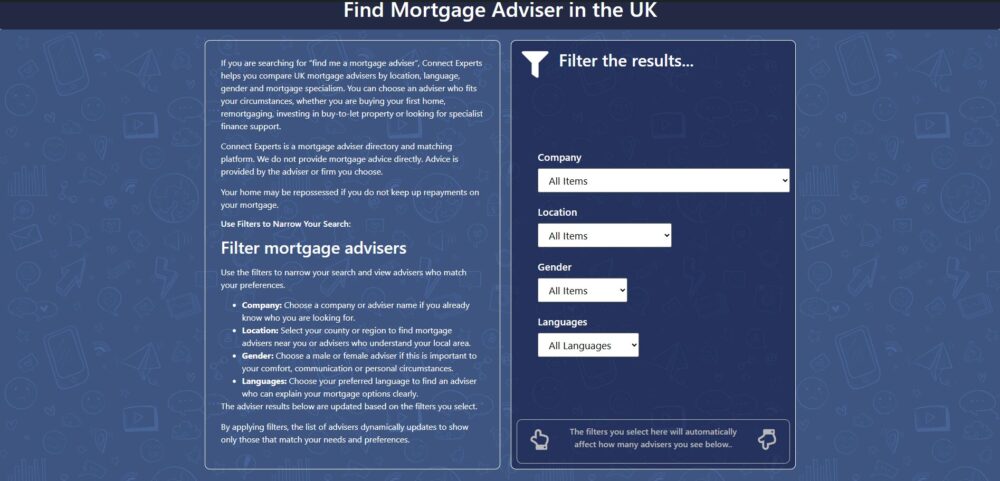
For borrowers who want to choose an adviser by location, language or mortgage need, Connect Experts offers a way to find a mortgage adviser across the UK.
Connect Experts is a mortgage adviser directory and matching platform. Mortgage advice is provided by the adviser or firm you choose.
The Common Thread: Evidence Creates Confidence
Over-50 borrowers, self-employed applicants and first-time buyers may seem like different groups.
Yet the same principle applies to each one.
Lenders need evidence. Borrowers need clarity. Advisers need enough detail to identify the right route.
The more complex the case, the more important the preparation becomes.
A strong mortgage application tells a clear story. It explains income, affordability, deposit, credit history and repayment plans in a way the lender can assess.
That is the practical meaning of mortgage success.
Mortgage Success Checklist
Before applying, consider the following steps:
- Check your credit file early
- Gather proof of income
- Review your bank statements
- Confirm your deposit source
- List your monthly commitments
- Think about your preferred mortgage term
- Consider future income changes
- Prepare questions before speaking to an adviser
This checklist is not only for complex cases. It can help any borrower apply with more confidence.
Speak To Connect Mortgages
Your mortgage route should reflect your real circumstances.
That may mean planning around age, self-employed income, first-time-buyer questions, or a combination of these factors.
Connect Mortgages can help you understand your options before you apply. The aim is to make the process clearer, more practical and better prepared from the start.
If you are unsure where to begin, speak to Connect Mortgages about your next step.
FAQs About Mortgage Success
Can I get a mortgage after 50?
Yes, you may be able to get a mortgage after 50. Lenders will usually assess your income, age, mortgage term, retirement plans, credit profile and repayment strategy.
Can I get a mortgage if I am self-employed?
Yes, self-employed borrowers can get mortgages. You may need to provide stronger income evidence, such as tax calculations, Tax Year Overviews, accounts and bank statements.
Can a first-time buyer get a mortgage with a small deposit?
Some first-time buyers may be able to buy with a smaller deposit, subject to lender criteria, affordability and credit checks. A larger deposit may improve options.
What improves mortgage approval chances?
Clear income evidence, a suitable deposit, stable spending, accurate documents and a well-managed credit file can all support a mortgage application.
Should I speak to a mortgage adviser before applying?
Yes, speaking to an adviser before applying can help you understand which lenders may fit your circumstances. This may reduce the risk of applying to an unsuitable lender.
Your home may be repossessed if you do not keep up repayments on your mortgage.