
Self-Employed Mortgage Brokers: Income, Evidence and Lender Checks – Getting a mortgage when you are self-employed is not usually about whether you earn enough.
It is often about whether your income can be clearly evidenced, properly explained, and assessed by the right lender.
That is where self-employed mortgage brokers can help. They do not create a separate mortgage product for self-employed applicants. Instead, they help present income, documents, and circumstances in a way that fits the lender’s criteria.
This matters because self-employed income can be more varied than employed income. A sole trader may show net profit. A limited company director may take salary and dividends. A contractor may work through fixed-term agreements. A freelancer may have several income streams over the course of the year.
The philosophy is simple. Lenders are not only looking at what you earn. They are looking at whether the income is reliable, sustainable and supported by evidence.
At a Glance
Self-employed mortgage brokers help applicants prepare income evidence, understand lender criteria and avoid applying to lenders that may not suit their circumstances.
A self-employed applicant may need SA302 tax calculations, Tax Year Overviews, accounts, bank statements, contracts, dividend evidence or business details.
A broker can help if you are a sole trader, freelancer, contractor, partner, CIS worker or limited company director.
The key issue is not self-employment itself. The key issue is how your income is documented and assessed.
What Does a Self-Employed Mortgage Broker Do?
A self-employed mortgage broker helps people whose income does not come from standard PAYE employment.
This can include:
- Sole traders
- Freelancers
- Contractors
- Limited company directors
- Business partners
- CIS workers
- Applicants with mixed income
- Applicants with one year of accounts
The broker’s role is practical. They review how your income is recorded, what lenders may ask for, and whether your case is likely to fit standard or more specialist criteria.
This can be useful before you apply. A declined application can delay a purchase, affect confidence and leave an unnecessary credit search on your file.
If you need a deeper product page, read our guide to a self-employed mortgage.
When Are You Treated as Self-Employed?
Lenders may treat you as self-employed if your main income comes from your own business, freelance work, contracting, partnership income or company directorship.
Some lenders may also treat you as self-employed if you own a meaningful share of a business and receive income from it.
This does not mean you cannot get a mortgage. It means the lender may assess your income differently.
An employed applicant may provide payslips and a P60. A self-employed applicant may need tax documents, accounts, bank statements and proof that the business can continue to support the mortgage.
What Income Evidence May Be Needed?
The documents depend on your business structure and lender criteria.
Common documents may include:
- SA302 tax calculations
- HMRC Tax Year Overviews
- Certified accounts
- Business bank statements
- Personal bank statements
- Accountant details
- Company accounts
- Dividend vouchers
- Current and previous contracts
- CIS payslips or statements
- Proof of deposit
- Credit commitments and regular outgoings
The aim is not to provide every document to every lender. The aim is to provide the right documents for the right case.
A broker can help you understand what is likely to be needed before an application is submitted.
How Lenders Assess Self-Employed Income
Different lenders assess self-employed income in different ways.
For sole traders, lenders often look at net profit shown through tax documents.
For limited company directors, some lenders use salary and dividends. Others may consider retained profit, depending on the company’s position and the lender’s policy.
For contractors, some lenders may use day rate, contract value or declared income. They may ask how long the contract has been running and whether there is evidence of future work.
For business partners, lenders may assess your share of profit.
For CIS workers, some lenders may treat income differently from standard self-employment if the work pattern is clear.
This is why the lender’s choice matters. Two applicants with the same income may receive different outcomes depending on how the income is structured.
Why 2023 Made Preparation More Important
The 2023 mortgage market placed more pressure on affordability.
Rates were higher than many borrowers had been used to, and lenders were careful when assessing income and expenditure. In September 2023, the Bank of England reported that the effective interest rate on newly drawn mortgages had risen to 5.01%. Mortgage approvals for house purchase also fell to 43,300, the lowest level since January 2023.
For self-employed applicants, this made preparation more important. Lenders still wanted to lend where the case was strong, but income evidence, spending patterns and affordability needed to be clear.
That is still the lesson for borrowers today. The stronger the evidence, the easier it is for a lender to understand the case.
Can You Get a Mortgage With One Year’s Accounts?
It may be possible to get a mortgage with one year’s accounts, but lender choice may be smaller.
A lender may want to understand:
- Your previous work history
- Whether you worked in the same trade before becoming self-employed
- Whether your first year’s income is sustainable
- Whether you have signed contracts or repeat clients
- Whether your bank statements support the declared income
- Whether your deposit and credit profile are strong
One year of trading does not automatically mean no. It does mean the case needs careful placement.
What Can Delay a Self-Employed Mortgage Application?
Delays often happen when income evidence is incomplete or inconsistent.
Common issues include:
- Accounts not yet finalised
- Tax Year Overviews not matching SA302 figures
- Declining profits without an explanation
- Large business expenses reducing taxable income
- Mixed personal and business spending
- Recent change from employed to self-employed
- Undisclosed credit commitments
- Contract income not supported by paperwork
- Deposit source not fully evidenced
A broker can help identify these issues early. That can save time before the application reaches underwriting.
Self-Employed Remortgage Cases
A self-employed remortgage can still require updated income evidence.
Even if you already own the property, a new lender may need to reassess affordability. This may include recent accounts, tax documents, bank statements and details of current borrowing.
If your current deal is ending, it can help to start the review early. This gives time to compare product transfer options, new lender options and any changes to your income position.
You can read more about your wider remortgage options.
What if You Have Adverse Credit?
Adverse credit does not always stop a self-employed mortgage application.
However, it can affect lender choice, deposit requirements, and the available rate. Lenders may look at the type of credit issue, when it happened, whether it has been satisfied and how your current finances are managed.
Self-employed applicants with adverse credit may require a more detailed review because two areas are being assessed simultaneously: income evidence and credit profile.
For more information, read our adverse credit mortgage guide.
Why Protection Matters When You Are Self-Employed
A mortgage is a long-term financial commitment.
If you are self-employed, you may not have the same sick pay, death-in-service benefit or employee support as someone in PAYE employment. That does not mean every protection product is suitable. It does mean the conversation should not be ignored.
Protection may include life cover, critical illness cover or income protection, depending on your needs and eligibility.
Read more about mortgage protection insurance to understand how cover may support your mortgage planning.
When Should You Speak to a Broker?
It can help to speak to a broker before you start viewing properties or before your current deal ends.
Early advice can help you understand:
- How your income may be assessed
- What documents to prepare
- Whether your accounts support the borrowing needed
- Whether your deposit level is suitable
- Which lender criteria may apply
- Whether your credit file needs review
- Whether timing matters before submitting an application
You can also read more about residential mortgage advice if your aim is to buy or remortgage a home.
Find a Self-Employed Mortgage Broker
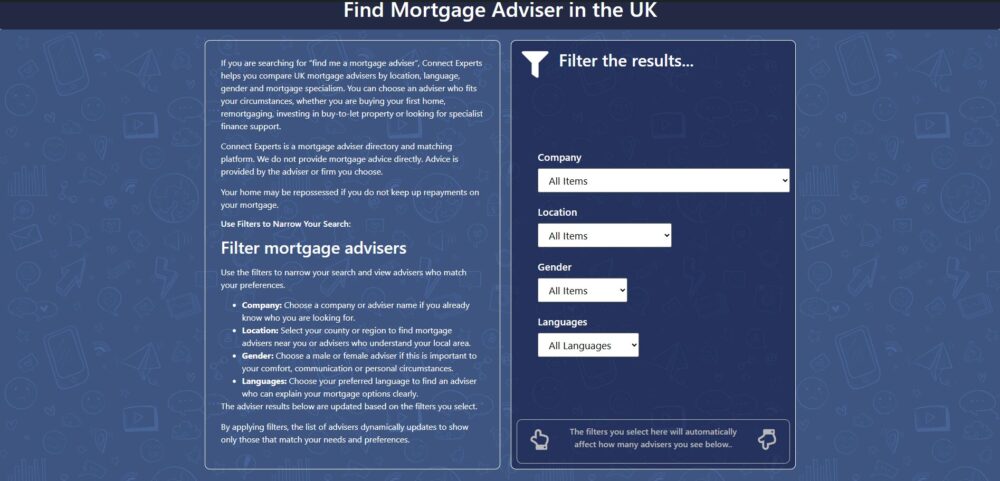
Some applicants want to choose an adviser based on location, language, gender or specialist experience.
Connect Experts, part of Connect Group, helps users search for advisers with practical filters. You can use Connect Experts to find self-employed mortgage brokers or read the UK self-employed mortgage guide for more details.
Connect Experts does not provide mortgage advice directly. Advice is provided by the adviser or firm selected by the customer.
FAQs About Self-Employed Mortgage Brokers
Can self-employed people get a mortgage?
Yes. Self-employed people can get mortgages if they meet lender criteria. The main difference is how income is evidenced and assessed.
Do self-employed applicants need two years of accounts?
Many lenders prefer two years of accounts, but some may consider one year. This depends on the case, income level, deposit, credit profile and lender criteria.
What income do lenders use for sole traders?
Lenders often use net profit, supported by SA302 tax calculations and Tax Year Overviews.
What income do lenders use for company directors?
Some lenders use salary and dividends. Others may consider retained profit where the lender criteria allow it and the company position supports it.
Are self-certification mortgages available?
No. Self-certification mortgages are not available in the way they were before the financial crisis. Lenders must verify income using suitable evidence.
Can contractors get a mortgage?
Yes. Contractors may be assessed through day rate, contract income or declared income, depending on the lender.
Can a broker improve my chances?
A broker cannot guarantee approval. However, they can help you prepare documents, understand lender criteria and avoid lenders that may not fit your case.
What Next?
If you are self-employed and planning to buy, move home or remortgage, prepare your documents before applying.
The right question is not only “How much can I borrow?”
It is also “Can my income be understood clearly enough for the lender to make a responsible decision?”
That is where preparation, evidence and suitable advice matter.