

Understanding First-Time Buyers: Buying your first home is not only a financial step. It is a test of clarity.
A first-time buyer needs to understand more than the monthly payment. Lenders look at deposit, income, credit history, debts, property type and future affordability. A mortgage broker helps turn those details into a workable route.
This guide explains how mortgage brokers support first-time buyers. It also explains the technical parts of the process, from affordability checks to mortgage offers.
At a Glance
A first-time buyer mortgage is usually for someone buying their first residential home.
A mortgage broker can help by checking affordability, comparing lenders, reviewing documents and explaining the application process.
First-time buyers usually need to consider:
- Deposit size
- Loan-to-value
- Income and outgoings
- Credit history
- Mortgage type
- Product fees
- Valuation requirements
- Solicitor and conveyancing steps
- Stamp Duty or property tax
- Buildings insurance
- Protection needs
The right mortgage is not always the lowest rate. It should fit the buyer’s income, deposit, property, credit profile and long-term plans.
For a wider product guide, read our First-Time Buyer Mortgage page.
What is a First-Time Buyer?
A first-time buyer is usually someone who has never owned a residential property before.
This can include property owned in the UK or abroad. It can also include property inherited, gifted or owned jointly.
The definition matters because it can affect:
- Stamp Duty relief
- First-time buyer mortgage products
- Deposit planning
- Government support options
- Lender criteria
- Adviser recommendations
If two people buy together, both may need to meet the first-time buyer rules for certain benefits.
This is where small details matter. A buyer may feel new to the process, but a lender may still look at past property ownership.
Why First-Time Buyers Need More Than a Rate Search
A mortgage rate is only one part of the decision.
A first-time buyer also needs to know whether the lender will accept the case. This depends on how the lender assesses risk.
A lender may review:
- Employment type
- Length of time in role
- Basic income
- Overtime, bonuses or commission
- Self-employed income
- Existing credit commitments
- Student loans
- Childcare costs
- Dependants
- Bank statements
- Credit file conduct
- Deposit source
- Property type
- Lease length, where relevant
A low rate is of little use if the lender will not accept the income, deposit or property.
A mortgage broker helps compare both rate and criteria. This is important because lenders do not all assess first-time buyers in the same way.
How Mortgage Affordability Works
Affordability is the lender’s view of whether the mortgage is sustainable.
A lender will usually check income, regular spending, debts and future payment pressure. They may also consider how payments could look if rates changed.
This is why two buyers with the same income may receive different borrowing outcomes.
For example, borrowing may be affected by:
- Credit card balances
- Personal loans
- Car finance
- Childcare costs
- Maintenance payments
- Student loan deductions
- Variable income
- Recent job changes
- Number of financial dependants
Before viewing homes, it helps to carefully estimate your borrowing capacity. Use our Residential Affordability Calculator as an early guide.
Deposit and Loan-To-Value
The deposit is the money the buyer contributes towards the purchase.
Loan-to-value, often abbreviated as LTV, is the mortgage amount relative to the property’s value.
For example, a £250,000 property with a £25,000 deposit would need a £225,000 mortgage. That would be 90% loan-to-value.
Many first-time buyers start with a 5% or 10% deposit. However, a larger deposit can sometimes improve lender choice and reduce monthly payments.
A lender may ask for a bigger deposit if:
- The buyer has recent credit issues
- Income is complex
- The property is unusual
- The buyer needs a specialist lender
- Affordability is tight
- The property is a new build
- The buyer is using a gifted deposit
A gifted deposit usually needs to be declared. The person giving the gift may need to confirm it is not repayable.
First-Time Buyer Stamp Duty Position
This blog was first published in September 2023. At that time, first-time buyer Stamp Duty rules in England and Northern Ireland were using temporary thresholds.
Between 23 September 2022 and 31 March 2025, the first-time buyer nil-rate threshold was temporarily increased to £425,000. The maximum property value eligible for First-Time Buyers’ Relief was temporarily increased to £625,000.
Stamp Duty rules are different in Scotland and Wales. Scotland uses Land and Buildings Transaction Tax. Wales uses Land Transaction Tax.
First-time buyers should always check the tax position before making an offer. You can estimate potential costs with our Stamp Duty Calculator.
For official background on the temporary SDLT threshold changes, see the UK Government’s Stamp Duty Land Tax temporary increase to thresholds.
What Does a Mortgage Broker Do For a First-Time Buyer?
A mortgage broker helps the buyer understand the route before an application is submitted.
The role can include:
- Reviewing deposit and income
- Checking affordability
- Explaining mortgage types
- Comparing lender criteria
- Identifying suitable lenders
- Reviewing credit history
- Explaining documents needed
- Submitting the application
- Liaising with the lender
- Helping manage post-offer queries
The broker does not replace the solicitor. The solicitor handles the legal work.
The broker focuses on mortgage advice, lender criteria and the application process.
Mortgage Types First-Time Buyers May See
Most first-time buyers use a repayment mortgage.
With a repayment mortgage, each monthly payment covers interest and part of the loan. If all payments are made, the mortgage balance reduces over time.
A first-time buyer may also see:
- Fixed-rate mortgages
- Tracker mortgages
- Discounted variable-rate mortgages
- Standard variable rate products
- Repayment mortgages
- Interest-only options, where suitable
Fixed rates are often popular with first-time buyers because payments stay the same during the fixed period. This can help with budgeting.
However, the right choice depends on the buyer’s income, plans, risk tolerance and expected time in the property.
What Documents Do First-Time Buyers Need?
Documents are not just paperwork. They are evidence.
A lender needs evidence before it can make a decision. Missing or unclear documents can delay the application.
First-time buyers may need:
- Passport or driving licence
- Proof of address
- Payslips
- P60, where relevant
- Bank statements
- Proof of deposit
- Gifted deposit letter, where relevant
- Credit commitment details
- Details of bonuses or overtime
- Tax documents, if self-employed
- Solicitor details
- Estate agent memorandum of sale
Self-employed buyers may need more evidence. This can include tax calculations, tax year overviews, accounts and business bank statements.
If your income is not straightforward, read our Self-Employed Mortgage guide.
Credit History and First-Time Buyer Mortgages
A credit file helps lenders understand how a buyer has managed borrowing.
Credit history can affect lender choice, deposit requirements and interest rates.
A lender may review:
- Missed payments
- Defaults
- County Court Judgments
- Debt management plans
- Payday loan use
- Credit card balances
- Overdraft conduct
- Recent applications
- Linked financial relationships
A past credit issue does not always stop a mortgage. However, the date, amount, reason and outcome can matter.
First-time buyers should avoid making multiple mortgage applications without advice. A declined application can make the next step harder.
For specialist situations, read our Adverse Credit Mortgage guide.
Broker Versus Direct Lender
A first-time buyer can apply directly to a lender or use a mortgage broker.
A direct lender can only offer its own products. A broker can compare products and criteria across the lenders they work with.
A broker may help when:
- The buyer has a small deposit
- Income includes overtime or bonus
- The buyer is self-employed
- The credit file is not perfect
- The property is leasehold
- The buyer needs family support
- The case needs careful packaging
However, buyers should understand broker fees before proceeding.
Some brokers charge a fee. Some receive commission from the lender. Some may use both. The fee structure should be explained clearly before an application is submitted.
The Mortgage Application Process
The process usually follows a clear order.
First, the buyer speaks with a broker or lender. Affordability and deposit are reviewed.
Next, the buyer may receive a decision in principle. This is not a final mortgage offer. It is an early indication based on the details supplied.
The buyer then makes an offer on a property. If accepted, the full mortgage application can be submitted.
The lender may then assess:
- Income documents
- Bank statements
- Credit file
- Deposit evidence
- Property value
- Property condition
- Solicitor details
- Overall affordability
The lender may request more information before making a decision.
Valuation, Survey and Mortgage Offer
A mortgage valuation is for the lender. It helps the lender decide whether the property is suitable security for the mortgage.
A valuation is not the same as a full survey.
A buyer may choose to arrange a separate survey for their own protection. This can help identify property condition issues.
If the lender is satisfied with the application and valuation, it may issue a mortgage offer.
The mortgage offer confirms the loan amount, product, rate, term and conditions.
At this point, the solicitor continues the legal work before exchange and completion.
The Post-Offer Process
The mortgage offer is important, but the purchase is not complete.
After the offer, the solicitor or conveyancer handles legal checks. These can include searches, title review, enquiries and contract preparation.
The buyer should keep the lender and broker updated if anything changes.
Important changes can include:
- Job change
- Income change
- New credit agreement
- Deposit change
- Purchase price change
- Property issue
- Relationship change between joint buyers
The lender may need to reassess the case if material details change.
In England, Wales and Northern Ireland, exchange of contracts creates a legal commitment. In Scotland, the legal process works differently through missives.
Completion is usually when the buyer pays the balance, the mortgage funds are released and the keys are collected.
Costs First-Time Buyers Should Budget For
The deposit is only one cost.
A first-time buyer may also need to budget for:
- Mortgage broker fee
- Lender arrangement fee
- Valuation fee
- Survey cost
- Solicitor or conveyancer fee
- Search fees
- Stamp Duty or property tax
- Buildings insurance
- Contents insurance
- Moving costs
- Service charges, if leasehold
- Ground rent, where relevant
- Furniture and repairs
It is unwise to use every pound of savings on the deposit. A buyer still needs funds for moving, insurance and early home costs.
Protection and Insurance
A mortgage creates a long-term commitment. First-time buyers should consider how that commitment would be maintained if circumstances changed.
Protection may include:
- Life insurance
- Critical illness cover
- Income protection
- Buildings insurance
- Contents insurance
Buildings insurance is usually required by the lender from exchange of contracts. Other protection needs depend on the buyer’s circumstances.
You can read more about cover on our Mortgage Protection Insurance page.
How to Choose a Mortgage Broker
Choosing a broker should not be rushed.
A first-time buyer should ask:
- Are you authorised and regulated?
- What lenders do you work with?
- Do you charge a fee?
- When is the fee payable?
- Do you advise on protection?
- How will you communicate updates?
- What documents do you need?
- What happens if the lender declines the case?
A good broker should explain the process in plain English. They should also explain risks, costs and next steps.
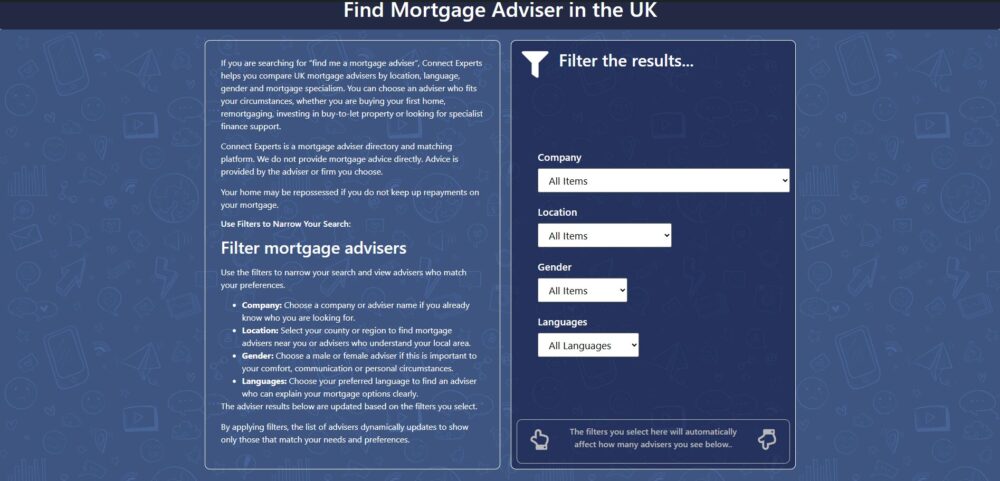
If you prefer to search by adviser, location or language, use the Connect Experts mortgage adviser directory.
Practical First-Time Buyer Checklist
Before applying, check the following:
- Confirm your deposit amount
- Check where the deposit came from
- Review your bank statements
- Check your credit file
- Avoid unnecessary new borrowing
- Estimate monthly payments
- Budget for fees and moving costs
- Prepare income documents
- Speak with a broker before applying
- Check property tax rules
- Understand the mortgage offer conditions
- Arrange insurance at the right stage
A first home is not only bought with money. It is bought with evidence, timing and informed decisions.
What Next?
If you are buying your first home, start with the numbers.
Check your deposit, affordability, credit history and documents before applying. A mortgage broker can then help match your position to suitable lenders.
You can also search for a local adviser through our Mortgage Brokers Near You page.
Frequently Asked Questions
What is a first-time buyer?
A first-time buyer is usually someone buying their first home who has not owned residential property before.
This can include property owned in the UK or abroad.
How much deposit does a first-time buyer need?
Many first-time buyers start with a 5% or 10% deposit.
Some lenders may require more, depending on credit history, income, property type and affordability.
Can a first-time buyer get a mortgage with bad credit?
Yes, it may be possible.
However, bad credit can reduce lender choice and may increase the deposit required.
Is a mortgage broker better than going direct?
A broker can compare lenders and criteria. A direct lender can only offer its own products.
The better route depends on the buyer’s circumstances, confidence and case complexity.
What is a decision in principle?
A decision in principle is an early indication of possible borrowing.
It is not a final mortgage offer. The lender still needs to review the full application and property.
What happens after a mortgage offer?
The solicitor continues the legal work. The buyer should avoid major financial changes before completion.
The lender may reassess the case if income, employment, deposit or property details change.
Do first-time buyers need buildings insurance?
Most lenders require buildings insurance from exchange of contracts.
Contents insurance and personal protection depend on the buyer’s needs.
Where can first-time buyers get impartial guidance?
MoneyHelper provides a useful government-backed first-time home buyer guide covering deposits, costs and buying steps.