
Understanding Second Charge Mortgages: Borrowing against a home is never just about access to money. It is about structure, timing, risk and consequence.
A second charge mortgage may allow a homeowner to raise funds without replacing their current mortgage. That can be useful when the existing mortgage rate is worth keeping, or when remortgaging would trigger high early repayment charges.
However, the technical point matters. A second charge mortgage is not free equity. It is a separate secured loan, registered behind the main mortgage. You keep the first mortgage, but you add another repayment, another lender, and another legal charge against the property.
That is why understanding the product comes before deciding whether it is suitable.
Understanding Second Charge Mortgages at a Glance
A second charge mortgage is a separate loan secured against a property that already has a mortgage.
It may help if you want to borrow more without changing your current mortgage. This can be useful where your existing rate is low, your lender will not offer further borrowing, or a remortgage would be expensive.
However, it means two secured loans sit against the same property. Your home may be repossessed if you do not keep up repayments on your mortgage or any loan secured on it.
Before applying, compare the total cost, term, fees, interest rate, affordability and alternatives.
You can read more about second charge mortgages or search for a second charge mortgage adviser if you need specialist support.
What Is a Second Charge Mortgage?
A second charge mortgage is a loan secured against a property that already has a mortgage.
Your existing mortgage stays in place. This remains the first charge. The new borrowing becomes the second charge.
The word “charge” refers to the legal security registered against the property. If the property is sold, the first charge lender is usually repaid first. The second charge lender is repaid after that.
This is one reason second charge mortgage rates can be higher than first charge mortgage rates. The second lender takes more risk because it sits behind the first lender.
A second charge mortgage is also known as:
- a second mortgage
- a secured homeowner loan
- a secured loan
- a second charge loan
The names may vary, but the core structure is the same. It is borrowing secured against your home while your main mortgage continues.
How a Second Charge Mortgage Works
A second charge mortgage usually follows a separate application process.
The lender will review your property value, existing mortgage balance, income, credit history, expenditure and reason for borrowing. They will also assess whether the repayments are affordable alongside your current mortgage.
For example, if your home is worth £350,000 and your current mortgage balance is £220,000, there may be £130,000 of equity. This does not mean you can borrow the full amount. Lenders apply their own loan-to-value limits and affordability checks.
If approved, the second charge mortgage runs beside your current mortgage. You make one payment to your first mortgage lender and another payment to the second charge lender.
The second charge will usually have its own:
- interest rate
- repayment term
- monthly payment
- arrangement fees
- valuation requirements
- early repayment rules
- legal process
- lender criteria
The practical question is not only whether you can borrow. It is whether the structure makes sense over the full term.
Why Homeowners Consider Second Charge Mortgages
A second charge mortgage may be considered when a homeowner needs extra funds but does not want to disturb their main mortgage.
This can happen when the current mortgage deal is still valuable. For example, a borrower may have a low fixed rate that would be lost through remortgaging.
It may also help where a remortgage would involve early repayment charges. In that case, replacing the whole mortgage could make the borrowing more expensive than expected.
Common reasons include:
- home improvements
- debt consolidation
- business funding
- tax bills
- school fees
- property investment
- family support
- major one-off expenses
Each purpose needs careful review. The fact that borrowing is possible does not mean it is suitable.
When a Second Charge Mortgage May Be Useful
A second charge mortgage may be worth exploring if:
- Your current mortgage rate is lower than available new rates
- You would face early repayment charges by remortgaging
- Your current lender will not offer a further advance
- Your income has changed since your first mortgage
- Your credit profile needs specialist lender review
- You need a larger loan than an unsecured lender may offer
- You want to keep your current mortgage arrangement separate
This product can be useful when the first mortgage needs protection. However, that benefit must be weighed against the cost of the second loan.
The decision should be based on total cost, not headline rate alone.
When a Second Charge Mortgage May Not Be Suitable
A second charge mortgage may not be suitable if the extra payment would stretch your monthly budget.
It may also be unsuitable where an unsecured loan, further advance or remortgage would be cheaper overall.
Caution is especially important when using a second charge mortgage to consolidate unsecured debts. This may reduce monthly payments, but it can also turn unsecured borrowing into debt secured against your home.
You may also pay more interest if the loan is arranged over a longer term.
A second charge mortgage may not be the right route if:
- You only need a small loan
- You have little available equity
- Your income is uncertain
- Your credit commitments are already high
- You may move home soon
- The fees outweigh the benefit
- A further advance would cost less
- A remortgage would produce a better total outcome
Borrowing should solve a problem, not hide one.
Second Charge Mortgage Costs to Check
The cost of a second charge mortgage is more than the monthly payment.
Before deciding, check:
- The interest rate
- Whether the rate is fixed or variable
- The total amount repayable
- The repayment term
- Bbroker fees
- Lender fees
- Valuation fees
- Legal costs
- Early repayment charges
- Exit fees
- The effect of spreading borrowing over a longer term
The total amount repayable is important. A lower monthly payment can look attractive, but a longer term may increase the overall cost.
This is where the product becomes technical. The cheapest-looking payment is not always the cheapest borrowing.
What Lenders Assess
Second charge lenders usually look at the full financial picture.
They may review:
- property value
- current mortgage balance
- available equity
- loan-to-value
- income type
- employment status
- self-employed accounts
- credit history
- existing debts
- household expenditure
- dependants
- loan purpose
- repayment term
- future affordability
The lender must be satisfied that the loan is affordable. This includes checking how the new payment fits beside your existing mortgage and other commitments.
Some lenders may consider complex income, adverse credit, self-employed borrowers or unusual property circumstances. Others may have tighter rules.
This is why lender criteria matter as much as the product itself.
Second Charge Mortgage vs Remortgage
A remortgage replaces your current mortgage with a new one. A second charge mortgage keeps your current mortgage and adds a separate loan.
A remortgage may suit you if your current deal is ending, your rate is no longer competitive, or you want one mortgage payment.
A second charge mortgage may suit you if your existing mortgage rate is valuable, or leaving your current deal would trigger high charges.
For a deeper comparison, read Remortgage vs Second Charge Loan.
The better option depends on total cost, flexibility, timing and risk.
Second Charge Mortgage vs Further Advance
A further advance is extra borrowing from your existing mortgage lender.
This can be simpler because the same lender already holds the first charge. However, your current lender may decline the request. They may also offer a rate or term that does not suit your needs.
A second charge mortgage uses a different lender. It may offer more flexibility, but it creates a separate secured loan.
A further advance should usually be checked before a second charge mortgage is arranged. It may be cheaper, but not always.
Second Charge Mortgage vs Personal Loan
A personal loan is usually unsecured. That means it is not secured against your property.
For smaller borrowing needs, a personal loan may be more suitable. It may also avoid placing another charge on your home.
However, unsecured lending may have lower maximum loan sizes. It may also be harder to obtain if your credit profile, income or debt level does not fit lender rules.
A second charge mortgage may allow larger borrowing, but the risk is greater because your property is used as security.
Second Charge Mortgage vs Bridging Finance
Bridging finance is usually short-term borrowing. It is often used where funds are needed quickly, or where a borrower has a clear exit route.
A second charge mortgage is usually a longer-term borrowing. It is normally assessed around ongoing monthly affordability.
If your borrowing need is temporary, or linked to a property sale, a bridging loan may be considered. However, bridging finance has its own costs, risks and exit requirements.
The right option depends on the reason for borrowing and how the loan will be repaid.
Can You Use a Second Charge Mortgage for Debt Consolidation?
Some homeowners use second charge mortgages to consolidate debts.
This may reduce monthly payments if debts are spread over a longer term. However, it can also increase the total amount repaid.
It can also turn unsecured debts, such as credit cards or personal loans, into debt secured against your home.
Debt consolidation should be reviewed carefully. It may help some borrowers, but it can increase risk if spending habits or income pressure remain unchanged.
Can You Move Home With a Second Charge Mortgage?
If you sell your home, the second charge mortgage will normally need to be repaid from the sale proceeds.
Some lenders may allow the loan to be transferred to another property, but this is not guaranteed. The new property, loan-to-value, affordability and lender criteria would need to fit.
If you may move soon, this should be discussed before taking a second charge mortgage.
Are Second Charge Mortgages Regulated?
Many second charge mortgages on residential property are regulated by the Financial Conduct Authority.
This means lenders and advisers must follow rules around affordability, disclosure and suitability.
However, the exact position can depend on the property, borrower and loan purpose. For example, some business or investment-related borrowing may be treated differently.
You can also read general public guidance from MoneyHelper on second mortgages.
The Main Risks
The main risk is simple. Your home may be repossessed if you do not keep up repayments on your mortgage or any loan secured on it.
Other risks include:
- paying more interest over a longer term
- adding another secured monthly payment
- using home equity for short-term spending
- securing previous unsecured debts
- paying fees that reduce the benefit
- finding it harder to move home
- being affected by rate changes if the loan is variable
A second charge mortgage can be useful, but it should not be treated as casual borrowing.
A Practical Checklist Before Applying
Before applying, ask:
- What is the exact reason for borrowing?
- Is the amount needed realistic?
- What is the current mortgage rate?
- Are there early repayment charges?
- Has a further advance been checked?
- Would a remortgage be cheaper overall?
- Is a personal loan suitable?
- What is the total amount repayable?
- Can both mortgage payments remain affordable?
- What happens if income falls?
- What happens if the property needs to be sold?
Good borrowing decisions are rarely made by looking at one rate. They are made by looking at the whole structure.
Why Advice Matters
Second charge mortgage advice can help compare the product against other routes.
This may include a remortgage, a further advance, a personal loan, bridging finance, or no borrowing at all.
Advice also helps assess the lender criteria, affordability, repayment term, fees and risks.
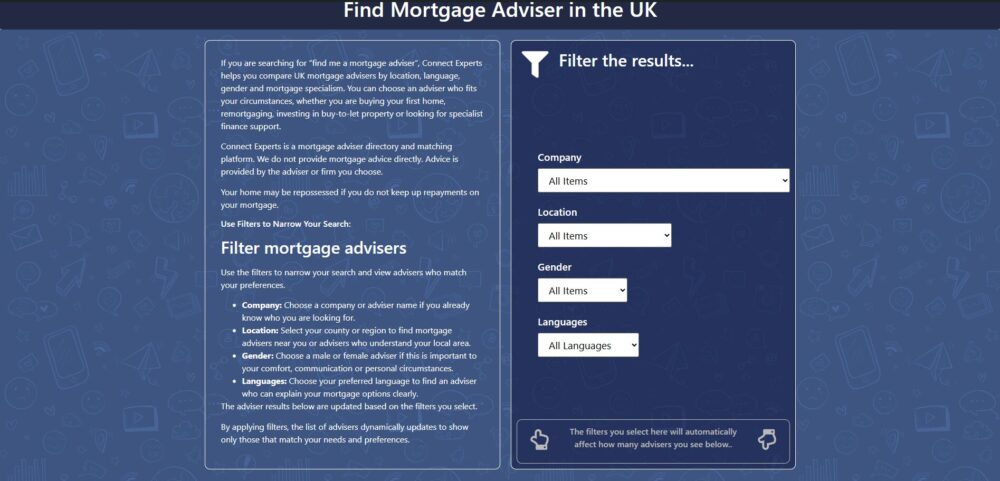
If you want to explore adviser support, you can also use Connect Experts to find mortgage advisers by location, language, gender and area of expertise.
FAQs About Understanding Second Charge Mortgages
What is a second charge mortgage?
A second charge mortgage is a separate loan secured against a property that already has a mortgage. Your existing mortgage remains in place, and the second loan runs beside it.
Is a second charge mortgage the same as a secured loan?
In many cases, yes. A second charge mortgage is often called a secured homeowner loan or secured loan because it is secured against your property.
Does a second charge mortgage replace my current mortgage?
No. Your current mortgage stays in place. The second charge mortgage is a separate loan with its own payment, rate and term.
Why would someone use a second charge mortgage?
A homeowner may use one to raise funds without remortgaging. This may help if their current mortgage rate is low or they would face early repayment charges.
Can I use a second charge mortgage for home improvements?
Yes, home improvements are a common reason for second charge borrowing. Lenders will still assess equity, income, credit history and affordability.
Can I use a second charge mortgage to consolidate debt?
Yes, but this needs careful advice. Debt consolidation may reduce monthly payments, but it can turn unsecured debts into debt secured against your home.
Is a second charge mortgage cheaper than remortgaging?
Not always. A second charge mortgage may protect your current mortgage rate, but the second loan may have a higher rate. The total cost must be compared.
Do I need equity in my home?
Yes. A second charge mortgage is based on available equity. Lenders will compare your property value with your existing mortgage balance and the new loan amount.
Will I have two mortgage payments?
Yes. You will usually make one payment to your existing mortgage lender and another payment to the second charge lender.
What is the biggest risk?
The biggest risk is repossession if repayments are not maintained. Your home may be repossessed if you do not keep up repayments on your mortgage or any loan secured on it.