

Asset-Rich but Income-Light: Being wealthy on paper does not necessarily mean having a large, regular salary.
Some borrowers hold substantial property equity, investments, business interests or cash reserves while drawing a comparatively modest income. Conventional mortgage assessments may struggle to reflect that wider financial strength.
Some lenders may consider complex income, assets, liquidity and credible repayment strategies. However, assets alone do not guarantee a mortgage. The borrower must still demonstrate how monthly payments will be maintained and, where relevant, how the capital will be repaid.
A specialist adviser can examine the complete financial position before identifying suitable lender routes.
Wealth Does Not Always Arrive as a Monthly Salary
A balance sheet can tell one story while a payslip tells another.
A business owner may hold valuable company interests yet draw only the income required for daily life. A landlord may own several properties but retain capital for maintenance and future purchases. A retired borrower may have investments, pensions and property equity without receiving a conventional salary.
These people may be financially secure. Yet a standard affordability model may see only the income entering their bank account each month.
This creates an important distinction.
Being asset-rich concerns what a person owns after liabilities are considered. Being income-light concerns the regular income available to support mortgage payments. One measures accumulated financial strength; the other measures present cash flow.
A mortgage requires both security and a credible payment strategy. The property and wider assets may provide comfort, but the lender must still understand where each monthly payment will come from.
What is an Asset-rich, Income-Light Mortgage?
An asset-rich, income-light mortgage is not one standard product.
The phrase describes a mortgage case where the applicant holds considerable wealth but has limited, irregular or unconventional documented income.
That wealth might include:
- Cash deposits.
- Investment portfolios.
- Shares and securities.
- Residential property.
- Buy-to-let property.
- Business interests.
- Trust distributions.
- Pension assets.
- Proceeds from a company or asset sale.
- Overseas assets.
- Inherited wealth.
The borrower’s income may come from several less predictable sources, such as dividends, rental profits, bonuses, investment distributions or pension withdrawals.
Some lenders have specialist underwriting teams that can consider a broader financial picture. Others rely more heavily on salary, taxable profit or a conventional income multiple.
This variation makes lender selection critical. A decline may mean that the case does not satisfy one lender’s policy. It does not automatically establish that the borrowing is impossible.
Our guide to specialist mortgages explains why some borrowers, properties and income structures require more detailed underwriting.
Asset-rich Does Not Always Mean High Net Worth Under FCA Rules
“Asset-rich” is an informal description. “High net worth mortgage customer” has a specific regulatory meaning.
The FCA defines a high-net-worth mortgage customer as someone with annual net income of at least £300,000, net assets of at least £3 million, or mortgage obligations guaranteed by someone meeting either threshold. The FCA Handbook contains the current definition.
Meeting that definition does not guarantee acceptance. It does not establish how much someone can borrow, and it does not remove the need for a lender to make a responsible decision.
Equally, someone may appear wealthy in ordinary terms without meeting the FCA threshold. Their case might still suit a lender prepared to assess multiple income sources or complex financial circumstances.
A high-net-worth mortgage broker can help distinguish between:
- A large but straightforward mortgage.
- A complex-income application.
- A case meeting the FCA high-net-worth definition.
- Specialist underwriting based on broader financial strength.
- Private banking or bespoke lending.
- A mortgage that remains unsuitable despite substantial assets.
Labels may open a conversation. Evidence determines where that conversation can go.
Why Can Conventional Affordability Fall Short?
Most residential lenders assess whether verified income can support the proposed mortgage alongside household expenditure and existing commitments.
This approach is necessary. A valuable asset cannot make a monthly payment unless it produces income, can be accessed responsibly or forms part of a credible repayment strategy.
However, a standard calculation may not capture the full position where an applicant:
- Draws a small salary from a profitable company.
- Retains company profits for commercial reasons.
- Receives irregular dividends.
- Earns substantial discretionary bonuses.
- Has several rental income streams.
- Holds investments that generate varying returns.
- Receives income in a foreign currency.
- Is between senior executive roles.
- Has recently sold a business.
- Is moving from employment into retirement.
- Has wealth held through trusts or family arrangements.
In these circumstances, the challenge may not be an absence of resources. It may be proving which resources are dependable, accessible and acceptable to a lender.
Which Income Sources Might a Lender Consider?
Policies vary, but a lender may examine one or more of the following:
- Basic salary.
- Regular bonuses and commission.
- Company dividends.
- A share of business profits.
- Partnership income.
- Rental income.
- Investment income.
- Pension income or planned pension drawings.
- Trust income.
- Foreign-currency earnings.
- Contract income.
- Carried interest.
- Share awards that have vested.
- Income from a professional practice.
The lender may apply reductions where income is variable, paid in another currency or dependent on future performance. It may also average figures across several years.
Retained company profit requires particular care. Money remaining within a company belongs to the company, not automatically to the director. Some lenders may consider a director’s share of profit, while others focus mainly on salary and dividends.
Applicants should therefore avoid increasing their drawings solely to satisfy a mortgage calculation without speaking to their accountant and mortgage adviser. A decision intended to strengthen affordability could create tax or business consequences elsewhere.
Our self-employed mortgage guide explains how lenders may assess company directors, sole traders and other self-employed applicants.
Assets Matter, but Liquidity Matters Too
Two assets with the same value may not offer the same support to a lender.
Cash can usually be accessed quickly. A diversified investment portfolio may also be relatively liquid, although its value can fall. A minority holding in a private company may be valuable but difficult to sell. Property may provide strong security but can take months to convert into cash.
A lender may consider:
- The current value of each asset.
- Existing liabilities secured against it.
- Ownership and control.
- Whether the asset can be sold.
- How long a sale may take.
- Market volatility.
- Tax consequences.
- Whether the asset is already pledged elsewhere.
- Whether its value depends on one company or sector.
- Whether it is located outside the UK.
- The currency in which it is held.
This is why gross wealth and usable wealth are not always the same.
A £3 million portfolio may not be treated as £3 million of dependable mortgage support if it is concentrated, volatile, inaccessible or subject to considerable liabilities.
How Might Monthly Payments be Supported?
Even where substantial assets exist, the lender will usually want to understand the source of regular mortgage payments.
Possible sources could include:
- Employment income.
- Business drawings.
- Rental income.
- Investment distributions.
- Pension income.
- Scheduled withdrawals from investments.
- Trust distributions.
- A combination of several income streams.
The evidence should show that payments can remain affordable after tax, household spending and existing debts.
A plan that depends on selling assets each month requires close scrutiny. Investment values can fall, transaction costs may apply and repeated disposals could create tax consequences.
HMRC explains that Capital Gains Tax may arise when certain assets are sold or disposed of. Tax treatment depends on individual circumstances and can change. Mortgage advice is not tax advice, so an accountant or qualified tax adviser may also be required.
The central question is not merely, “What are these assets worth today?”
It is, “How will this household meet the mortgage through different economic conditions?”
Could Interest-Only Borrowing be Considered?
Interest-only mortgages may suit some asset-rich applicants because the monthly payment covers interest rather than reducing the original capital balance.
This can preserve cash flow, but it creates a crucial obligation: the full capital must still be repaid at the end of the term.
A lender may consider repayment strategies involving:
- Sale of the mortgaged property.
- Sale of another property.
- Investment portfolio liquidation.
- Pension proceeds.
- A business sale.
- Maturing investments.
- A planned future capital payment.
Each strategy carries risk. Property and investment values can fall. A business sale may be delayed. Pension values and access rules may change.
MoneyHelper’s official guidance explains that an interest-only mortgage requires a credible repayment plan. It also warns against assuming that future property growth alone will clear the debt.
Read our interest-only mortgage guide for further information about repayment strategies and lender assessment.
An Illustrative Asset-Rich Household
Consider a fictional applicant with the following position:
| Financial position | Illustrative amount |
|---|---|
| Main residence | £1,800,000 |
| Investment portfolio | £1,250,000 |
| Rental properties | £1,100,000 |
| Cash reserves | £300,000 |
| Business interest | £900,000 |
| Total gross assets | £5,350,000 |
| Mortgages and other liabilities | £1,450,000 |
| Illustrative net assets | £3,900,000 |
| Current annual income | £105,000 |
The applicant wants to buy a new home but draws only a modest amount from their company. A conventional lender might assess the documented annual income without giving equal weight to the investment portfolio or business strength.
A specialist assessment may examine:
- The source and stability of the £105,000 income.
- Company accounts and retained profit.
- Portfolio income.
- Rental income after finance costs.
- The value and liquidity of investments.
- Existing mortgages and personal liabilities.
- The requested loan-to-value.
- Monthly affordability.
- The proposed mortgage term.
- The repayment plan.
The asset position may strengthen the case, but it does not answer every question. The outcome would depend on verified evidence, lender policy and the sustainability of the proposed borrowing.
This example is illustrative only. It is not an indication of available borrowing or a mortgage recommendation.
What Documents Could be Required?
Asset-rich and complex-income cases often need a detailed evidence pack.
Depending on the circumstances, this could include:
- Proof of identity and address.
- Personal bank statements.
- Business bank statements.
- Tax calculations and Tax Year Overviews.
- Company or partnership accounts.
- Payslips and bonus records.
- Dividend vouchers.
- Investment statements.
- Pension statements.
- Trust documents.
- Property portfolio schedules.
- Existing mortgage statements.
- Rental agreements or income records.
- Professional asset valuations.
- Evidence of liabilities.
- Source-of-deposit evidence.
- Source-of-wealth evidence.
- Foreign income and tax documents.
- A written interest-only repayment strategy.
The aim is not to produce the largest possible file. It is to create a clear account of ownership, income, liabilities, liquidity and future intentions.
An adviser may also need to work with the applicant’s accountant, solicitor, tax adviser or wealth manager. Each professional has a different role, and mortgage advice should not be treated as legal, investment or tax advice.
Private Bank, Specialist Lender or Mainstream Lender?
Substantial wealth does not automatically make private banking the right route.
A mainstream lender may remain suitable where income is high, the property is conventional, and the loan meets standard policy.
A specialist lender may be more appropriate where income is irregular, the property is unusual or manual assessment is required.
A private bank may consider broader assets, international wealth or a wider banking relationship. However, eligibility, pricing and asset-management requirements vary.
The right comparison should consider:
- Interest rate.
- Arrangement fees.
- Valuation and legal costs.
- Loan term.
- Repayment basis.
- Early repayment charges.
- Required assets under management.
- Currency exposure.
- Flexibility.
- Total projected cost.
- Consequences for existing investments.
Prestige is not a lending criterion. The strongest route is the one that accurately reflects the applicant’s finances while remaining affordable and suitable.
When Might an Asset-Based Approach Be Unsuitable?
Substantial assets do not make every borrowing decision responsible.
A mortgage may be unsuitable where:
- Monthly cash flow cannot support the payments.
- Assets are difficult to value or sell.
- The repayment plan depends on uncertain growth.
- The applicant would need to dispose of essential assets.
- Selling investments could create unacceptable losses or tax costs.
- The loan would place retirement security under pressure.
- Foreign-currency movements could weaken affordability.
- Existing liabilities are already considerable.
- The mortgage term conflicts with future plans.
- The applicant is borrowing more simply because more appears available.
True financial strength is not measured by the largest loan someone can obtain. It is measured by how comfortably that commitment can coexist with the rest of their life.
Why Specialist Advice Can Make a Difference
An asset-rich mortgage case often needs interpretation before it needs an application.
A specialist adviser can help:
- Map income, assets and liabilities.
- Separate gross wealth from accessible wealth.
- Identify acceptable income evidence.
- Test monthly affordability.
- Examine interest-only repayment strategies.
- Compare mainstream, specialist and private-bank routes.
- Prepare the case before lender contact.
- Explain likely fees and risks.
- Coordinate with other professional advisers.
- Reduce unnecessary applications to unsuitable lenders.
Connect Experts allows borrowers to find high-net-worth mortgage brokers with experience in large loans, complex wealth and unconventional income.
Connect Experts is a directory and matching service. Mortgage advice is provided by the selected adviser or firm.
The Value of Seeing the Complete Picture
Wealth can be held in a home, a business, an investment account or a lifetime of careful decisions.
Yet a mortgage cannot rest on appearance. It must rest on evidence.
Assets may show resilience. Income may show capacity. Liquidity may show flexibility. A repayment strategy may show foresight. None should be examined alone.
The purpose of specialist mortgage advice is not to make the numbers say yes. It is to ensure the right numbers are being heard.
For an asset-rich, income-light borrower, that fuller conversation can be powerful. It may reveal a responsible route that a conventional calculation could not see. It may also reveal that waiting, borrowing less or restructuring the plan would offer greater security.
Either answer has value when it is reached with clarity.
Frequently Asked Questions
Can I get a mortgage if I have substantial assets but limited income?
Possibly. Some lenders may consider investments, property wealth, business strength and several income sources. You must still demonstrate sustainable monthly affordability and satisfy the lender’s criteria.
Can investments be used as mortgage income?
Some lenders may consider investment income or scheduled portfolio withdrawals. Treatment varies, and lenders may reduce the amount recognised to allow for volatility, tax and future sustainability.
Will a lender accept retained company profits?
Some lenders may consider a company director’s share of retained profit or wider business performance. Others assess salary and dividends. Company accounts and accountant confirmation may be required.
Do assets replace mortgage affordability checks?
No. Assets may strengthen an application or support a repayment strategy, but lenders still need to understand how payments will be maintained.
Is an asset-rich mortgage always interest-only?
No. Capital-and-interest and interest-only structures may both be considered. Interest-only borrowing requires an acceptable method for repaying the capital.
Do I need a private bank?
Not necessarily. A mainstream lender or specialist lender may offer a suitable route. The decision should reflect eligibility, cost, flexibility and the overall financial position.
Does meeting the FCA high-net-worth definition guarantee approval?
No. The definition does not guarantee acceptance, a particular loan size or favourable terms. The lender will still consider the property, affordability, liabilities, credit profile and repayment strategy.
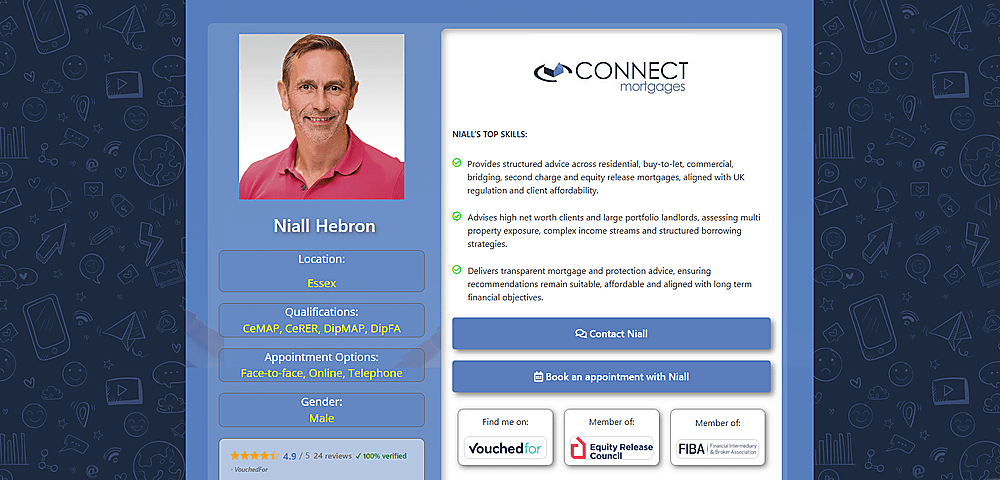
Speak to Niall Hebron about a complex mortgage
Niall Hebron works with high-net-worth and complex-income clients whose finances may include dividends, retained profits, property income, bonuses or overseas assets.
His approach begins with a detailed review of income, expenditure, credit history, assets and long-term objectives. Where appropriate, he can explore lenders experienced in assessing more complex financial profiles.
Niall is based in Hornchurch and supports clients in Essex, London and other UK locations through remote appointments where suitable.
If your wealth is substantial but your declared income does not tell the complete story, speaking with Niall may help you understand which evidence matters and whether a suitable mortgage route exists.
Mortgage approval is not guaranteed. Recommendations remain subject to affordability, suitability and lender criteria.
Important information
Connect Mortgages is a credit broker, not a lender. We have access to an extensive range of lenders. After assessing your needs, we may recommend a lender and product suited to your circumstances. You are not obliged to accept that recommendation.
A fee may be payable for arranging your mortgage. Your adviser will confirm the amount before you choose to proceed.
Your home or property may be repossessed if you do not keep up repayments on your mortgage or other loans secured against it.
The FCA does not regulate some forms of buy-to-let, commercial mortgage and bridging finance. Tax treatment depends on individual circumstances and may change.