
Self-Employed Mortgage Income Guide: A self-employed mortgage is not usually a separate mortgage product. It is a mortgage application where the lender needs stronger income evidence.
Lenders may review SA302 tax calculations, Tax Year Overviews, certified accounts, company accounts, dividends, retained profit, contracts and bank statements. The aim is simple: can the income support the mortgage now and remain reliable over time?
The better your evidence, the easier it is for a lender to understand your case.
Can You Get a Mortgage if You are Self-Employed?
Yes, you may be able to get a mortgage if you are self-employed.
The main difference is proof. An employed applicant may rely on payslips and a P60. A self-employed applicant often needs to show trading history, taxable income, business performance and bank conduct.
This can apply if you are a sole trader, freelancer, contractor, limited company director, business partner or CIS worker.
The philosophical point is simple. Lenders do not lend on confidence alone. They lend on evidence. A strong application turns variable income into a clear financial story.
For a service-led overview, see our self-employed mortgage page.
Why Lenders Look More Closely at Self-Employed Income
Self-employed income can be steady, growing or seasonal. It can also be affected by tax planning, retained profit, one-off costs or delayed invoices.
That does not mean the income is weak. It means it needs to be explained properly.
A lender may want to understand:
- How long you have traded
- Whether income is stable, rising or falling
- What income is declared to HMRC
- Whether the business can keep trading
- How much personal debt you have
- Whether the deposit source is clear
- Whether the mortgage remains affordable if rates change
This is why preparation matters. A rushed application can make a strong business look unclear.
How Different are Self-Employed Applicants Assessed
Sole traders
Sole traders are usually assessed on net profit. Lenders may review SA302 tax calculations and Tax Year Overviews. Some lenders may average the last two years. Others may use the latest year if the figures are strong and supported.
If profit has fallen, the lender may ask why. If profit has increased, the lender may check whether the increase is sustainable.
Limited company directors
Company directors may be assessed using salary and dividends. Some lenders may consider retained profit, but this depends on the lender and the strength of the business.
Evidence may include company accounts, personal tax documents, business bank statements and dividend records.
This is often where advice can help. A director may feel the company is profitable, but the lender may only use income that fits its criteria.
Contractors
Contractors may be assessed using declared income, day rate or contract value. Lenders may request current and previous contracts, bank statements and evidence of future work.
A contractor with gaps between contracts may still have options, but the explanation must be clear.
Freelancers
Freelancers often need to show income consistency. Invoices, accounts, tax documents and bank statements can help show the pattern behind irregular payments.
The question is not only “how much did you earn?” It is also “how reliable is that income?”
Business partners
Business partners may be assessed on their share of profit. Partnership accounts, tax records and bank statements may be needed.
The lender may also check whether the business structure supports the income being used.
What Documents May be Needed?
The exact documents depend on the lender, your structure and your trading history.
You may need:
- proof of ID
- proof of address
- SA302 tax calculations
- Tax Year Overviews
- certified accounts
- company accounts
- personal bank statements
- business bank statements
- dividend vouchers
- current contracts
- invoices
- proof of deposit
- details of loans, credit cards and other commitments
Before applying, it can also help to test affordability using the residential affordability calculator.
Can You Get a Mortgage with One Year’s Accounts?
It may be possible to get a mortgage with one year’s accounts, but lender choice is usually smaller.
A lender may want stronger supporting evidence. This could include a larger deposit, strong credit conduct, previous experience in the same sector, signed contracts, growing bank statements or an accountant’s explanation.
One year of trading is not always the problem. The issue is whether the lender can evidence reliable income.
What Can Weaken a Self-Employed Mortgage Application?
Some issues can reduce lender choice.
These include:
- late tax filing
- falling income without explanation
- unclear business bank conduct
- mixed personal and business spending
- high unsecured debt
- recent missed payments
- unexplained large deposits
- inconsistent figures across documents
- applying before accounts are ready
A lender does not expect every business to be perfect. It does expect the figures to make sense.
Does Deposit Size Matter?
A larger deposit can help because it reduces the lender’s risk. It may also improve access to more products.
However, deposit size does not replace affordability. Lenders still need to verify income, spending, credit history and the property details.
A smaller deposit may still be possible, but the application must fit lender criteria.
What if Your Income Has Changed?
Many self-employed applicants have changing income. That can happen because of growth, tax planning, investment, maternity or paternity leave, illness, sector changes or one-off business costs.
The key is explanation.
A lender may be more comfortable where the change is supported by documents. For example, new contracts, management accounts, bank statements or accountant notes may help explain what happened.
The aim is not to make the application look simple when it is not. The aim is to make it understandable.
Self-Employed Remortgage Considerations
If your current mortgage deal is ending, you may need updated income evidence for a new lender.
A product transfer with your existing lender may not always need a full new affordability check. A full remortgage to a new lender usually involves fresh underwriting.
This can matter if your income has changed since your last mortgage. It can also matter if you want to raise more borrowing.
For wider options, read our remortgage guide.
Protection When You are Self-Employed
A mortgage is a long-term commitment. For self-employed borrowers, protection planning can be especially important because sick pay and employee benefits may be limited.
Income protection, life cover and critical illness cover may help protect the mortgage if your circumstances change.
You can read more on our mortgage protection and life insurance page.
When Should You Speak to an Adviser?
It can help to speak to an adviser before you apply, especially if your income is complex.
This may apply if:
- You have one year’s accounts
- Income has fallen or risen sharply
- You are a company director
- You use dividends and retained profit
- You are a contractor
- You have adverse credit
- You want to remortgage and borrow more
- Your accounts are being finalised
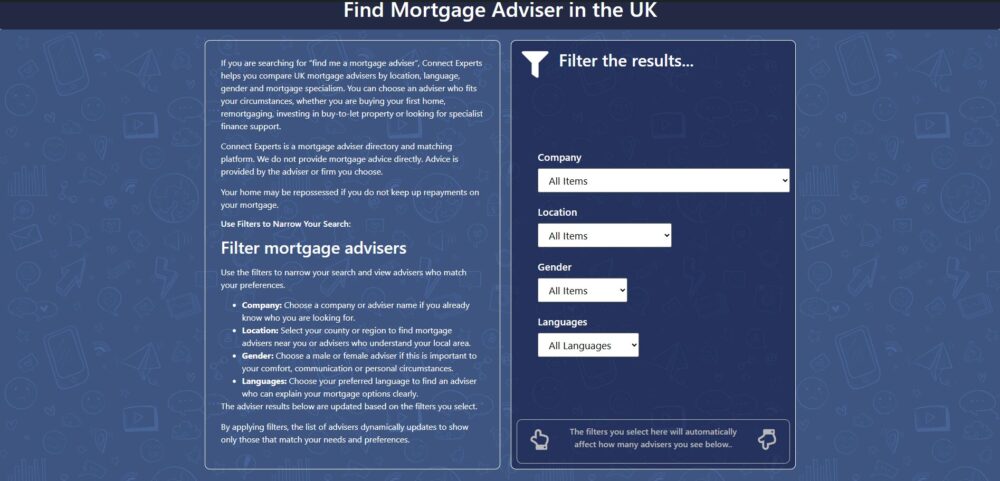
You can also search for a self-employed mortgage adviser through Connect Experts.
FAQs
Is a self-employed mortgage different from a normal mortgage?
Not usually. The mortgage product may be the same. The difference is how the lender checks income and affordability.
Do self-employed applicants need two years of accounts?
Many lenders prefer two years of evidence. Some may consider one year, depending on the case, deposit, credit profile and supporting documents.
Can dividends be used for a mortgage?
Dividends may be considered for limited company directors. Some lenders use salary and dividends. Others may consider retained profit if their criteria allow it.
Are self-cert mortgages still available?
No. Self-cert mortgages are no longer permitted in the UK. Lenders must verify income and assess affordability.
How many bank statements will lenders ask for?
This varies by lender. Many ask for personal and business bank statements, often covering recent months. More may be needed if the case is complex.
Can I get a mortgage if my income has fallen?
It may still be possible, but the lender will want to understand why income fell and whether the new income level is affordable.