Buy-to-lets affordability is not just about whether a landlord can afford the monthly payment. It is about whether the property can carry the debt through changing rates, changing rent, lender stress tests and long-term risk.
That is the quiet discipline of buy-to-let lending. A property may look profitable on paper, but lenders ask a harder question. Will the rent still support the mortgage if the numbers move against the landlord?
At Connect Mortgages, we help landlords understand how lenders assess buy-to-let affordability before they apply. This includes rental income, loan-to-value, interest cover, stress testing, ownership structure, landlord experience and property type.
Buy-to-Let Affordability
Buy-to-let affordability is how lenders assess whether rental income can cover a mortgage on a property let to tenants.
Most lenders focus on the expected or current rent, not just the applicant’s personal income. They usually check whether the rent covers the mortgage interest by a required margin.
This is often called rental coverage, interest cover or ICR. The calculation can change depending on the lender, interest rate, tax position, fixed-rate period, loan-to-value and whether the property is owned personally or through a limited company.
A lower mortgage amount, higher rent, larger deposit or longer fixed rate may improve affordability. However, each lender uses its own criteria.
You can read our wider guide to buy-to-let mortgages if you want to understand the full landlord mortgage journey.
What Does Buy-to-Let Affordability Mean?
Buy-to-let affordability means the lender is testing whether the rental property can support the mortgage.
With a residential mortgage, lenders usually focus on personal income, spending and household commitments. With a buy-to-let mortgage, the lender usually gives more weight to rental income.
The lender wants to know whether the property can produce enough rent to cover the mortgage interest. They may also review the borrower’s income, credit profile, landlord experience and wider financial position.
This matters because buy-to-let lending is investment lending. The property is expected to create income. Therefore, the rent is central to the decision.
How Lenders Assess Buy-to-Let Affordability
Many lenders use an Interest Coverage Ratio, often called ICR.
This checks whether the monthly rent covers the mortgage interest by a set percentage. For example, a lender may want the rent to cover 125%, 145% or another percentage of the stressed mortgage payment.
The lender may not use the actual product rate for this calculation. Instead, it may use a higher stress rate to test whether the mortgage could still work if rates rise.
This is why two landlords can receive different results on similar properties. The calculation may depend on:
- Monthly rental income
- Mortgage amount
- Loan-to-value
- Interest rate used for stress testing
- Fixed-rate period
- Personal tax position
- Limited company or personal ownership
- Property type
- Landlord experience
- Existing buy-to-let portfolio
- Wider credit commitments
A property can have strong rent and still fail one lender’s test. Another lender may take a different view.
Why the Stress Test Matters
A stress test is a lender’s way of adding caution to the calculation.
It asks a practical question. If interest rates rise, would the rent still cover the mortgage by enough margin?
This protects the lender, but it also protects the landlord from relying on a narrow calculation. A buy-to-let property should not only work on the day of completion. It should have enough strength to withstand change.
That does not mean every case must be simple. Some landlords have complex income, unusual property types or several properties. The key is matching the case to a lender that understands the full picture.
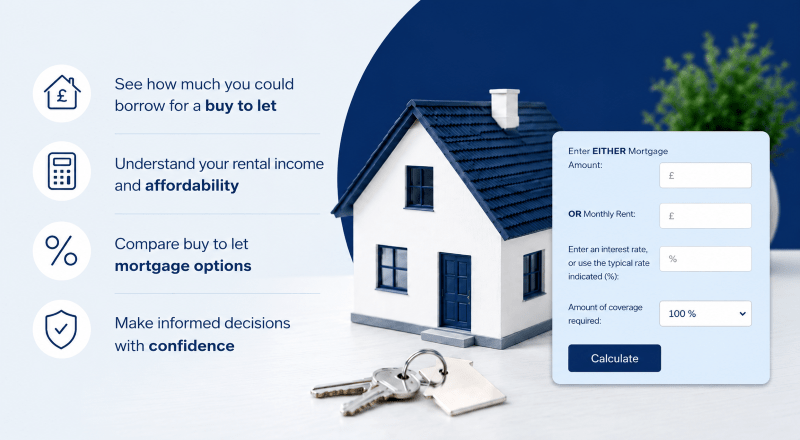
You can use the Buy-to-Let Affordability Calculator to estimate borrowing based on rent and coverage. The result is only a guide, because lender criteria can vary.
Main Factors That Affect Buy-to-Let Affordability
Buy-to-let affordability is rarely based on one number. Lenders usually consider several moving parts.
Rental income
Rental income is usually the starting point. The lender may use the current rent, expected market rent or the valuer’s rental figure.
If the expected rent is too low, the maximum loan may reduce. In some cases, the landlord may need a larger deposit or a lower loan amount.
Loan-to-value
Loan-to-value compares the mortgage amount with the property value.
A lower loan-to-value can reduce risk for the lender. It may also improve product choice. However, it does not automatically solve affordability if the rent is weak.
Interest rate and fixed-rate period
The product chosen can affect the affordability result.
Some lenders may apply different calculations for shorter and longer fixed rates. A longer fixed rate may offer more payment certainty, but it must still match the landlord’s plans.
Ownership structure
Some landlords buy in their personal name. Others use a limited company.
The structure can affect affordability, tax treatment, lender choice, legal work and administration. Our guide to limited company buy-to-let mortgages explains how lenders may assess company applications.
You should also take separate tax advice before choosing an ownership structure.
Property type
A standard single-let property is often assessed differently from an HMO, multi-unit block, holiday let or unusual property.
The lender may look at licensing, valuation method, tenancy type, rental demand and property condition.
First-Time Landlords and Buy-to-Let Affordability
First-time landlords can still access buy-to-let mortgages, but criteria may be more detailed.
Some lenders want applicants to own their own home. Others may consider first-time buyers or renters, depending on the case.
The lender may review:
- Deposit source
- Personal income
- Credit history
- Property type
- Expected rent
- Landlord experience
- Letting plan
- Exit strategy
For a first-time landlord, the main risk is assuming that a good personal income will solve every issue. It may help, but the rental calculation still matters.
Portfolio Landlords and Affordability
Portfolio landlords usually face wider checks.
If you own several rental properties, the lender may review the full portfolio. This means they may assess existing rents, mortgage balances, property values and overall exposure.
A single new purchase may look strong on its own. However, the wider portfolio may affect the decision.
Our buy-to-let portfolio mortgages guide explains how lenders may assess landlords with multiple mortgaged rental properties.
HMO Properties and Affordability
HMO properties can produce higher rental income, but they can also involve stricter checks.
A lender may review the licence position, room numbers, property layout, valuation method and landlord experience. Some lenders use the total room rent. Others may take a more cautious view.
This is why HMO affordability can differ from standard buy-to-let affordability. Higher rent does not always mean easier borrowing.
You can read more in our guide to HMO mortgages.
What Can Improve Buy-to-Let Affordability?
Several actions may improve the calculation, depending on the case.
- Increasing the deposit
- Reducing the mortgage amount
- Choosing a suitable fixed-rate period
- Reviewing the ownership structure
- Improving the property’s rental position
- Selecting a lender with suitable criteria
- Preparing documents before applying
- Reviewing the wider portfolio
- Checking the likely rental figure before offer
The aim is not to force the numbers. The aim is to understand them early.
A buy-to-let mortgage should support the investment, not hide weaknesses inside it.
Documents Lenders May Ask For
The documents needed depend on the lender and case. However, landlords are often asked for:
- Proof of identity
- Proof of address
- Bank statements
- Evidence of deposit
- Current mortgage statement
- Tenancy agreement, where the property is already let
- Expected rental income
- Property details
- Personal income documents
- Portfolio schedule, where relevant
- Limited company documents, where relevant
- HMO licence, where required
- Credit commitment details
Preparing these documents early can reduce delays and avoid avoidable lender questions.
Buy-to-Let Affordability and Landlord Risk
Affordability is not only a lender’s rule. It is also a landlord’s warning system.
A property investment can fail for several reasons. Rent may change. Costs may rise. The property may need repairs. A tenant may leave. Interest rates may move. Regulation may add new duties.
That is why landlords should think beyond the minimum lender calculation.
Good affordability planning should consider:
- Mortgage payments
- Letting agent fees
- Maintenance costs
- Insurance
- Void periods
- Tax position
- Safety checks
- Licensing costs
- Service charges
- Ground rent, where relevant
- Future refinance options
Landlords may also need suitable cover. Our landlord insurance page explains insurance considerations for rental properties.
Official Guidance and Regulation
Buy-to-let lending can sit in different regulatory categories.
Some buy-to-let mortgages are not regulated by the Financial Conduct Authority. However, consumer buy-to-let cases can fall under specific rules.
The FCA provides guidance on consumer buy-to-let regulation. The Bank of England’s Prudential Regulation Authority also sets expectations for buy-to-let underwriting standards.
These references are useful because they show why affordability is not just a sales calculation. It is part of responsible lending and risk control.
When Should You Speak to a Buy-to-Let Adviser?
You should consider speaking to an adviser before making an offer, refinancing, changing ownership structure or expanding a portfolio.
This is especially important if:
- The rental income is close to the required level
- You are buying through a limited company
- You own several rental properties
- The property is an HMO
- You are a first-time landlord
- You live outside the UK
- You have complex income
- The property type is unusual
- Your current rate is ending soon
A broker can help compare lender criteria, explain the likely calculation and reduce the risk of applying to an unsuitable lender.
If you want to compare adviser options, you can use Connect Experts to find a buy-to-let mortgage adviser